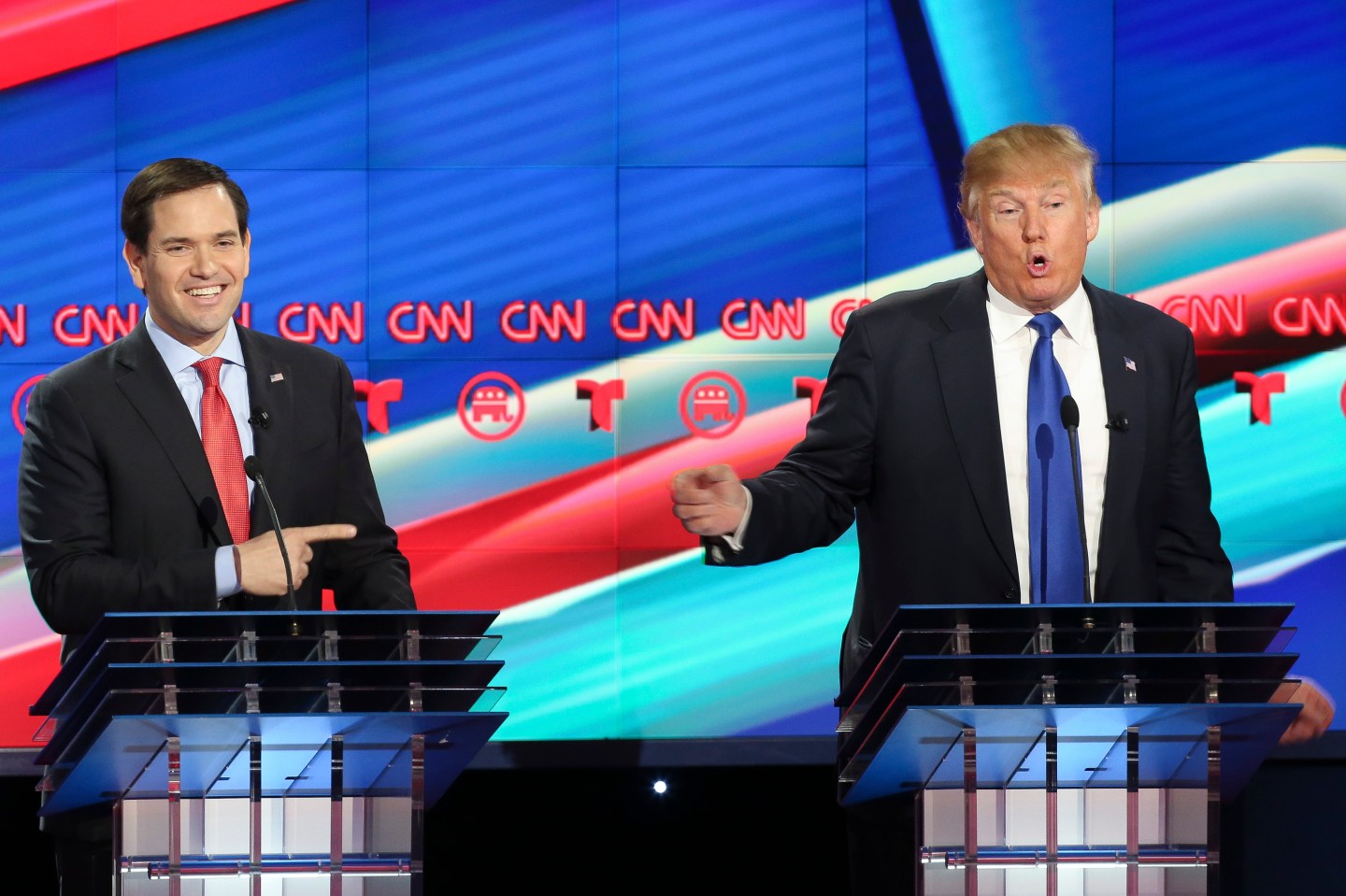
Florida Sen. Marco Rubio scored a hit during Thursday night’s CNN debate by exposing Donald Trump’s inability to offer more than a vague talking point on his plans for replacing Obamacare. But the exchange failed to scratch the surface of the how lacking Trump’s idea is.
Rubio suggested the real estate developer’s only proposal apes a longstanding Republican suggestion to allow health insurers to compete across state lines.
“What is your plan on health care?” Rubio asked. “You don’t have a plan.”
“When you get rid of the lines, it brings in competition,” Trump said. “So instead of having one insurance company taking care of New York or Texas, you’ll have many. They’ll compete. And it will be a beautiful thing.”
“So that’s the only part?” Rubio said. “Just the lines?”
“You’ll have competition,” Trump said. “You’ll have so many plans.”
“Now he’s repeating himself,” Rubio said with a smile, alluding to the criticism he faced for repeating himself in a debate in New Hampshire.
“I watched him repeat himself five times four weeks ago,” Trump said.
“I saw you repeat yourself five times five seconds ago,” Rubio countered, to laughs.
That was one of several instances on Thursday in which Rubio, finally going after the GOP frontrunner, scored points.
But Rubio noted that he too supports increasing interstate competition among health insurers (as does Texas Sen. Ted Cruz), leaving major questions about the idea unanswered.
Yes, Trump’s healthcare proposal consists of one talking point, and that’s a problem. But the bigger problem is that that idea would likely do little to reduce health care costs for Americans.
There is no federal prohibition on selling health insurance across state lines. In fact, the Affordable Care Act includes provisions to encourage regional and national healthcare insurance sales.
As the New York Times noted last fall, state laws, not federal ones, restrict local insurance competition. Local lawmakers set unique requirements for selling health insurance in their states. But few people who study the health care markets think those local laws are the main reason insurance markets lack competition. Market barriers matter more.
“Selling insurance in a new region or state takes more than just getting a license and including all the locally required benefits,” the Times said. “It also involves setting up favorable contracts with doctors and hospitals so that your customers will be able to access health care.”
Insurance is cheaper in states like Colorado, with relatively young, healthy people. And it costs more in states like Florida, with older residents. Letting a Colorado insurer compete in Florida would not mean the company could offer Sunshine state residents Colorado prices. Nor would it help that Colorado health insurance company offer customers a network of local Florida doctors to choose from.
A handful of states have passed laws to allow out-of-state health insurers to compete in their markets. But a 2012 study published by the Georgetown University Health Policy Institute found that when six states—Maine, Kentucky, Washington, Rhode Island, Georgia, and Wyoming—enacted such laws, they didn’t work. Not a single insurer took the opportunity to sell insurance in any of those states.
This is why even scholars who advocate for interstate competition in health insurance say it would provide a marginal boost to competition, not a panacea, as Trump suggested on Thursday.
This was only the most obvious example of Trump’s limited familiarity with the details of the U.S. healthcare. The businessman likes to say that, unlike his GOP opponents, he would not let poor Americans “die in the street,” or, as he put it Thursday night, “on the sidewalks,” due to a lack of health insurance. That formulation ignores the existence of a law designed to do just that. The Emergency Medical Treatment and Active Labor Act of 1986 requires emergency rooms to treat anyone seeking medical care, “regardless of citizenship, legal status, or ability to pay.”
Trump said on Thursday night that “the insurance companies are making an absolute fortune” under Obamacare. That’s not true. While insurance companies mostly backed the Affordable Care Act, the law has yet to pay off for them. UnitedHealthcare Group, a leading healthcare insurer, announced last month that it lost $720 million in Obamacare exchanges in 2015.
On healthcare, as on all policy questions, Trump is in his own class when it comes to vagueness. But he’s not alone. As Rubio mocked Trump’s lack of specificity, Thursday night, @MarcoRubio tweeted: “What is Donald Trump’s plan for healthcare? Here’s mine: http://rub.io/QqKu6E.”
There, you find three bullet points totaling 94 words on the senator’s ideas for replacing Obamacare. Set aside Rubio’s plans to cut Medicare and Medicaid, and just one proposal remains: Give every American “a refundable tax credit that can be used to purchase insurance.”