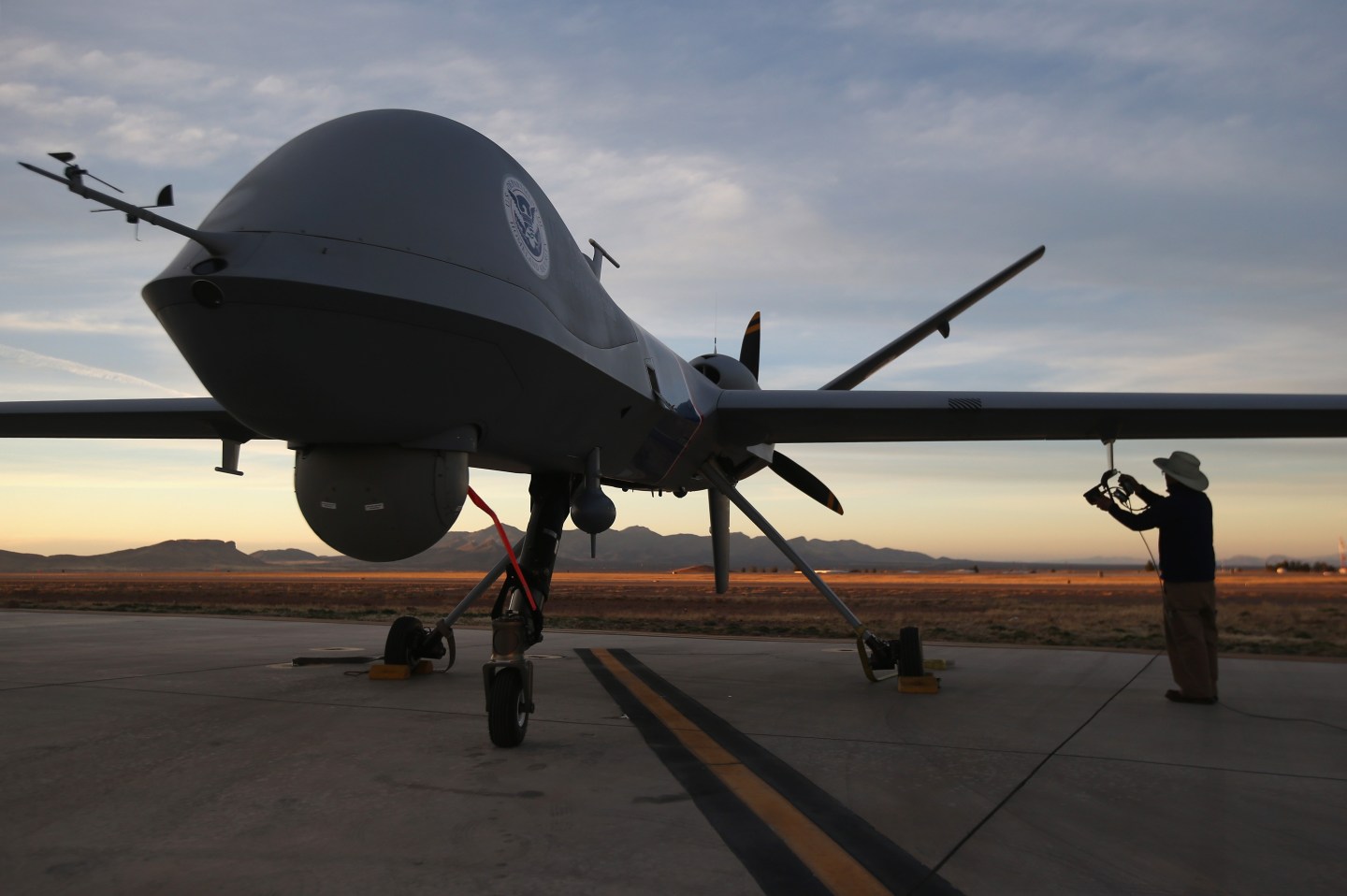
Last week Nigeria joined a dubious international clique when it bombed a logistics base used by the militant group Boko Haram in the country’s northeast. Though the airstrike itself was unremarkable—the Nigerian Air Force has conducted hundreds of strikes against Boko Haram in recent months—it was the first Nigeria has delivered via an unmanned drone.
For many, the news wasn’t that Nigeria had used a weaponized drone in combat for the first time, but that the Nigerian military has weaponized drones at all. While it’s well-understood that military powers like the U.S., U.K., and China possess armed drones, it’s less well-known that Nigeria, South Africa, and Somalia (most likely) have them as well. Pakistan and Iraq have both used weaponized drones in combat inside their own borders. At least a dozen other nations have publicly declared they are pursuing armed drone technologies, and countless others seek to discreetly build or buy them as well.
In the past 18 months the weaponized drone club has quietly grown to double-digit membership, largely thanks to Chinese technology that is both less expensive and easier to obtain than U.S. drone technology.
So how many countries now possess armed drones? The long answer is nuanced, depending on what exactly constitutes a “weaponized drone.” The short answer is at least 10, and soon it will be a far larger club than that.
Get Data Sheet, Fortune’s technology newsletter.
According to a report the New America Foundation released last year, the list of countries that possess armed drones includes the U.S., the U.K., China, Israel, Pakistan, Iran, Iraq, Nigeria, Somalia, and South Africa. Two non-state organizations—Hamas and Hezbollah—also make the list, though this is where the distinctions between “weaponized drone” and “model-aircraft-with-a-grenade-strapped-to-it” begin to become important, and not just in terms of tallying membership in the weaponized drone club. An aircraft’s range and the size of the payload it can carry has important ramifications in the international weapons marketplace, triggering international arms control agreements in some cases and not in others (more on that below).
Suffice it to say that a U.S. Air Force MQ-9 Reaper capable of traveling hundreds of miles to hurl precision-guided Hellfire missiles at targets on the ground is in practice a very different tool than a small recreational drone crudely hacked into a remotely guided missile. The weaponized drone club is growing not just at the less-sophisticated end of that spectrum but also at the very high end as well.
In November, the U.S. State Department approved the sale of weaponized MQ-9 Reaper technology to Italy, making it only the second country to receive the U.S. Air Force’s signature drone strike technology (following the U.K. in 2007). Around the same time, Spain also acknowledged that it would pursue weaponization of its own fleet of MQ-9s at some undetermined point in the future. The Canadian air force reportedly is shopping for an armed drone capability as well, though neither Spain nor Canada has received clearance from the U.S. to import the technology.
That clearance is key to a larger trend in the proliferation of weaponized drones, particularly the ones now emerging in combat roles in places like Nigeria, Iraq, and Pakistan. The U.S. is signatory to something called the Missile Technology Control Regime, or MTCR—a voluntary 1987 arms control agreement aimed largely at controlling the proliferation of cruise missile technologies as the Cold War came to a close.
The MTCR requires member nations to apply a “strong presumption of denial” on the sale and export of airborne technologies that can travel 185 miles or more and carry a 1,100-pound payload. Though signed with cruise missile exports in mind, the MTCR has ensnared many large, long-range aerial drones in its language as well.
While the U.S. is signatory to the MTCR, drone exporters like China and Israel are not. Not only has that hurt the U.S. drone industry (for both armed and unarmed models) in the global marketplace, but it’s made China a particularly attractive vendor. (While Israel exports its drone technologies, its security situation requires that it be a more discerning seller of weaponized drone technology.) Though pricing information is scarce, analysts estimate the price tag on a Chinese CH-4 drone is roughly a quarter that of the American MQ-9 Reaper it is designed to emulate. Buying weaponized drones from China also entails far fewer regulatory hurdles.
That’s one reason we’re now seeing armed drones entering combat in places like Nigeria, Pakistan, and Iraq, each of which operates Chinese CH-3 or CH-4 models. Two CH-4s reportedly crashed in Algeria last year during evaluation by the Algerian military (though it’s not clear if Algeria went through with its purchase after the botched demo). Both Saudi Arabia and the United Arab Emirates have reportedly purchased Chinese drones as well, as arms control considerations have thus far barred them from purchasing the technology from their usual weapons vendors in the United States.
For more on the drone market, watch:
The proliferation of armed Chinese drones is stratifying the weaponized drone club somewhat, says Sarah Kreps, an associate professor in Cornell University’s department of government and an expert on weapons proliferation and international security. At the high end of that strata there’s the U.S. and a handful of its allies that have the resources to sustain satellites, global data links, and foreign bases that offer the kind of global reach the U.S. drone program is renowned for, she says. Then there’s a lower tier that includes those countries operating Chinese-made weaponized platforms capable of flying only a few hundred miles from their ground controller.
That limited range doesn’t make the lower tier any less deadly, she says. For many countries battling insurgencies within their own borders or targeting the neighbor next door, a shorter range and fewer technological bells and whistles isn’t all that limiting, as evidenced by deadly strikes inside the borders of Nigeria, Pakistan, and Iraq. The fact that the weaponized drones most popular on the global market are theoretically less effective than U.S.-made drone hardware has not blunted their effect in practice.
The silver lining, at least for the time being: The countries that have thus far used armed drones are doing so in conflicts where conventional, manned airstrikes are already underway. That is, the argument that having armed drones will prompt militaries to launch relatively low-risk drone strikes in situations where they otherwise wouldn’t have used deadly force has not yet manifested itself among the latest inductees to the weaponized drone club.
“I’ve been working on this issue since 2009, and I feel like it’s actually become a little less worrisome,” Kreps says. “You look at the U.K. experience, for example, and they’re using them in pretty restrained ways. For countries involved in armed conflict this is another tool in their toolbox. It’s not Terminator.”