Updated from Feb. 9
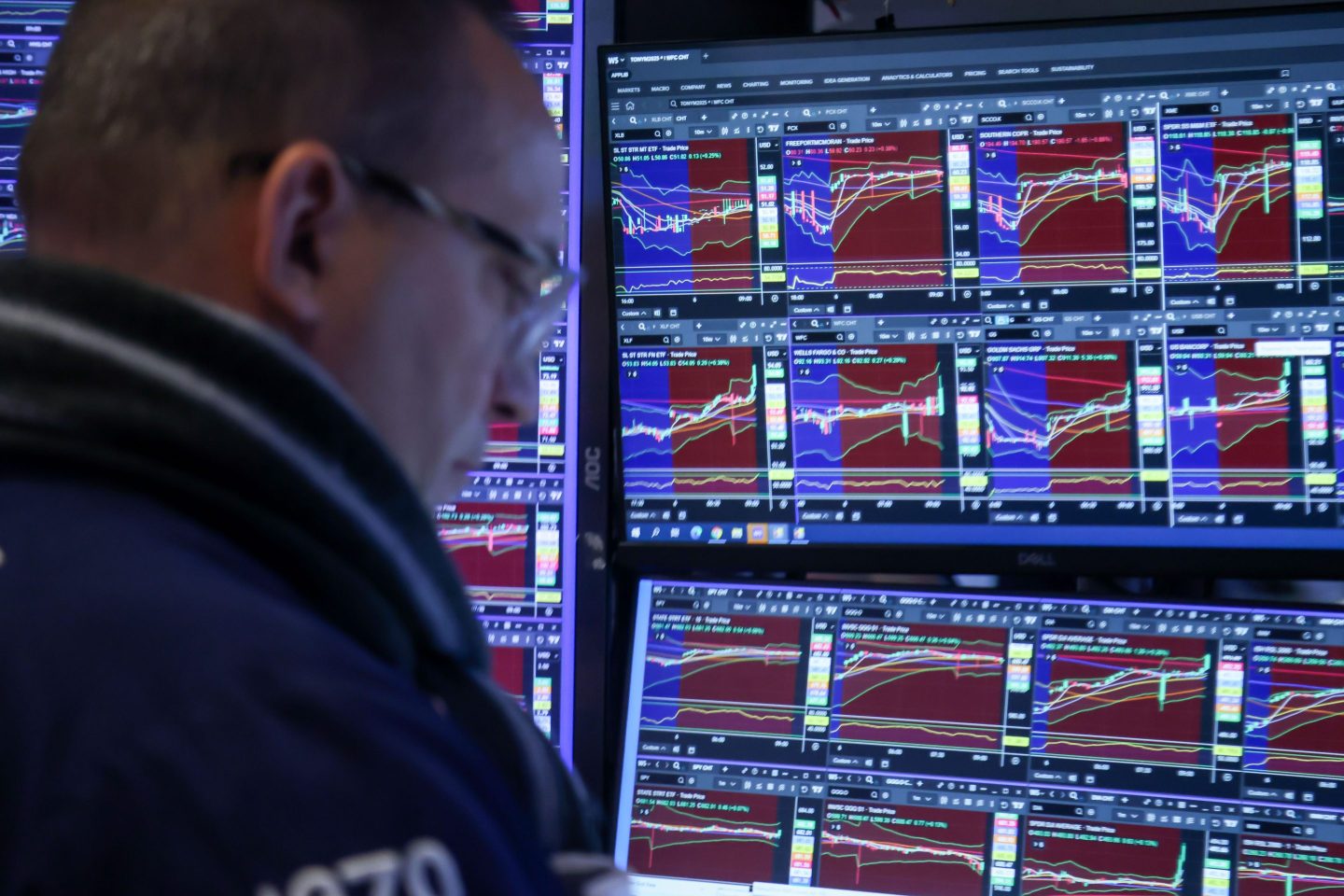
The stock market is having a horrible time so far in 2016, with the S&P 500 down more than 9%. Gold, on the other hand, is up nearly 10% year-to-date and hit a four-month high of just under $1200 per ounce on Monday before dipping 0.7% Tuesday to $1189.30. (Update: Gold surged to as high as $1,242.26 an ounce Thursday, the highest level since February 2015, as the dollar stumbled following Janet Yellen’s Congressional testimony on Wednesday.)
It’s a bit of a cliché to say that people turn to gold in times of uncertainty: Sometimes that works, sometimes it doesn’t. Gold did phenomenally well from 2000-2011 but really suffered after hitting nearly $2000 per ounce in 2011. From 2011 to 2015, the yellow metal pretty much fell in a straight line amid the European financial crisis (remember Greece?), ISIS’s rise, Russia’s annexation of Crimea and quasi-invasion of Ukraine, among many other moments of ‘uncertainty.’
So why is gold rallying?
Historically, gold tends to do best when people are worried about inflation, which is not the case right now — at least not in the developed world. Gold also does well when people are worried about risks in the financial system, which is becoming a concern.
Bank stocks have fallen harder than the Dow and S&P 500 this year and, more importantly, bank-funding costs are rising. This is especially true in Europe, where concerns about Deutsche Bank (DB), whose shares have fallen nearly 40% this year, prompted both its CEO and Germany’s finance minister to publicly declare (in essence): Everything’s fine…nothing to see here. Remain calm, all is well.
For those who remember the 2008 crisis, this had the opposite effect as reflected by Nassim “Black Swan” Taleb’s Tweet.
https://twitter.com/nntaleb/status/697089798239084544
Meanwhile, China’s foreign currency reserves are at a three-year low, raising questions about how long China’s central bank can keep supporting the renminbi without triggering a huge flight of capital. Some of that capital isn’t waiting around to find out and is parking itself in gold.
Generally speaking, investors are becoming more risk averse and with cash providing little or no return, some people are putting money in gold on the hopes of getting a return on their ‘safe haven’ investment.
This last point is critical because what really, ultimately drives gold is the dollar – which went on a tear in the second half of 2015 amid expectations the Fed would start raising rates aggressively while other global central banks have been easing. But recent market volatility and weak U.S. economic data have caused some people to rethink whether the Fed will keep raising rates in 2016; some people are even speculating the Fed might have to go to negative interest rates, as has occurred in Japan, Switzerland, Denmark and the European Central Bank. (Update: Sweden’s Riksbank surprised the markets Thursday with a 15 basis point rate cut, bringing its key lending rate to minus 0.5%. The bank cited “weakening confidence” in achieving its inflation target of 2% and warned that monetary policy could be made “even more expansionary if this is needed to safeguard the inflation target,” The FT reports.)
In fact, more than 20% of global GDP is currently operating in a negative interest rate regime, according to The Wall Street Journal. And Bloomberg reports that more than $7 trillion of global government debt currently has negative yields.
What does that mean? In a nutshell, negative rates mean people and institutions are paying the banks to hold their cash, or paying governments to invest in their bonds. Rationally speaking, if it’s costing you money to keep cash in the bank, why not invest in something like gold that has an opportunity to provide a return on investment?
Janet Yellen’s Congressional testimony on Wednesday could likely determine whether the dollar resumes its 2015 rally or continues its more recent dip; expect gold to move in the opposite direction. Whatever clues – if any – Yellen gives (or the market divines) about the Fed’s thinking will determine whether gold’s recent rally continues, or stalls out — at least in the short term. And, long-term, what the Fed does (or doesn’t do) is going to be the single biggest determinant of the dollar’s fate and, thus, how gold does (or doesn’t) perform. (Update: Yellen said “I don’t think it’s going to be necessary to cut rates” but didn’t rule out the possibility of the Fed going to negative rates during her testimony and said “financial conditions in the U.S. have recently become less supportive of growth.” The dollar and U.S. Treasury yields fell sharply in reaction, the former helping give gold a boost on Thursday.)
So what should investors do?
In the past few years, a number of people, including The Blaze founder and conservative icon Glenn Beck, have been touting the virtues of gold. You’re probably seen the commercials on late-night TV — usually moderated by someone with a British accent – and heard the predictions of Gold $3000! Gold $5000! Gold $10,000!!
If you’re one of those people who has believed THE WORLD IS ENDING – BUY GOLD! — I recommend you use this recent rally to lighten up, meaning SELL some of your gold.
On the other hand, if you’ve looked at gold as a barbarous relic with no intrinsic value, I recommend you BUY some gold, on the off chance the world really is about to end – or at least that gold is going to keep rallying.
Depending on your level of risk tolerance, gold should be anywhere between 2% and 10% of your portfolio, but not much more than that — because the world is only going to end once, and how are you going to collect on your bets if it does?