
• Home
  • Latest
  • Fortune 500
  • Finance
  • Tech
  • Leadership
  • Lifestyle
  • Rankings
  • Multimedia
LeadershipHuman Capital

IBM Is Blowing Up Its Annual Performance Review

Claire Zillman
By
Claire Zillman
Claire Zillman
Editor, Leadership
Down Arrow Button Icon
February 1, 2016, 12:52 PM ET
Fortune Global Forum 2015
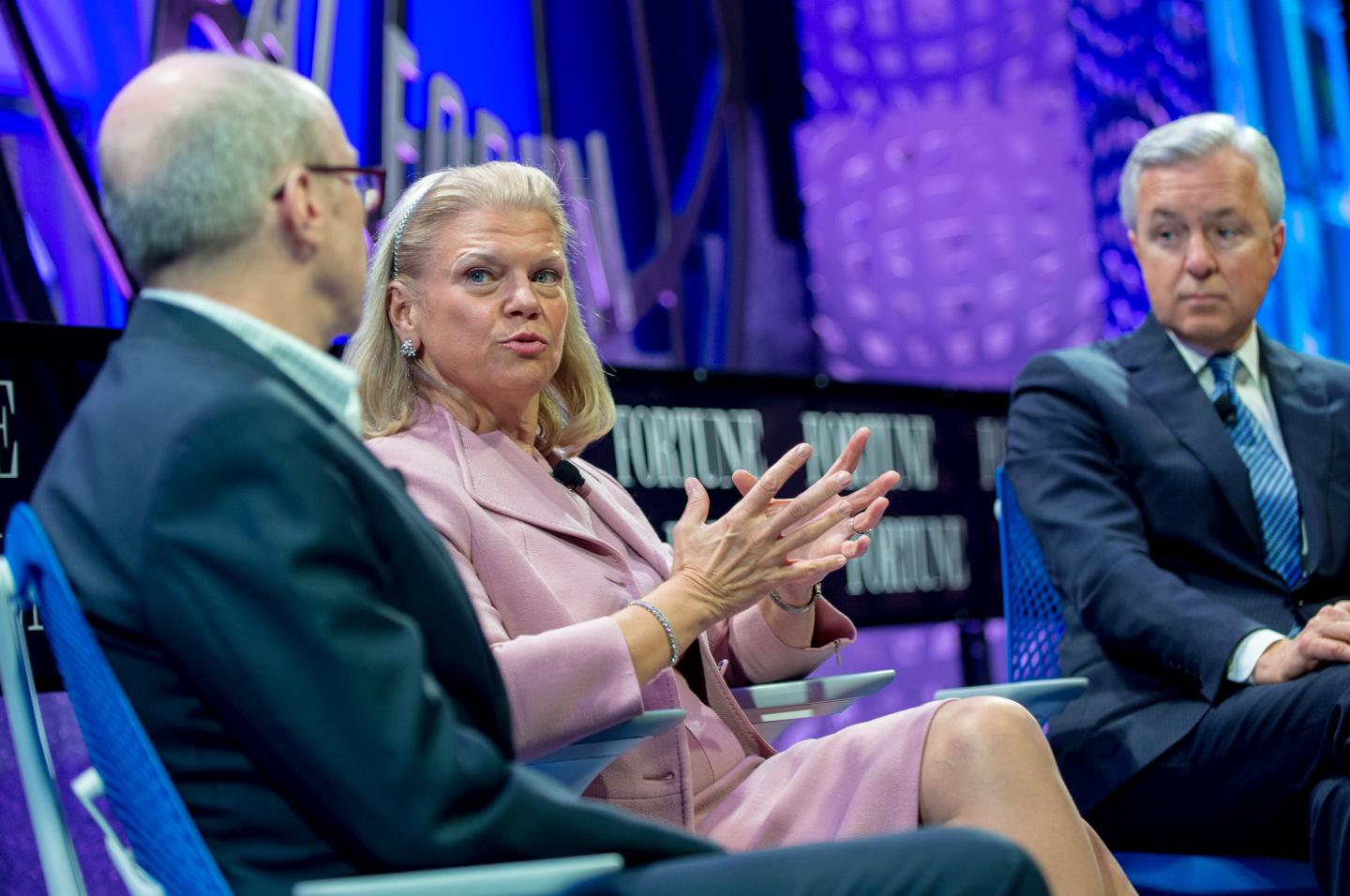
FORTUNE GLOBAL FORUM Monday, November 2nd, 2015 2015 FORTUNE GLOBAL FORUM San Fransisco, CA, USA 3:00-3:40 pm OPENING PLENARY: WINNING IN THE DISRUPTIVE CENTURY The very logic of the corporation is being reshaped by technology. Workers are becoming entrepreneurs, supply chains are becoming marketplaces, innovation is being crowdsourced, and rapidly growing new platforms are not only enriching their owners but empowering users. In this opening session, we’ll begin to explore the enormous ramifications of these accelerating trends. Panelists: Ginni Rometty, Chairman, President, and CEO, IBM John Stumpf, Chairman, President and CEO, Wells Fargo & Co. Moderator: Alan Murray, Fortune Photograph by Stuart Isett/Fortune Global ForumStuart Isett Stuart Isett/Fortune Global Foru

Over the course of IBM’s ongoing evolution, Chairman and CEO Ginni Rometty has abided by the motto, “never protect your past.”

“That’s what reinvention is. This is why I’ve divested—even in my time—$8 billion of businesses of ours,” she said on stage at the Fortune Global Forum in November.

That maxim, it seems, also applies to IBM’s annual performance review—a 10-year-old system called Personal Business Commitments. The program will be replaced with a brand new approach this week, one that gives more opportunity to shift employee goals throughout the year and includes more frequent feedback.

A big impetus for the change was that IBM employees “were already doing work differently than the system assumed,” Diane Gherson, IBM’s chief human resource officer, told Fortune.

Many corporate workers would probably recognize the company’s previous performance review system. It asked employees to set their goals for the year in January. Workers would then have a mid-year check-in with managers. They would then receive a final assessment and a single performance score in December.


But during the year, “new things [would] come along,” Gherson says. IBM (IBM) employees are “iterating and experimenting,” she says, and oftentimes that means they’re not necessarily working towards what they originally listed as an annual objective. Nevertheless, staffers would end up in an “irrelevant discussion” in December, Gherson says, trying to assess whether they’d fulfilled the goals they’d drafted 11 months earlier.

This past summer, Gherson and her team decided to change IBM’s performance review system to match the way the company’s employees now work. The shift is part of a larger series of changes as the 105-year-old tech giant undergoes a lengthy transition away from hardware to higher-growth areas like mobile, data analytics, and cloud-based services.

To revamp its performance review system, the HR department didn’t just pick a new system and implement it; it turned to its 380,000 employees in 170 countries to crowdsource the process. Gherson posted a message in July on Connections, IBM’s internal social media platform, asking employees to share their ideas for a new performance management system. The post received 75,000 views and 2,000 comments from employees.

IBM then ran a text analysis on the comments and organized them into themes. The HR department followed up with some employees to get additional input.

The employee suggestions convinced IBM to tweak its review system in ways it hadn’t necessarily expected. For instance, the company had floated the idea of asking employees to do a self assessment. “We learned through this process that our employees didn’t want that,” Gherson says. The department also did away with relative performance rankings—in which managers met with one another and compared their employees. And employees said that they wanted to receive feedback more frequently.

The end result is a new app-based performance review system called Checkpoint, which goes live to IBM employees on Monday.

With Checkpoint, IBM employees will set shorter-term goals, and managers will provide feedback on their progress at least every quarter. At the end of the year, employees will be judged across five criteria—business results, impact on client success, innovation, personal responsibility to others, and skills. Managers will assess whether employees have exceeded or achieved expectations for their role in each of those five dimensions or if there’s a need for improvement.

There is no single measure of an employee’s performance like before. “In the old system, there was one score. People [got] sort of obsessed by that,” Gherson said. “In the new system, there are five scores. It leads to a much richer, more balanced discussion.”

In moving away from the traditional annual performance review, IBM joins companies like General Electric, Microsoft, Accenture, and Adobe.

The trend is not surprising to Kevin Murphy, a senior research scientist who has studied performance reviews at Colorado State University. “Performance appraisals are very expensive, complex systems for making people unhappy,” he says.

Review systems also tend to be plagued by “grade inflation,” since managers have an incentive to give their employees good scores. Receiving a low score will anger an employee and potentially harm his or her productivity. “That makes the [manager] look bad because it’s [her] job to get employees to work well,” Murphy says.

“So companies are saying, ‘This is time consuming. We’re going to pull the plug and do something much simpler,'” according to Murphy.

While that’s understandable, executives should be careful to ensure that evaluations made through more casual systems are still based on a worker’s performance and not a manager’s personal feelings. And they shouldn’t try to do too much with a performance review system.

“Very often, companies try to do lots of things with performance appraisals that are in conflict with one another,” he says. Either use them to compare employees against each other—who gets a raise, for instance—or use them to judge an employee individually by evaluating his strengths and weaknesses. But don’t do both.

About the Author
Claire Zillman
By Claire ZillmanEditor, Leadership
LinkedIn iconTwitter icon

Claire Zillman is a senior editor at Fortune, overseeing leadership stories. 

See full bioRight Arrow Button Icon

Latest in Leadership

Finance
Lorem ipsum dolor sit amet, consectetur adipiscing elit, sed do eiusmod tempor incididunt ut labore et dolore magna aliqua. Ut enim ad minim veniam
By Fortune Editors
October 20, 2025
Finance
Lorem ipsum dolor sit amet, consectetur adipiscing elit, sed do eiusmod tempor incididunt ut labore et dolore magna aliqua. Ut enim ad minim veniam
By Fortune Editors
October 20, 2025
Finance
Lorem ipsum dolor sit amet, consectetur adipiscing elit, sed do eiusmod tempor incididunt ut labore et dolore magna aliqua. Ut enim ad minim veniam
By Fortune Editors
October 20, 2025
Finance
Lorem ipsum dolor sit amet, consectetur adipiscing elit, sed do eiusmod tempor incididunt ut labore et dolore magna aliqua. Ut enim ad minim veniam
By Fortune Editors
October 20, 2025
Finance
Lorem ipsum dolor sit amet, consectetur adipiscing elit, sed do eiusmod tempor incididunt ut labore et dolore magna aliqua. Ut enim ad minim veniam
By Fortune Editors
October 20, 2025
Finance
Lorem ipsum dolor sit amet, consectetur adipiscing elit, sed do eiusmod tempor incididunt ut labore et dolore magna aliqua. Ut enim ad minim veniam
By Fortune Editors
October 20, 2025

Most Popular

Finance
Lorem ipsum dolor sit amet, consectetur adipiscing elit, sed do eiusmod tempor incididunt ut labore et dolore magna aliqua. Ut enim ad minim veniam
By Fortune Editors
October 20, 2025
Finance
Lorem ipsum dolor sit amet, consectetur adipiscing elit, sed do eiusmod tempor incididunt ut labore et dolore magna aliqua. Ut enim ad minim veniam
By Fortune Editors
October 20, 2025
Finance
Lorem ipsum dolor sit amet, consectetur adipiscing elit, sed do eiusmod tempor incididunt ut labore et dolore magna aliqua. Ut enim ad minim veniam
By Fortune Editors
October 20, 2025
Finance
Lorem ipsum dolor sit amet, consectetur adipiscing elit, sed do eiusmod tempor incididunt ut labore et dolore magna aliqua. Ut enim ad minim veniam
By Fortune Editors
October 20, 2025
Finance
Lorem ipsum dolor sit amet, consectetur adipiscing elit, sed do eiusmod tempor incididunt ut labore et dolore magna aliqua. Ut enim ad minim veniam
By Fortune Editors
October 20, 2025
Finance
Lorem ipsum dolor sit amet, consectetur adipiscing elit, sed do eiusmod tempor incididunt ut labore et dolore magna aliqua. Ut enim ad minim veniam
By Fortune Editors
October 20, 2025
Rankings
  • 100 Best Companies
  • Fortune 500
  • Global 500
  • Fortune 500 Europe
  • Most Powerful Women
  • Future 50
  • World’s Most Admired Companies
  • See All Rankings
Sections
  • Finance
  • Leadership
  • Success
  • Tech
  • Asia
  • Europe
  • Environment
  • Fortune Crypto
  • Health
  • Retail
  • Lifestyle
  • Politics
  • Newsletters
  • Magazine
  • Features
  • Commentary
  • Mpw
  • CEO Initiative
  • Conferences
  • Personal Finance
  • Education
Customer Support
  • Frequently Asked Questions
  • Customer Service Portal
  • Privacy Policy
  • Terms Of Use
  • Single Issues For Purchase
  • International Print
Commercial Services
  • Advertising
  • Fortune Brand Studio
  • Fortune Analytics
  • Fortune Conferences
  • Business Development
About Us
  • About Us
  • Editorial Calendar
  • Press Center
  • Work At Fortune
  • Diversity And Inclusion
  • Terms And Conditions
  • Site Map

© 2025 Fortune Media IP Limited. All Rights Reserved. Use of this site constitutes acceptance of our Terms of Use and Privacy Policy | CA Notice at Collection and Privacy Notice | Do Not Sell/Share My Personal Information
FORTUNE is a trademark of Fortune Media IP Limited, registered in the U.S. and other countries. FORTUNE may receive compensation for some links to products and services on this website. Offers may be subject to change without notice.


Latest in Leadership

Future of Workthe future of work
A Walmart employee nearly doubled her pay after entering its pipeline for skilled tradespeople. ‘I was able to move out of my parents’ house’
By Anne D'Innocenzio and The Associated PressDecember 20, 2025
9 hours ago
Successspace
Paraplegic engineer becomes the first wheelchair user to blast into space — laughing all the up, while on board a Blue Origin rocket
By Marcia Dunn and The Associated PressDecember 20, 2025
9 hours ago
Scott Anthony
Future of WorkColleges and Universities
‘They’ll lose their humanity’: Dartmouth professor says he’s surprised just how scared his Gen Z students are of AI
By Nick LichtenbergDecember 20, 2025
19 hours ago
Future of WorkGen Z
Gen Z is open minded about blue-collar work and the Fords of the economy need them — but both sides are missing each other
By Muskaan ArshadDecember 20, 2025
22 hours ago
Josie Lauducci on the front of her boat
SuccessCareers
Meet the Gen Xer who lives on a boat—she supercommutes to California every few weeks for her $100-an-hour job. Just eight shifts cover all her bills
By Preston ForeDecember 20, 2025
23 hours ago
C-SuiteFortune 500 Power Moves
Fortune 500 Power Moves: Which executives gained and lost power this week
By Fortune EditorsDecember 19, 2025
2 days ago

Most Popular

placeholder alt text
Success
The scientist who helped create AI says it’s only ‘a matter of time’ before every single job is wiped out—even safer trade jobs like plumbing
By Orianna Rosa RoyleDecember 19, 2025
2 days ago
placeholder alt text
Economy
James Talarico says the biggest 'welfare queens' in America are 'the giant corporations that don't pay a penny in income taxes'
By Dave SmithDecember 20, 2025
21 hours ago
placeholder alt text
Success
As graduates face a ‘jobpocalypse,’ Goldman Sachs exec tells Gen Z they need to know their commercial impact 
By Preston ForeDecember 18, 2025
3 days ago
placeholder alt text
Economy
Sneaking unemployment rate means the U.S. economy is inching closer to a key recession indicator, says Moody’s
By Eleanor PringleDecember 19, 2025
2 days ago
placeholder alt text
Future of Work
'They'll lose their humanity': Dartmouth professor says he's surprised just how scared his Gen Z students are of AI
By Nick LichtenbergDecember 20, 2025
19 hours ago
placeholder alt text
AI
Meta’s 28-year-old billionaire prodigy says the next Bill Gates will be a 13-year-old who is ‘vibe coding’ right now
By Eva RoytburgDecember 19, 2025
2 days ago