• Home
  • Latest
  • Fortune 500
  • Finance
  • Tech
  • Leadership
  • Lifestyle
  • Rankings
  • Multimedia
LeadershipHuman Capital

Why Some CEOs Are Ordering Employees to Take Vacation

By
Jennifer Alsever
Jennifer Alsever
Down Arrow Button Icon
By
Jennifer Alsever
Jennifer Alsever
Down Arrow Button Icon
December 15, 2015, 7:00 AM ET
Illustration by Michael Byers

Most employers push new hires to start as soon as they can. Jason Freedman tells them to take a couple of weeks of vacation first. As CEO of 42Floors, an office-listing website, Freedman instructs his employees to take time off and stay balanced, despite the pressures of working at a startup. “They feel guilty taking vacation,” he says. “I want people to know I’m serious. You need it.”

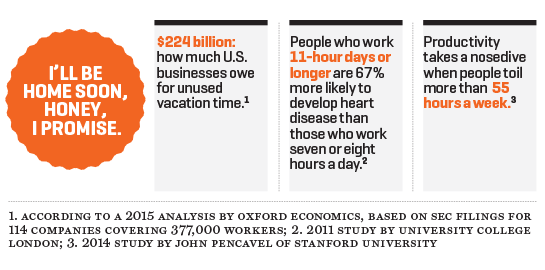
Work-life balance is a perpetually hot topic, with 40% of full-time American workers logging more than 50 work hours a week, according to a 2014 Gallup poll. People eat at their desks, check emails in bed, and, yes, forgo R&R. Some execs, most of them at young enterprises, are starting to push their workers to take time off—because it benefits not only the employee but also the employer.

Consider Bart Lorang, CEO of software company FullContact. Lorang requires his staff of 75 to take at least three weeks off per year. The company will even pay up to $7,500 for the vacation—but only if the employees don’t work while away. A photo hangs in the company’s Denver office as a cautionary reminder. It shows Lorang with his fiancée riding camels in Egypt. But instead of gazing up at the pyramids, he was staring down at his smartphone.

FullContact’s policy has paid off in more than happiness, says Eden Elder, its chief people officer. Productivity is up. Vacationers, she says, make up for the time off “right away because when they unplug and see the world, it pumps up the energy of everyone.” (It also means an avalanche of job applications.)
HUM.12.15.15.sidebar

Beyond vacations, Ryan Sanders and Ben Peterson, co-founders of Utah-based software maker BambooHR, attempted to realign office habits with a “no workaholics” policy: Employees must leave at 5 p.m. and work no more than 40 hours a week. The two claim they almost fired one worker who regularly violated the rule. “We know this balance leads to much happier employees, and happy employees do great things,” Peterson says. Indeed, BambooHR has landed accolades for being a top workplace in Utah.

Corey Blake takes a page from addiction treatment to deal with workaholics. The CEO and founder of Round Table Companies organizes interventions. The company has 36 employees who help co-author and produce books, videos, and articles for experts and executives. When the workload overwhelms somebody, three or four colleagues will call up and, Blake says, “lovingly confront” the employee, recommending help from a personal coach.

One such intervention three years ago left executive editor Katie Gutierrez in tears. But a few days later she realized they were right: She was editing six to seven books at once, and her performance was suffering. The painful conversation, she says, helped her change her habit of taking on too much and improved her relationship with Blake and other employees. “It felt like there was an urgency behind it and things had to change soon,” she says. “We’ve all been there, and it’s not healthy to be working that much—even if you love it.”

A version of this article appears in the December 15, 2015 issue of Fortune with the headline “Take It Easy. That’s An Order!”.


About the Author
By Jennifer Alsever
See full bioRight Arrow Button Icon

Latest in Leadership

Asiathe future of work
The CEO of one of Asia’s largest co-working space providers says his business has more in common with hotels
By Angelica AngDecember 12, 2025
4 hours ago
Donald Trump
HealthHealth Insurance
‘Tragedy in the making’: Top healthcare exec on why insurance will spike to subsidize a tax cut to millionaires and billionaires
By Nick LichtenbergDecember 12, 2025
11 hours ago
three men in suits, one gesturing
AIBrainstorm AI
The fastest athletes in the world can botch a baton pass if trust isn’t there—and the same is true of AI, Blackbaud exec says
By Amanda GerutDecember 12, 2025
12 hours ago
Brainstorm AI panel
AIBrainstorm AI
Creative workers won’t be replaced by AI—but their roles will change to become ‘directors’ managing AI agents, executives say
By Beatrice NolanDecember 12, 2025
12 hours ago
Ryan Serhant lifts his arms at the premiere of Owning Manhattan, his Netflix show
Successrelationships
Ryan Serhant, a real estate mogul who’s met over 100 billionaires, reveals his best networking advice: ‘Every room I go into, I use the two C’s‘
By Dave SmithDecember 12, 2025
13 hours ago
Fei-Fei Li, the "Godmother of AI," says she values AI skills more than college degrees when hiring software engineers for her tech startup.
AITech
‘Godmother of AI’ says degrees are less important in hiring than how quickly you can ‘superpower yourself’ with new tools
By Nino PaoliDecember 12, 2025
14 hours ago

Most Popular

placeholder alt text
Economy
Tariffs are taxes and they were used to finance the federal government until the 1913 income tax. A top economist breaks it down
By Kent JonesDecember 12, 2025
20 hours ago
placeholder alt text
Success
Apple cofounder Ronald Wayne sold his 10% stake for $800 in 1976—today it’d be worth up to $400 billion
By Preston ForeDecember 12, 2025
16 hours ago
placeholder alt text
Success
At 18, doctors gave him three hours to live. He played video games from his hospital bed—and now, he’s built a $10 million-a-year video game studio
By Preston ForeDecember 10, 2025
3 days ago
placeholder alt text
Success
40% of Stanford undergrads receive disability accommodations—but it’s become a college-wide phenomenon as Gen Z try to succeed in the current climate
By Preston ForeDecember 12, 2025
16 hours ago
placeholder alt text
Success
Palantir cofounder calls elite college undergrads a ‘loser generation’ as data reveals rise in students seeking support for disabilities, like ADHD
By Preston ForeDecember 11, 2025
2 days ago
placeholder alt text
Economy
For the first time since Trump’s tariff rollout, import tax revenue has fallen, threatening his lofty plans to slash the $38 trillion national debt
By Sasha RogelbergDecember 12, 2025
11 hours ago
Rankings
  • 100 Best Companies
  • Fortune 500
  • Global 500
  • Fortune 500 Europe
  • Most Powerful Women
  • Future 50
  • World’s Most Admired Companies
  • See All Rankings
Sections
  • Finance
  • Leadership
  • Success
  • Tech
  • Asia
  • Europe
  • Environment
  • Fortune Crypto
  • Health
  • Retail
  • Lifestyle
  • Politics
  • Newsletters
  • Magazine
  • Features
  • Commentary
  • Mpw
  • CEO Initiative
  • Conferences
  • Personal Finance
  • Education
Customer Support
  • Frequently Asked Questions
  • Customer Service Portal
  • Privacy Policy
  • Terms Of Use
  • Single Issues For Purchase
  • International Print
Commercial Services
  • Advertising
  • Fortune Brand Studio
  • Fortune Analytics
  • Fortune Conferences
  • Business Development
About Us
  • About Us
  • Editorial Calendar
  • Press Center
  • Work At Fortune
  • Diversity And Inclusion
  • Terms And Conditions
  • Site Map

© 2025 Fortune Media IP Limited. All Rights Reserved. Use of this site constitutes acceptance of our Terms of Use and Privacy Policy | CA Notice at Collection and Privacy Notice | Do Not Sell/Share My Personal Information
FORTUNE is a trademark of Fortune Media IP Limited, registered in the U.S. and other countries. FORTUNE may receive compensation for some links to products and services on this website. Offers may be subject to change without notice.