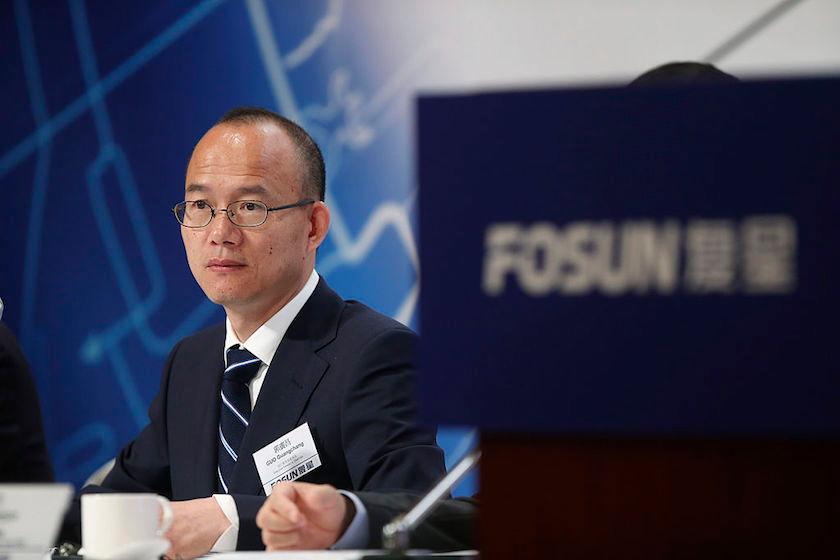
When China’s seventh-richest private entrepreneur is mysteriously detained to “assist” an official criminal investigation and then just as mysteriously resurfaced, the world should start paying attention.
Guo Guangchang, whose disappearance in mid-December sent shock waves through China’s business community, is no ordinary entrepreneur. He is the majority owner of Fosun Group, a conglomerate that has recently made headlines for a string of high-profile overseas acquisitions that includes Club Med and Cirque du Soleil.
The Chinese government has said nothing about the case involving Guo. Whatever the outcome of the Guo case, this episode epitomizes the insecurity of wealth in contemporary China.
During the Mao Zedong era, accumulating wealth was punishable by jail terms or even execution. Thanks to Deng Xiaoping’s reforms, getting rich in China is supposed to be “glorious.” But those who have taken Deng’s exhortations literally are now finding themselves rich in glory but poor in security.
Guo is by no means the first to get a taste of such glorious insecurity. He is merely following a path trodden by a succession of Chinese moguls who apparently have forgotten the Chinese adage “fat pigs get slaughtered first” and have become too successful for their own good.
Huang Guangyu, the founder of Gome Group, China’s largest private retailer of electronics and appliances, was once the country’s richest person. Today, he is serving a 14-year sentence after being convicted of running an illegal business, bribing officials, and other crimes. By pure coincidence, a few days before Guo’s disappearance, Xu Ming, a real estate tycoon who gave millions of dollars of “gifts,” including a multimillion-dollar luxury mansion on the French Riveria, to the family of Bo Xilai, the former party boss of Chongqing, was found dead in his jail cell far away from his hometown (the quick cremation of his body raised suspicions of foul play).
The occupational hazard of China’s business tycoons comes is a direct consequence of the high concentration of power within the nation’s economy. Chinese officials who award contracts, dispose government-owned property such as land, mines, and factories, and approve licenses are logical targets of bribery for businessmen hungry for quick profits. And those who have made their ill-gotten fortunes live in constant fear of a visit from the Chinese police.
China’s deeply flawed system of commercial laws, marked by vagueness and excessive restrictions on legitimate business activities, is another well-known minefield for entrepreneurs. The official Chinese legal culture remains “everything is forbidden unless explicitly permitted,” the opposite of the Western legal culture. Successful entrepreneurs can always be prosecuted for some ill-defined technical violation.
Private wealth is also made insecure because of the lack of legal protection for both private property and its owners. It is revealing that, in the case of Guo, he apparently had no legal representation when he was hauled in. Even though the Chinese constitution formally pledges to protect private property and the rights of their owners, there is one glaring hole: no institution can enforce the constitution if the Chinese Communist Party and the Chinese state it controls are above the law.
When China was a more closed economy, its successful businessmen had few options to protect themselves or their wealth. But as the Chinese economy has become intertwined with the global economy, owners of insecure private wealth have begun to reduce their exposure to an arbitrary government by investing their capital abroad and acquiring foreign passports.
Guo, a 48-year-old self-made billionaire with a net worth of $7.8 billion last year, is the best example of this trend. In the last 12 months, his investment vehicle, Fosun International, has gone on an acquisition binge in the U.S. and Europe, spending $6.3 billion to buy two small American insurance companies and well-known travel brands like Club Med and Thomas Cook.
Other Chinese tycoons and the merely affluent have been snatching up western companies and real estate in the U.S., Europe, Canada, and Australia. These acquisitions, along with the devaluation pressures on the Chinese currency, are responsible for the more than $600 billion in net capital outflows from China since mid-2014.
The case of Guo is a loud warning to those wishing to profit from China’s rise. Chinese tycoons today are majority owners of large publicly traded companies in Hong Kong and Shanghai. Western investors have considerable exposure to emerging markets (Chinese companies typically account for 20% of various emerging market indexes). Yet it is unclear whether they have factored the risks of an arbitrary government, insecure wealth, and a lack of legal protection for business leaders. If they have not, it is time to demand a higher political risk premium on Chinese stocks.
Minxin Pei is the Tom and Margot Pritzker ’72 Professor of Government at Claremont McKenna College