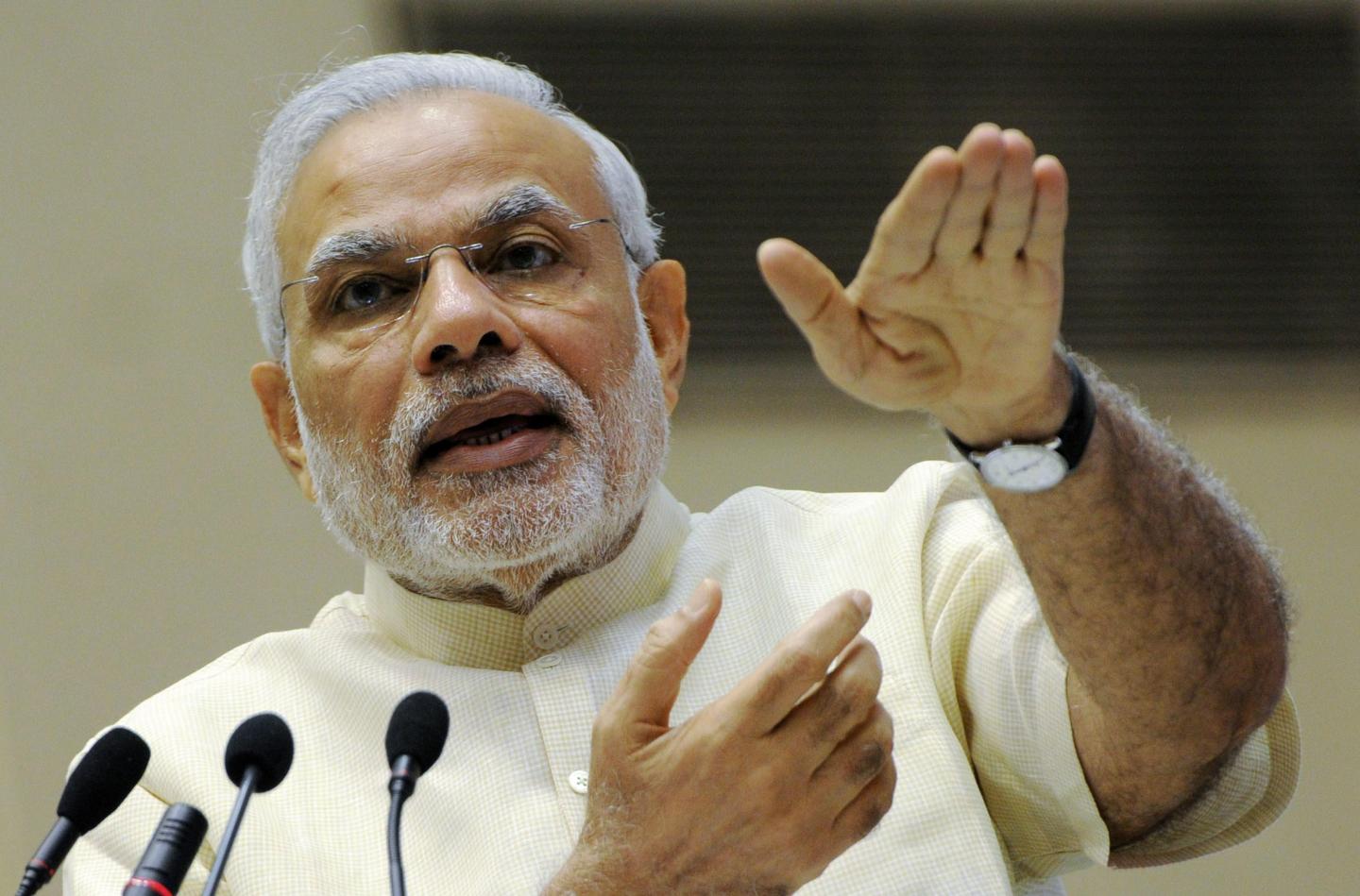
India’s Prime Minister Narendra Modi stole the show and the headlines on the first day of COP 21 in Paris — no small feat given the U.N. climate conference features nearly 150 sitting Presidents and Prime Ministers, the biggest gathering of heads of state in France since 1948.
In the weeks leading up to the mammoth conference and again on its first day, Modi has positioned himself as the loudest voice for the developing world, by pushing the term “climate justice.” In brief, India is determined that poor, developing countries are not forced to pay the price for decades in which the U.S. and Europe have polluted the planet, at the very moment when countries like India are becoming major industrial nations.
India is now the world’s fastest-growing economy, according to the IMF, and is set to become the world’s most populous country in just seven years, according to the U.N. India is also the world’s third-biggest emitter of carbon, after China and the U.S., according to according to the World Resources Institute, a global research body.
When Modi opened the India Pavilion at the climate conference center in Paris on Monday afternoon, he said the display aimed to “look beyond climate change and focus on climate justice.” And when he addressed the full plenary of world leaders, he said: “The prosperous still have a strong carbon footprint, but the world’s billions at the bottom of the development ladder are seeking space to grow.”
Back home—where Modi’s Bharatiya Janata Party has lost key elections in New Delhi and Bihar states since he came to power—the talk of redressing old historic injustices plays big.
“When Indians hear ‘climate justice,’ they hear that there are people who are actually responsible for the problem,” says Harjeet Singh, climate change manager for the development agency Action Aid. Singh, who lives in New Delhi, tells Fortune that Indians feel a keen sense of unfairness that they are being asked to roll back their economic surge—much of it reliant on heavy pollutants—while the rich Western countries were never asked to do any such thing.
“Indians feel they get bullied and unfairly treated,” says Singh, who heads Action Aid’s delegation at the Paris talks. “The developing countries feel they should not have to be responsible for what the developed world has done. And the U.S. and E.U. countries put more than 50% of carbon emissions into the atmosphere.”
Indeed, when Secretary of State John Kerry said last week that forcing India to cut down on its carbon emissions would be a “challenge” at the climate talks, India’s Environment Minister Prakash Javadekar shot back that India would not be “bullied” by Western powers meeting in Paris. “The developed world must recognize that they have to atone for the historical carbon emissions that they have been putting out in the atmosphere for over 150 years in their search for prosperity.”
In addition to wielding a defiant stick, Modi also brought carrots to Paris.
‘The Sunrise of Hope’
To a packed conference room, Modi told journalists and delegates that India was spearheading a new International Solar Alliance, in order to dramatically expand solar-power technology and distribution in poorer countries. Solar power is something those countries desperately need, even though many are ironically located in the sunbaked tropics.
“The vast majority of humanity is blessed with generous sunlight around the year, yet many are also without any source of power,” Modi told journalists and officials during his announcement.
The Indian Prime Minister outlined his plan for an alliance of countries, mostly African and Latin American, but including also the U.S., China, and France. The group would share solar technology and innovation, and invest in expanding solar power across emerging markets. Modi said India would invest $30 million in building the alliance’s headquarters in New Delhi, adding: “This day is the sunrise of hope not only for clean energy but for homes still in darkness.”
Leaving aside that poetic flourish, grabbing the leadership of a new global solar group is a smart move for Modi, both for his own political standing, and for the Indian economy, according to analysts.
First, India is in dire need of renewable energy. About 200 million Indians, about one in seven citizens, are currently without electricity, and Modi promised to tackle that urgent problem during his election campaign early last year. How he fixes that problem could be crucial for the planet too.
“Left unchecked, India’s annual GHG [greenhouse gases] could by the highest in the world by 2050,” says Varun Sivaram, a renewable energy expert at the Council of Foreign Relations in New York. “Achieving effective climate policy in India is a global challenge, and one that if surmounted could bring global benefits.”
India’s solar market is set for a big boost: when Modi took power last year, he increased India’ solar-power targets from 30 gigawatts to 175 gigawatts by 2022—a date chosen to time with the 150th birthday of India’s national hero Mahatma Ghandi. With Modi’s new alliance, the country has a shot at boosting its own energy companies by developing solar technology at home, rather than watch Chinese, European and U.S. solar companies carve up the market. India could further benefit by exporting its homegrown technologies to other sunny countries; India has promised increased investment in Africa, and at last month’s India-Africa summit in New Delhi, Modi promised $600 million in aid to African countries, where Indian companies lag far behind Chinese rivals.
“India now wants to start positioning itself as a key global solar market, and not just another name of the list of emerging solar markets,” Jasmeet Khurana, associate director of the country’s leading clean-tech advisory company Bridge to India wrote in a blog post last month. That means racing to seal relationships with dozens of hungry-power countries, “rather than depending on costly transfer of technologies from Europe and the U.S.”
Certainly, there could be fortunes to be made. In a report last March Deutsche Bank estimated that by 2030 solar power would account for the biggest single part of electricity supply worldwide, and potentially be worth $5 trillion in revenues. But becoming a major solar power will not be easy for Modi—despite the fact that solar power has plummeted in price by about 70% since 2009. Already, giant-sized solar facilities are under construction in developing countries, including Oman, whose national oil company has partnered with California solar company GlassPoint to build one of the world’s biggest facilities; Morocco says its new solar farm in the Sahara will be the world’s biggest.
For Modi, then, solar power is a way to boost business for India, massively increase Indians’ access to power at the same time, and hopefully carve out for himself a major role in the world’s energy transition. In a working paper earlier this month, India’s environment ministry described the Solar Alliance as a way for the sunny countries—largely developing nations—to “close their technological gaps by cooperating with each other,” and to share experiences. “These countries need a voice on the international stage,” said the paper. On Monday, they found one: Narendra Modi.