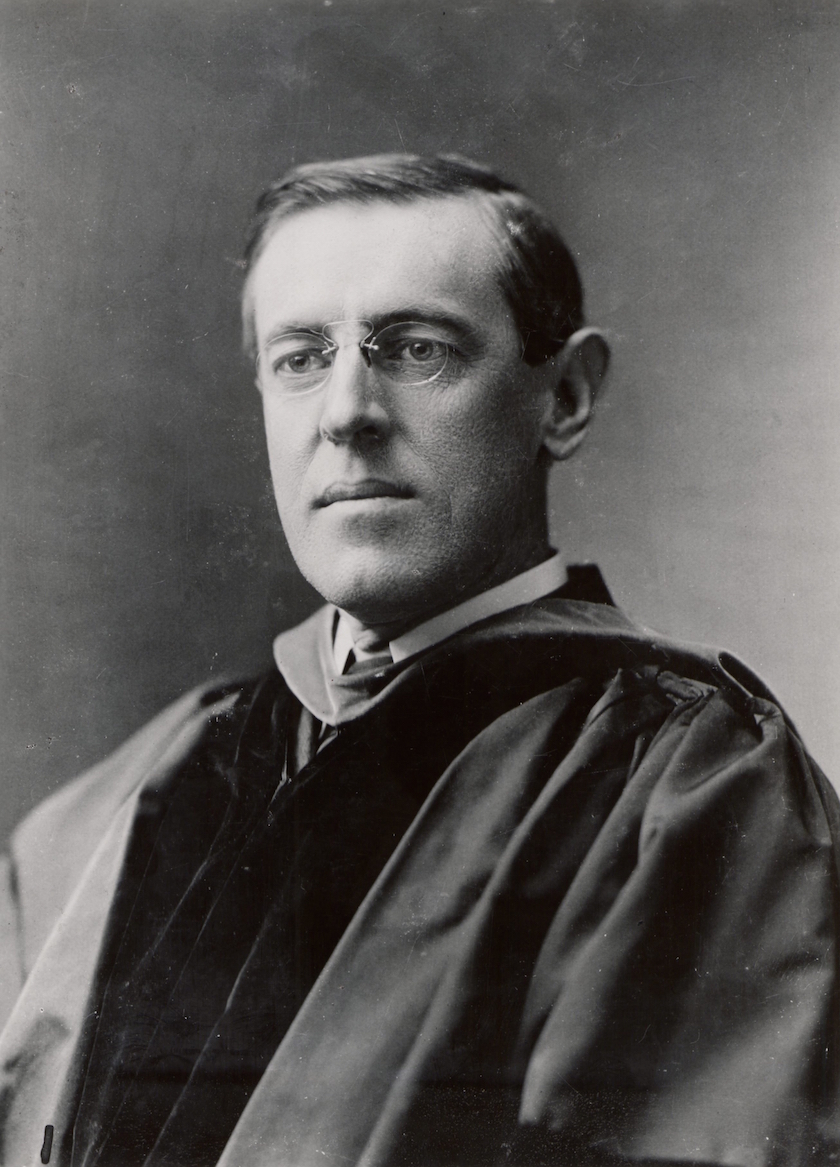
Had Woodrow Wilson not been president of the United States, he would still have been one of the greatest leaders of Princeton University. But it is doubtful that his legacy would be the target of the Black Justice League, which wants Princeton to erase the 28th president’s name from all public spaces and buildings and from the renowned Woodrow Wilson School of Public and International Affairs.
The league is demanding a Wilson-free university because, as president of the United States, he ordered the segregation of federal offices and assigned black troops to segregated units. Wilson’s discriminatory racial policies were not merely a concession to the standards of the day—they reflected his own beliefs. He never outgrew the prejudices of his native Virginia—views that were deplorably common among white Americans not only in the south but also in the north.
If Wilson had been noteworthy only, or even primarily, for racial bigotry—the demands of the Black Justice League would present an easier call. But Wilson was one of America’s most progressive presidents and a transformative figure in education. Before he entered politics, he was an eminent scholar of American government. He was regularly voted Princeton’s most popular professor.
When he was named the institution’s president in 1902, a college education was a privilege of the elite. Over the next eight years, he struggled against aristocratic alumni to democratize Princeton and to elevate the university’s academic standards. He raised admissions requirements and increased the quantity and quality of the faculty. He broke the hold of conservative Presbyterians over the board of trustees and appointed the first Jew and the first Catholic to the faculty. He sought to smash the elitist eating clubs that imposed a snobby hierarchy on campus social life and detracted from the college’s academic mission. Although that quest failed, Wilson had, as his biographer Arthur Link maintained, a “larger hand in the development of Princeton into a great University than any other man in the twentieth century.”
Wilson’s ambition at Princeton, memorably phrased, was for the university to produce young men “as unlike their fathers as possible.” But his clashes with university elites sped his exit from academia; they also probably nurtured his migration to the political left. As governor of New Jersey, Wilson was a more forceful progressive than his Wall Street backers had expected. He spearheaded the regulation of utilities, liberal workmen’s compensation, and primary elections.
As president, he liberated the U.S. economy from the stranglehold of high tariffs, tightened regulation of abusive monopolies, and signed a progressive income tax, the first in peacetime ever. He also appointed the first Jew, Louis Brandeis, to the Supreme Court.
He bitterly disappointed African-Americans, who had hoped that Wilson’s idealism would extend to civil rights. Perhaps they should have expected less; Wilson did not welcome black students at Princeton either.
But inadvertently, Wilson did pave the way for change in a latter generation. The Democratic Party of the post-Civil War era was dominated by southerners who were hostile to federal power. Wilson broke from the party’s laissez faire traditions and embraced a stronger federal government. The best example of this was the way he shaped the landmark Federal Reserve Act, which created the nation’s central bank.
The bill’s sponsor, Rep. Carter Glass—a fellow Virginian—proposed a completely decentralized network of regional Reserve Banks. Wilson insisted that the new system be governed by a Federal Reserve Board in Washington.
Glass reluctantly went along, but his next draft called for a Reserve Board run by private bankers. Once again, Wilson intervened, and demanded that the Reserve Board consist of public servants appointed by the president.
These changes heralded a new age of federal power over the economy, and presaged the Democratic Party’s metamorphosis into a force for a strong central government. And it was federal power that ultimately enforced anti-discrimination laws and secured civil rights for black people in the South, among a host of other progressive changes.
Mention of Carter Glass raises an important point. Glass is often approvingly cited as the author of the Glass-Steagall Act and as an architect of other financial legislation. He also (earlier in his career) rewrote the Virginia constitution to exclude black voters. His racism was a more overt part of his career than was Wilson’s (indeed, it propelled him into politics). But we remember Glass primarily for his legislation.
The fact is that much—perhaps most—of white America was racist both in public policy and private belief for the first several centuries after Columbus. But we cannot—should not—expunge every important American politician that predates, say, the post-World War II era. To do so would leave us with virtually no historical figures. As Geoffrey R. Stone has written, if Wilson’s name is stricken, “what are we to do with George Washington, Thomas Jefferson, James Madison,” who all owned slaves? Or with Franklin D. Roosevelt, who ordered the internment of Japanese-Americans during World War II? For that matter, no president before Barack Obama has supported full equality for gay and lesbian Americans.
Standards change. Not even Abraham Lincoln believed that the races were equal. To banish our patriarchs (and matriarchs) from public honor would be to reduce their achievements, brilliant in so many respects, to the single issue of their racial intolerance. A figure, I think, such as George C. Wallace, is different, because he was primarily famous—rather, notorious—for racism, and because he actively campaigned to thwart integration at a time when the nation’s conscience was finally aroused. Wilson was a segregationist at a time when it was—again, deplorably—accepted. And the stain of being a segregationist did not define the breadth of his career.
Wilson’s racial blinders were scarcely his only flaw. He was imperious and overly sensitive to criticism. During World War I, he cracked down on dissent, betraying the ideal of freedom for which America supposedly was fighting. Like the 42 other human beings who reached the White House, Wilson was, manifestly, imperfect. But he was more accomplished than most, and he is an indelible part of our history and of Princeton’s. He should be studied, debated, praised, and criticized—but not expunged, which feels too close to Orwellian erasure.
Princeton’s current president, Christopher L. Eisgruber, has said the university will consider removing a Wilson mural and Wilson’s name from buildings and programs. I hope he deliberates with courage. Universities, as Wilson knew, primarily exist to teach and to learn. Banishing his name would be an ill-fitting example for the students whose institution he served.
Roger Lowenstein is the author of the newly published America’s Bank: The Epic Struggle to Create the Federal Reserve.