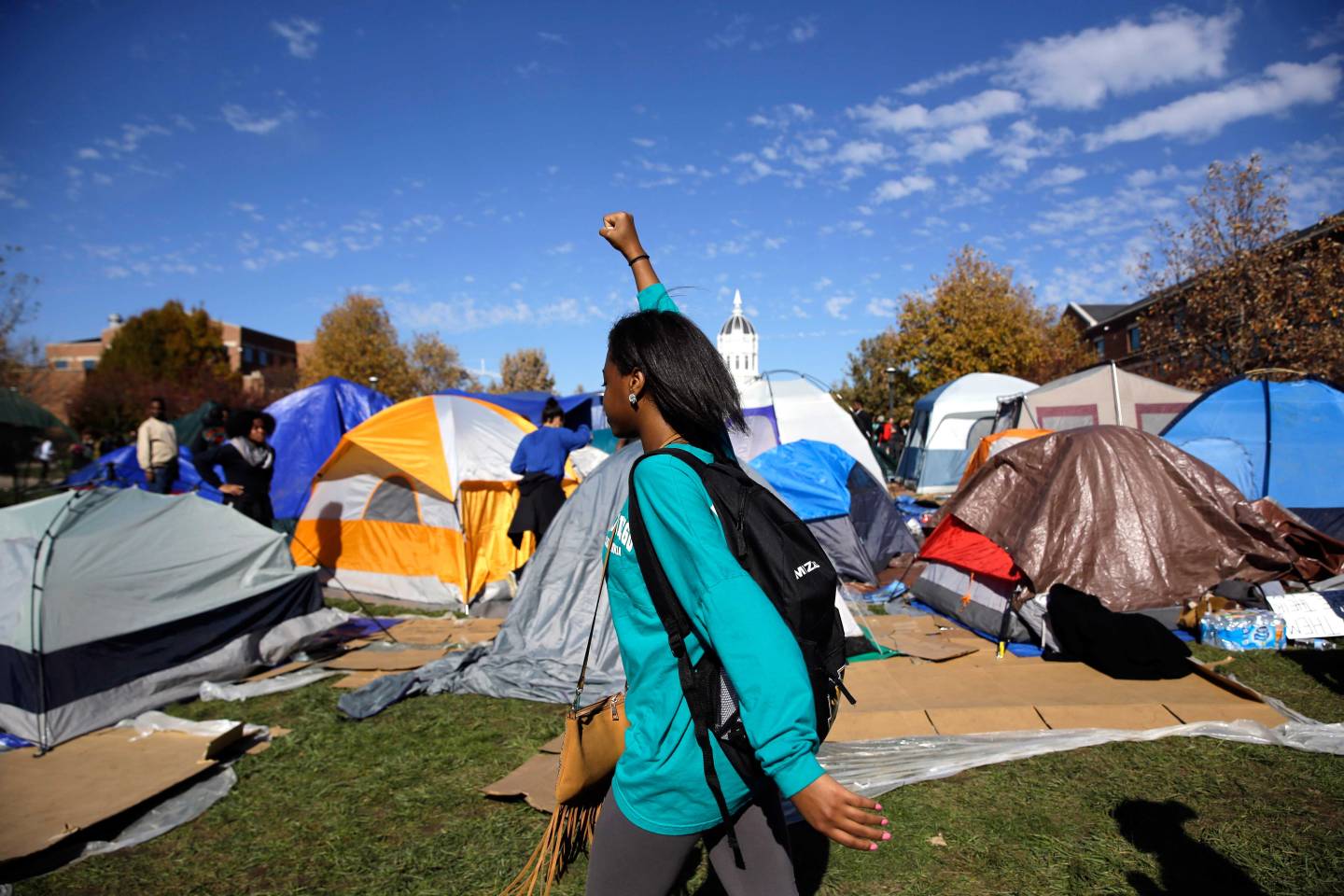
Last week, the president of the University of Missouri resigned amid student protests that he had not done enough to address racist incidents on campus. At Yale University, hundreds of students are protesting the university administration’s failure to create a welcoming and safe environment for minority students. Similar protests are erupting across the country at institutions, such as Claremont McKenna College, Weslyan University, and Ithica College.
Students want answers, and one common solution that student protestors are asking for is to increase the diversity of their faculties by hiring more women and minority professors. In deciding whether to accede to these demands, the relevant university administrators will face a crucial test of their integrity and their commitment to the rule of law; specifically, their commitment to ensure that their institution does not violate the Civil Rights Act of 1964.
To understand why, you must ignore anything you have heard about the Supreme Court’s decision in Grutter v. Bollinger, which held that the Equal Protection Clause of the Fourteenth Amendment allows public universities to consider an applicant’s race in their admission decisions. That decision is irrelevant to the question of whether universities can consider race and gender in deciding whom to hire as faculty. Employment decisions are governed by the Civil Rights Act, which applies to both public and private universities.
The Civil Rights Act permits universities to undertake strenuous affirmative action to assemble the most diverse pool of applicants possible. They may specifically recruit African-Americans, women, and other minorities to apply for faculty positions. But once the applicant pool has been assembled and the selection process has begun – once the search committee begins compiling its list of candidates for further consideration — deciding whom to put on the short list for on-campus interviews, and ultimately, whom to hire – the Civil Rights Act prohibits basing any decision on the candidate’s race, color, religion, sex, or national origin.
Although the student demonstrators are unlikely to be aware of this aspect of the Civil Rights Act, university administrators certainly are. Their integrity is on the line in how they respond to students.
Will they truthfully tell the student protestors that the law does not permit the university to simply go out and hire minority faculty – that the Civil Rights Act prohibits them from making such race-based hiring decisions?
Will they attempt to fudge the matter by making a commitment to employ every available legal means to increase the diversity of their faculty? If so, will they explain to students that because almost every university already does this, such a promise does not commit the university to doing anything new?
Or will they go ahead and make a promise to hire more minority faculty without mentioning the restrictions of the Civil Rights Act? If so, and if they intend to keep that promise, then it is not the administrators’ integrity that is in question, but their commitment to the rule of law.
Most university administrators know that the legal limitations on diversity hiring can be easily circumvented. Faculty search committees are composed, not of employment lawyers, but of ordinary professors who are unfamiliar with the workings of the Civil Rights Act. Most of these professors believe that there is nothing legally wrong with giving preference to women and minorities in the selection process. Many universities exploit this ignorance of the law by generating memoranda governing faculty hiring that studiously refrain from acquainting the members of search committees with the legal restrictions of the Civil Rights Act, while exhorting them to use their utmost efforts to advance the goal of achieving a diverse faculty.
When the Civil Right Act was first passed, bigoted employers removed the “whites only” requirement from their job ads, but continued to give hiring preference to whites over African-Americans. They simply indulged their racial preferences covertly rather than overtly. The bigoted employers’ response to the Civil Rights Act was to go on acting in the way that they believed to be right regardless of the law. Present day universities frequently employ the same tactic to achieve what they consider to be the more desirable goal of diversity.
Should they? Increasing the diversity of a university’s faculty is a laudable end, but circumventing the law to achieve it on the ground that the end justifies the means sets a troubling precedent. At the University of Missouri, student demonstrators used force and the threat of force to prevent journalists from exercising their First Amendment rights on public property. At Yale, student demonstrators shouted obscenities and spat upon professors and others who disagreed with their position. If the end really does justify the means, what grounds are there for condemning such actions?
Universities are educational institutions. The way their administrators respond to the demand to hire more minority faculty will teach important lessons about both what it means to act with integrity and the importance of the rule of law. It will be interesting to see what those lessons are.
John Hasnas is a professor of ethics at Georgetown University’s McDonough School of Business.