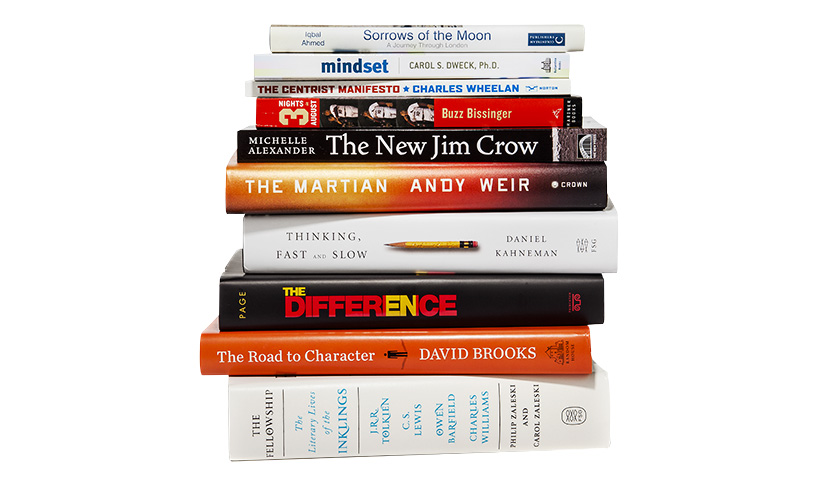
A good book will make you think; a really good book will change the way you do it. Fortune asked 18 CEOs, luminaries, and rising stars to name the one book they read this year that altered their perspective on life or business. Here are their picks for the most mind-bending and most useful reads out there today.
To see our own selections, read: Books That Changed My Mind This Year: Fortune Staff Picks.
1. The Road to Character, David Brooks

Beyond provoking valuable self-reflection and introspection, it sparked a wonderful discussion with my two daughters about why building inner character is just as important as building a career. In fact, the two go hand in hand—the moral compass of our lives must also be the moral compass of our livelihoods.
—Reviewed by Indra Nooyi, CEO, PepsiCo
2. Three Nights in August: Strategy, Heartbreak, and Joy Inside the Mind of a Manager, Buzz Bissinger

As a CEO, I have often thought about the balance of trusting data vs. gut in decision-making. I claim to be data-oriented, but in the moment, I often rely on my understanding of human nature. As I read about Tony La Russa’s maniacal focus on baseball’s mass of statistics, coupled with this nuanced understanding of his players and opponents, it was obvious that neither is enough on its own: The leader who truly understands the numbers will make the best gut decisions.
—Reviewed by Sam Yagan, CEO, IAC’s Match Group
3. Mindset: The New Psychology of Success, Carol S. Dweck

My children’s school recommended that we read Mindset: The New Psychology of Success. The book has a lot of great information that is as applicable to managers at high growth companies as it is to parents. The key takeaway for me is that highly capable people tend to be risk-avoiders because they are afraid of failure. They get so used to being praised for their achievements that they end up not pushing themselves to their full potential for fear of looking dumb. As a parent (or a manager), the book recommends praising effort, not accomplishment, and creating an environment that encourages risk-taking and celebrates failure. This is a concept that really resonates with me, not only as a part of my parenting style, but in the way I lead at Zillow Group. Our core values as a company encourage employees to take big swings, with the understanding that they won’t all work out. It’s how we’ve achieved our current success, and it’s what motivates our employees.
—Reviewed by Spencer Rascoff, CEO, Zillow Group
4. Age of Ambition: Chasing Fortune, Truth, and Faith in the New China, Evan Osnos

A standout for me this year was Age of Ambition: Chasing Fortune, Truth, and Faith in the New China, by Evan Osnos. Osnos spent eight years in China as a foreign correspondent, and his book helped me gain insight into today’s China through stories of people, some well-known and others ordinary.
—Reviewed by Dr. Sue Desmond-Hellmann, CEO, Gates Foundation
5. The Fellowship: The Literary Lives of the Inklings, Philip Zaleski and Carol Zaleski

I have always admired and enjoyed the writings and speeches of C. S. Lewis, the brilliant Christian apologist. Lewis’s ideas, like his carefully constructed sentences seem so fully formed from within. But my interest in Lewis got deeper and broader as I read The Fellowship: The Literary Lives of the Inklings. The intertwining of Lewis’s work with his relationships with mythmaker J. R. R. Tolkien and literary lions Owen Barfield and Charles Williams cast Lewis in a new and fascinating light. The story reminds us all that the fount of ideas in a great university is as much about conversations as it is about one’s original thoughts.
—Reviewed by Glenn Hubbard, Dean of Columbia Business School, former chairman of the Council of Economic Advisers
6. The Martian, Andy Weir

This book didn’t really change my mind, but rather reinforced the concept of the power of the individual. At a time when we depend more and more on big institutions to solve our business and social problems the real solutions are crafted by individual actions and initiative. This is true in the business world, where ideas from individual researchers or entrepreneurs can create mega companies overnight, and in the social sector, where such actions as high performing charter schools run circles around a moribund K-12 education system. Best we all remember that the next meaningful advances will come from individual initiative rather than massive governmental programs. After all, Google, Facebook, Uber, microloans and countless other success stories were not products of big government.
—Reviewed by Craig Barrett, former CEO of Intel
7. The Happiness Advantage, Shawn Achor

This book opened an ongoing conversation on our team around the relationship between employee happiness and productivity. Achor overturns the conventional belief that happiness is a natural outcome of success. Through practical research, experiences and anecdotes, he illustrates that happiness that will actually lead you to success. Happy people tend to work harder, collaborate better and be more productive. This in turn leads to better results. SoulCycle is and always has been an inherently positive experience and one of the things Achor’s book validated for us is that a meaningful commitment to employee well-being is a huge part of why we’re successful. We’ve integrated the book as a resource for our entire organization.
—Reviewed by Melanie Whelan, CEO, SoulCycle
8. Man’s Search for Meaning, Victor Frankl

Man’s Search for Meaning by Victor Frankl made a profound impact on me. Frankl, a psychologist, spent years in the Nazi concentration camps under barbaric conditions. Yet he was somehow able to convert and channel his own suffering into improving the lives of others with his work after the war.
Reading his story was an inspiration—a lesson and a deep and poignant message that if you can find the strength (and awareness) to attach meaning to your own suffering it can make it a little more bearable. And a further reminder as to how lucky we are to live in a free Western World. It tells us what it means to live with dignity, valuing freedom and our common humanity in spite of being subjected to unspeakable savagery.
—Reviewed by George Logothetis, CEO, Libra Group
9. Sorrows of the Moon: A Journey Through London, Iqbal Ahmed

Sorrows of the Moon: A Journey Through London, by Iqbal Ahmed, is a collection of the author’s observations about immigrant communities in London, usually focusing on an individual or two in those communities—how they live their lives, how they have settled into the rhythm of London, how they stay connected to the places they came from. It is a beautifully written book, but more than that, it is an excellent reminder of the amazing depth of people. Unless we pause long enough to listen, we seldom hear the compelling stories of the people we meet. For example, this author is a concierge in our Regents Park Marriott in London. Reading the book caused me to pause and listen. I will be forever grateful that I did.
—Reviewed by Arne Sorenson, CEO, Marriott International
10. Coming Apart: The State of White America, 1960-2010, Charles A. Murray

Murray made me realize that in thinking about the growth in inequality in recent decades, we need to think about more than just the economic forces at work. Sociological trends, such as differences in marriage patterns, may be just as important in explaining why the gap between the haves and the have-nots has grown so large.
—Reviewed by Greg Mankiw, Harvard professor and former chairman of the Council of Economic Advisers
11. The Road to Character, David Brooks
A married couple in their 80s, whom I have known for 32 years and dearly love and respect, gave the book to me this year for my birthday. They demanded I read it and then join them for dinner to discuss it. It opened my mind and made me think about how I live my life. David’s book elaborates on the concept of “Adam I” and “Adam II.” Adam I wants high status and external achievement, Adam II wants to do good and also be good. Our culture today is all Adam I. I left P&G seven years ago, after a 25-year career, to start a small business to help people in business discover their purpose and grow. David’s book helped me see more clearly why I did that, and inspired me with wonderful stories that set a thoughtful standard for a life of character.
—Reviewed by Jim Stengel, business author, former CMO of P&G
12. The Man Without Qualities, Robert Musil

Musil’s book is about many different things. The difference between Germany and Austria, Idealism and pragmatism, for example. But for me there was one huge takeaway: It explains why the lives of humans can only be partially studied in natural science. Counting people and their response to questions is less efficient than reading our poetry and listening to music if you want to understand the world we live in. When he writes “It was a fine spring day in Vienna,” we understand exactly and in great detail what that feels like. You can measure temperature, pressure and wind as much as you like, but sometimes science only muddies our understanding of each other.
—Reviewed by Christian Madsbjerg, founding partner, ReD Associates
13. The Centrist Manifesto, Charles Wheelan

The performance of the U.S. economy is weaker than we have experienced in generations, in terms of jobs, wages and economic opportunity for the average citizen. This reflects a structural decline in U.S. competitiveness, in well known problem areas such as education, workforce skills, infrastructure, corporate taxes, health care costs, regulatory costs, and an unsustainable budget. Yet the U.S. has failed to make meaningful progress in any of these areas for a decade or more. Instead, our nation’s economic strategy has degenerated to monetary stimulus.
At this moment in our history, I have come to believe that politics has become the fundamental constraint holding back the U.S. economy and our ability to bridge the many divisions we face. Neither political party delivered the leadership and solutions orientation necessary to address America’s problems. The public is frustrated. No matter who is the next president, we need a Congress that can compromise and get things done.
The Centrist Manifesto has helped me understand the root causes of political gridlock and why it has only gotten worse. The book also puts forth a bold new idea for how to change this, that can work even as soon as 2016.
—Reviewed by Michael Porter, Harvard Business School professor
14. Straight From the Gut, Jack Welch

I read Jack Welch’s book back in 2003 and it was at the time a great source of inspiration. There were a couple of things that got stuck in my mind and in some cases changed my mind: that there are no shortcuts, that facts always must be faced no matter how brutal and that losing or failing had a value as long as your learn from them. His thoughts on how crucial the soft values are, inspired me a lot. It is really a genuine focus on people and mindset, or call it culture, that makes an organization excel in the long run.
—Reviewed by Annika Falkengren, President and CEO, SEB Group
15. The New Jim Crow: Mass Incarceration in the Age of Colorblindness, Michelle Alexander

I read The New Jim Crow, a study of how the U.S. justice system disproportionately criminalizes and jails blacks and Latinos. Making our criminal justice system fairer and more effective is a huge challenge for our country. I’m going to keep learning about this topic, but some things are already clear: We can’t jail our way to a just society, and our current system isn’t working (adapted with permission from Facebook’s A Year of Books project).
—Reviewed by Mark Zuckerberg, CEO, Facebook
16. Thinking, Fast and Slow, Daniel Kahneman
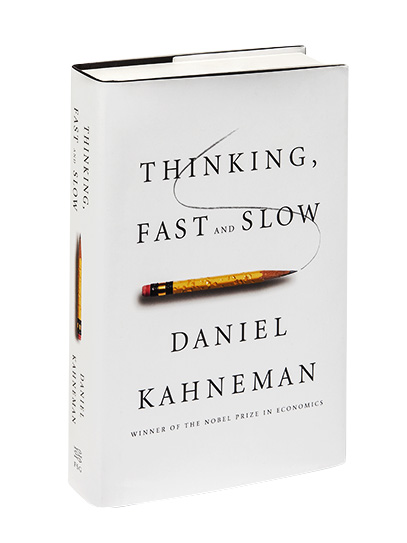
This book is amazing—it didn’t change my mind, so much as it has changed the way I think. It helps to understand the difference between the way you make quick decisions, versus considered decisions—it takes different mechanisms in the brain. Understanding which you’re doing at any given time can have a profound impact on what you ultimately decide.
—Reviewed by John Lilly, investment partner, Greylock Partners
17. The Hard Thing About Hard Things: Building a Business When There Are No Easy Answers, Ben Horowitz

I read this book at a time when Udemy was rapidly growing—over the 18 months where we went from 30 to 200 people. It was helpful to read about Horowitz’s challenges, worries, and triumphs when addressing the same types of issues at a similar stage of growth. There are so many big decisions you need to make where there’s just no clear-cut, right or wrong answer. There are a lot of gray areas. You gather information from your team, but the hard decisions rest with you. This book helped me realize that while I needed to carefully and objectively consider feedback, I was responsible for making a decision in the end—even when it was an unpopular one.
—Reviewed by Dennis Yang, CEO, Udemy
18. The Difference: How the Power of Diversity Creates Better Groups, Firms, Schools, And Societies, Scott E. Page

Page uses data to show that a diverse group of individuals often outperforms a narrow group of high-achievers, and he makes a compelling case that if you really want to lead a high-performing team, you have to be willing to accept that sometimes you’re wrong—because no matter how good you are, you can’t always be right. To be a leader who outperforms, you have to be willing to change your mind.
—Reviewed by Dr. Vivian Lee, CEO, University of Utah Health Care
A version of this article appears in the December 1, 2015 issue of Fortune with the headline “The Books That Changed My Mind.”