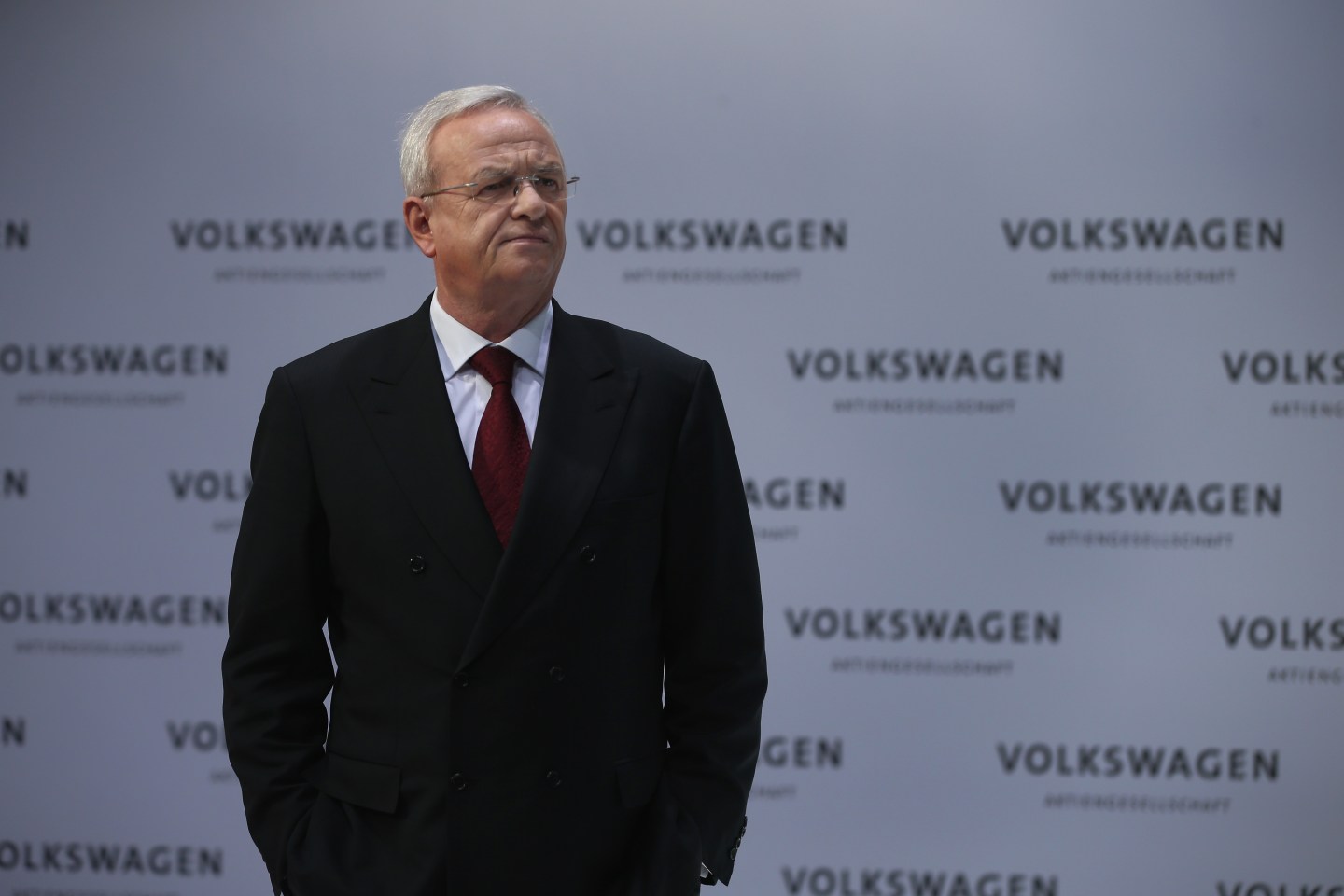
Former Volkswagen CEO Martin Winterkorn might have spared himself and his company by learning from, rather than competing with, other brands. Moreover, he may have benefited by adopting unconventional lessons from the cultures of Apple and the Navy SEALs. And the lesson is simple — success isn’t always measured by beating the competition, and it isn’t achieved by trying to do so.
Recall the pivotal moment when Steve Jobs turned Apple (AAPL) around and, in doing so, cast a comparative and contrasting light on Volkswagen’s stumble. It was 1997, and Apple was nearly bankrupt. By contrast, share prices of Microsoft (MSFT) were skyrocketing.
Steve Jobs had just returned to Apple, humbly pulled back from Pixar, to be interim CEO in an effort to reverse Apple’s downward slide toward insolvency. To do so, Jobs’ had negotiated a $150 million life-ring investment from — and “partnership” with — Microsoft, Apple’s then archrival. As Jobs began his keynote address in Boston for MacWorld and re-engaged Apple’s shareholders, the once and then interim-CEO spoke blasphemy to his audience: “We have to let go of this notion that for Apple to win Microsoft has to lose.” Astonishingly, Jobs was booed, and the heretic continued on. “So, the era of setting this up as a competition between Apple and Microsoft is over as far as I’m concerned.”
This is a stark comparison to the May 6, 2013 cover of Forbes Magazine. Winterkorn, then VW’s CEO, looks scornfully over a title that reads “Watch out GM and Toyota – VW will soon be the largest car company on the planet.” In his 2010 Annual Report, Winterkorn was clear about his chief goal: “Our pursuit of innovation and perfection and our responsible approach are designed to make us the world’s leading automaker by 2018.”
VW’s “responsible approach” is a clear reference to “clean diesel,” highlighting VW’s reliance on diesel penetration of the U.S. market as critical to their growth strategy to eclipse Toyota and GM (GM). VW’s “Strategy 2018” was perceived as ambitious when Winterkorn came on and established the goal in 2009. By 2013, following several years of above-target growth, the goal began to appear conservative. It was not only working — it was working faster than expected. By 2014, VW had surpassed GM to become #2 in global sales volume and was just shy of Toyota. VW’s overall sales growth, fueled by their strong growth in the U.S. diesel market, meant that they were poised to become #1 in 2015. Until #dieselgate.
Whereas Apple went on to become#1 after partnering with their rival and focusing inward on their own health, VW focused externally on beating their competition and stumbled just as they were achieving their goal.
As a former Navy SEAL, and in advising institutions on organizational performance, I’m often asked about the high-performance culture of military special forces. And people are often surprised when I tell them that special forces’ intense focus on competence isn’t necessarily accompanied by a preoccupation on competition. In other words, targeting the competition is not the way to become competitive. The surest way to beat the enemy is to focus inward and enter battle as high-performing as possible.
SEAL instructors often bark motivational slogans at their trainees such as “there is no I in team” and “it pays to be a winner.” Over time, this training shapes a culture whereby individual performance is valued in how it contributes to team success, and team-mindedness has a much higher premium than individual fitness. There is a subtle cultural norm that excess or reserve strength should be reinvested in helping the team, not beating teammates –strong runners and swimmers often drop back and help their slower teammates. Observers of the selection process are often perplexed when all-star athletes wash out. The trends are clear: tough-minded team players generally succeed, whereas standout super-stars need not apply.
Behavior is driven by culture and organization health. In the case of VW’s diesel engineers, their behavior dealt a devastating blow to their corporate bottom line, and it wasn’t a case of neglect, as with the BP oil spill crisis. This was deceit, a far more serious fault, and Europe is launching a criminal investigation. The company is now suffering upheaval in every dimension of its corporate health and its brand equity has been decimated. And yet, very little of the discourse is focused on the probable root case of corporate culture.
How VW (VW) cultivated such an industrial-scale faux pas will become a rich case study for the world’s business schools. Ironically, such programs are partially to blame, for they perpetuate the idea that unusually large benefits accrue to those at the top of their market, or the “best” in a given field. This norm has given rise to the convention of companies making growth — and beating the competition – their reason for being. Somehow, between grade school and business school, the emphasis on “how the game is played“ becomes “who wins or loses.“
This corporate conventional wisdom, that companies should aim to be the “best,” needs to be revisited. Even if it is true that special advantage goes to those at the top, the wrong way to go about getting there is to make that the goal. Competition is healthy in that it improves quality by fueling the engine of innovation – this effect fuels capitalist markets. However, an excess of zeal to beat one’s competitors also incentivizes cutting corners. Focusing instead on being “great” allows companies to focus inward on their own health, instead of the competition. In doing so, becoming the “best” flows as a consequence of pursuing “greatness.”
There are biological studies that highlight the unhealthy consequences of being highly competitive. Margaret Heffernan’s TED talk on “superchickens” is a trending example, in which she cites an agricultural study at Purdue University. Two flocks of chickens were maintained whereby one was normal, and the other was “selected” to create an uber-flock of “type A” attribute chickens. Over time, the uber-flock pecked itself to obliteration, and the normal flock was flourishing.
Much of the public commentary on VW has pondered whether Winterkorn had knowledge of the cheating, as if the answer matters. If VW’s high-pressure culture was the root cause of the fiasco, and if this culture was born from a corporate goal of becoming number one, then Winterkorn bears responsibility for the fiasco. So far, VW’s response has focused on cutbacks and a renewed focus on electric cars to recover from the scandal – they would do well to overhaul their corporate culture in addition to the drive train.
Deflated owners of “clean diesel” cars, deceived into believing they were green and “responsible” in buying a reasonably cheap and high-performing car, have reason to be angry. It is not unlike the revelation that an American cancer-survivor winning the Tour de France five times was too good to be true. A singular focus on winning competitions is to encourage cheating, and to sacrifice the most irrecoverable of attributes: trust. If Lance Armstrong’s path is any indication, VW has a very steep road to climb to redemption.
The corporate value of being the “best” is not only risky to the bottom line, it is also harmful to the workforce. A cut-throat workplace is harmful to society’s collective well-being — it pits employees against colleagues and pulls parents from their children. Focusing on the competition doesn’t just incentivize shortcuts — it also deprives the workforce of an opportunity to live a fuller life.
Of course this sounds un-American — Americans love competition. But our economic foundations and enthusiasm for sports need not generate a competitive way of life. America defined its greatness in opposition to, or in competition with, others for a century. This worked well in each World War, and in the Cold War. But as the world’s lone superpower, America’s path to success must be measured by our own greatness, not against what others are doing. Success is, first and foremost, the consequence of greatness — it can’t be guaranteed or sustained by short-circuiting the competition. A focus on finishing first is to risk finishing last. A focus on being great allows becoming the best to take care of itself.
Jeff Eggers is a senior fellow at New America and an independent advisor on organizational performance.