• Home
  • News
  • Fortune 500
  • Tech
  • Finance
  • Leadership
  • Lifestyle
  • Rankings
  • Multimedia
TechMarco Rubio

Marco Rubio’s Plan to Defund Highways Isn’t Quite as Crazy as it Sounds

By
David Z. Morris
David Z. Morris
Down Arrow Button Icon
By
David Z. Morris
David Z. Morris
Down Arrow Button Icon
November 13, 2015, 1:01 PM ET
Marco Rubio
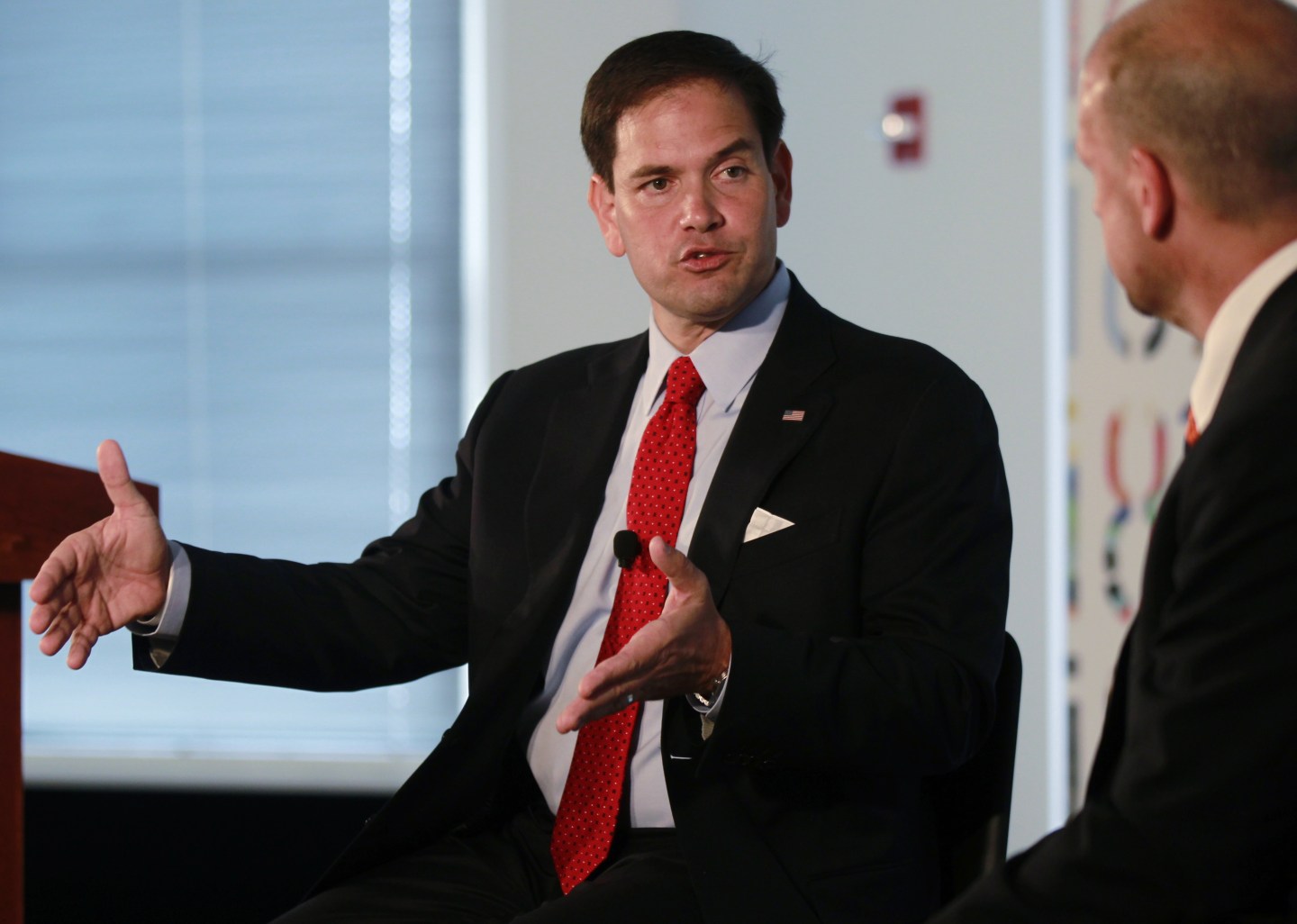
Republican presidential candidate Sen. Marco Rubio, R-Fla., speaks at 1871, an entrepreneurial hub for digital startups Tuesday, July 7, 2015, in Chicago. Rubio outlined a plan to lower corporate tax rates, loosen Internet regulation and broaden college accreditation, in his first major domestic policy speech as a presidential candidate. (AP Photo/Christian K. Lee)Photograph by Christian K. Lee — AP

Actual policy positions seem like a low priority for Republican presidential hopefuls, but Marco Rubio has been something of an exception. Along with takes on Obamacare (he’s against it), net neutrality (he’s against it), and Cuba (he’s against it), Rubio recently released his position on federal transportation funding. He’s against that, too, proposing to cut the national gasoline tax by 80%.

That might sound odd, considering that the federal Highway Trust Fund is already struggling. Even Rubio’s fellow far-right Republican James Inhofe said in July that the problems have hurt the overall economy.

But Rubio’s not simply giving up on highways—instead, he wants the states to take more responsibility for funding and management. The idea is known as “devolution,” and (unlike evolution) it has some vocal support on the right. For instance, a bill along the same lines was proposed by two Republican senators in 2013.

“The argument is that the national mission has diminished to a certain extent,” says Steven Polzin of the Center for Urban Transportation Research, in Rubio’s home state of Florida. That national mission includes the interstate highway system, which is largely complete, and a national high-speed passenger rail network, an effort that has mostly stalled.

Under the current system, Rubio and other critics claim that federal priorities trump local needs, and the money isn’t distributed equitably. One particular sticking point has been the portion of funding that goes to mass transit projects in dense areas, mostly the northeast. Rubio says he would phase out those programs.

Polzin points out two main risks for the plan. States with high interstate traffic but smaller populations, particularly in the West, could end up without enough local revenue to maintain their portions of the system.

“And there’s always the concern that some states won’t have the [political] will to do it,” says Polzin, “And the system will deteriorate.”

Many federal transportation agencies engaged in research, safety regulation, and monitoring are also funded from the gas tax Rubio proposes to cut.

Whatever its consequences, Polzin sees little chance for the plan to become reality, with or without a Rubio presidency. “It’s never had any significant constituency. There are an awful lot of vested interest groups that have a big stake in the way things are currently run.” That includes a broad swathe of highway builders.

But the reality we live with now is actually a milder version of the proposal. With no increase in the gas tax since 1993, and fuel efficiency gains further cutting revenue, states such as Oregon have increasingly pursued alternative and additional transportation funding. That has included just the sort of public-private partnerships that Rubio wants to encourage by cutting federal funding.

Rubio, though third in public polling among Republican candidates as of this week, has a strong lead in political prediction markets, and has gained some high-profile backers. The smart money seems to think (or just hope) that current frontrunners Ben Carson and Donald Trump will eventually cede the field to more traditional candidates.

For more on the Republican race:

Sign up for Data Sheet, Fortune’s daily newsletter about the business of technology.
About the Author
By David Z. Morris
See full bioRight Arrow Button Icon

Latest in Tech

AITech
IBM CEO warns there’s ‘no way’ hyperscalers like Google and Amazon will be able to turn a profit at the rate of their data center spending
By Marco Quiroz-GutierrezDecember 3, 2025
3 minutes ago
Workplace CultureBrainstorm Design
Designer Kevin Bethune: Bringing ‘disparate disciplines around the table’ is how leaders can ‘problem solve the future’
By Fortune EditorsDecember 3, 2025
14 minutes ago
AIBrainstorm Design
Microsoft AI wants all its employees to be AI-native by the end of the fiscal year, says VP of design Liz Danzico
By Angelica AngDecember 3, 2025
1 hour ago
Two men sit and smile in front of a building
Cryptostablecoins
Exclusive: Former Citadel employees raise $17 million for Fin, a global stablecoin app ‘without all the complexity’
By Carlos GarciaDecember 3, 2025
2 hours ago
CybersecuritySmall Business
Main Street’s make-or-break upgrade: Why small businesses are racing to modernize their tech
By Ashley LutzDecember 3, 2025
3 hours ago
MagazineMarkets
Why an AI bubble could mean chaos for stock markets—and how smart investors are protecting their portfolios
By Alyson ShontellDecember 3, 2025
3 hours ago

Most Popular

placeholder alt text
North America
Jeff Bezos and Lauren Sánchez Bezos commit $102.5 million to organizations combating homelessness across the U.S.: ‘This is just the beginning’
By Sydney LakeDecember 2, 2025
1 day ago
placeholder alt text
Economy
Ford workers told their CEO 'none of the young people want to work here.' So Jim Farley took a page out of the founder's playbook
By Sasha RogelbergNovember 28, 2025
5 days ago
placeholder alt text
Success
Warren Buffett used to give his family $10,000 each at Christmas—but when he saw how fast they were spending it, he started buying them shares instead
By Eleanor PringleDecember 2, 2025
1 day ago
placeholder alt text
Economy
Elon Musk says he warned Trump against tariffs, which U.S. manufacturers blame for a turn to more offshoring and diminishing American factory jobs
By Sasha RogelbergDecember 2, 2025
1 day ago
placeholder alt text
North America
Anonymous $50 million donation helps cover the next 50 years of tuition for medical lab science students at University of Washington
By The Associated PressDecember 2, 2025
1 day ago
placeholder alt text
C-Suite
MacKenzie Scott's $19 billion donations have turned philanthropy on its head—why her style of giving actually works
By Sydney LakeDecember 2, 2025
1 day ago
Rankings
  • 100 Best Companies
  • Fortune 500
  • Global 500
  • Fortune 500 Europe
  • Most Powerful Women
  • Future 50
  • World’s Most Admired Companies
  • See All Rankings
Sections
  • Finance
  • Leadership
  • Success
  • Tech
  • Asia
  • Europe
  • Environment
  • Fortune Crypto
  • Health
  • Retail
  • Lifestyle
  • Politics
  • Newsletters
  • Magazine
  • Features
  • Commentary
  • Mpw
  • CEO Initiative
  • Conferences
  • Personal Finance
  • Education
Customer Support
  • Frequently Asked Questions
  • Customer Service Portal
  • Privacy Policy
  • Terms Of Use
  • Single Issues For Purchase
  • International Print
Commercial Services
  • Advertising
  • Fortune Brand Studio
  • Fortune Analytics
  • Fortune Conferences
  • Business Development
About Us
  • About Us
  • Editorial Calendar
  • Press Center
  • Work At Fortune
  • Diversity And Inclusion
  • Terms And Conditions
  • Site Map

© 2025 Fortune Media IP Limited. All Rights Reserved. Use of this site constitutes acceptance of our Terms of Use and Privacy Policy | CA Notice at Collection and Privacy Notice | Do Not Sell/Share My Personal Information
FORTUNE is a trademark of Fortune Media IP Limited, registered in the U.S. and other countries. FORTUNE may receive compensation for some links to products and services on this website. Offers may be subject to change without notice.