Because of the economic, national security, and global policy potential India presents, a rising India offers one of the most significant opportunities to advance American national interests over the next two decades. India today holds the key to its own future: if it can maintain its current growth rate, currently hovering around 7%, let alone attain sustained double digit growth, it will have the potential over the next 20 to 30 years to follow China on the path to becoming another ten trillion dollar economy.
India is at a unique moment in which the right choices could make it a more significant contributor to global gross domestic product (GDP) growth in the decades ahead, and give it the wherewithal to become a stronger strategic partner to Washington. Our new report identifies sustained high rates of growth as the most important factor for India’s global rise and calls on the U.S. government to more actively support the growth of the Indian economy.
India’s economic growth created opportunities within India, for Indian citizens and Indian companies, and for American corporations and investors as well. In the process, India’s growth created new American constituents invested in India’s success. The U.S.-India Business Council, for example, grew from an anemic 60-some members in the late 1990s to more than 200 by 2008, and around 330 today. U.S.-India bilateral trade has crossed $100 billion in goods and services—a five-fold increase from $19 billion in 2000. But to put it in a global context, that $100 billion is only around one-sixth of U.S.-China trade. This contrast, though potentially disheartening, points to the opportunity ahead.
India has long been a country of tremendous promise, but it has not yet been able to translate that potential into the global power that its leaders—across parties—hope it will someday become. Economic reform, begun in 1991, has advanced in fits and starts, but more work remains. The Indian economy is now among the world’s ten largest, but it is only one-fifth the size of China’s. India has lifted more than 130 million people out of abject poverty over the past decade, but is still home to the world’s largest number of poor due to sheer scale. India has become South Asia’s regional power, but has some distance to go before it can play a more ambitious role on the global stage.
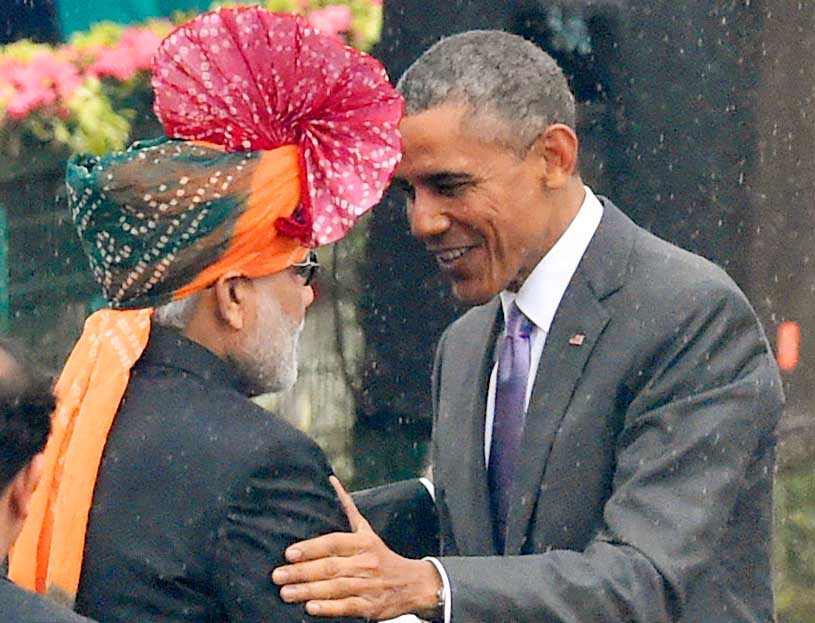
Today, however, India has a window of opportunity for significant change. Prime Minister Narendra Modi has prioritized job creation and economic growth without the baggage of welfare promises typically offered up in Indian politics. During his first 18 months in office, he has sought to revitalize Indian foreign policy, and signaled a desire for a stronger relationship with the United States.
Deepening ties will necessitate placing a higher priority on transforming the prickly economic dialogue between Washington and New Delhi—just as the civil nuclear deal transformed strategic ties over the past decade. Washington will need to shift gears in the way it approaches trade and other economic matters with India.
First and foremost, the United States should be much more ambitious in its trade and investment ties with India. India remains outside the major Asian trade initiative—the Trans-Pacific Partnership (TPP)—led by the United States. It is true India has adopted famously difficult negotiating stances in trade talks—but having no joint ambition will do little to change the status quo.
Instead of waiting for India to meet a threshold determined by the United States, Washington and New Delhi should craft a roadmap together toward some larger trade commitment. That goal might be a free trade agreement or membership in a future expanded TPP; with a commitment to reach the goal at a future date, the roadmap should then specify steps both can take along the way.
Active support for Indian membership in the Asia-Pacific Economic Cooperation forum, a nonbinding organization India seeks to join, would be a good start, as would discussions about sectoral agreements such as in services. And Washington possesses important technical expertise in matters that could be helpful to India’s reforms, like bank restructuring, infrastructure financing, or vocational skills training.
Of course, India harbors ambivalence about opening its economy further, but it risks being left behind by the strengthening networks of commerce growing up around it. To that end, Indian politicians—in government as well as in opposition—should build domestic constituencies across parties for a more open, market-oriented approach, all geared toward helping the Indian economy grow. A more open India will be able to draw upon the external resources needed to develop a larger manufacturing sector, create jobs, build infrastructure, and raise more people out of poverty—all top priorities for successive Indian governments, and central to the Modi agenda.
None of this will be easy, as the recent history of U.S.-India relations illustrates, and it will certainly not be fast. But in a world in which authoritarianism poses new threats to the interests of the United States and its allies, a stronger India—the world’s largest democracy—will be of even greater importance to U.S. interests.
Charles R. Kaye is co-chief executive officer of private equity firm Warburg Pincus and former chairman of the U.S.-India Business Council. Joseph S. Nye Jr. is distinguished service professor and former dean of the Harvard Kennedy School. Both are co-chairs of the Independent Task Force on U.S.-India Relations, sponsored by the Council on Foreign Relations. Alyssa Ayres is the senior fellow for India, Pakistan, and South Asia at the Council on Foreign Relations, and is the Task Force project director.