• Home
  • Latest
  • Fortune 500
  • Finance
  • Tech
  • Leadership
  • Lifestyle
  • Rankings
  • Multimedia
LeadershipChina

US-China summit: It’s time for some cautious optimism

By
Minxin Pei
Minxin Pei
Down Arrow Button Icon
By
Minxin Pei
Minxin Pei
Down Arrow Button Icon
September 28, 2015, 12:23 PM ET
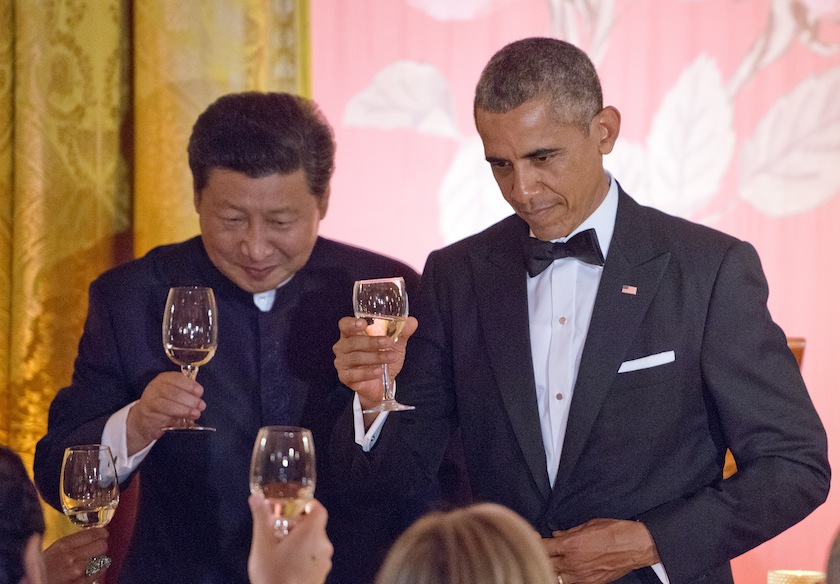
President Obama Hosts Chinese President Xi Jinping For State Visit
WASHINGTON, DC - SEPTEMBER 25: President Barack Obama and President Xi Jinping of China exchange toasts during a state dinner at the White House September 25, 2015 in Washington, DC. The two leaders will tackle a range of issues including regional tensions in Asia and cyber crimes. (Photo by Ron Sachs-Pool/Getty Images)Getty Images

For those concerned that the U.S. and China are headed toward another cold war, the just-concluded summit between Presidents Barack Obama and Xi Jinping should be greeted with enormous relief.

If nothing else, the summit has produced a much-needed pause in the downward spiral in bilateral relations in the last two years, even though the most contentious issues—cyber-attacks and the South China Sea—were not completely resolved.

For American business executives, though, it may be difficult to determine the economic significance of the U.S.-China summit. This is odd because commerce constitutes the most important pillar of the China-U.S. relationship. Indeed, Xi invested almost the same amount of time hobnobbing with leading U.S. businessmen as in talks with President Obama and American political leaders. And official Chinese media claims that 49 business deals were signed during Xi’s trip.

The trouble is, however, most of the signed agreements are relatively minor and company-specific. The most consequential agreements or plans announced at the summit are incomplete and require further negotiations. So, while the summit may have brightened U.S.-China ties economically, nothing should be taken for granted for now.

The two presidents reached a “common understanding” related to a ban on state-sponsored commercial cyber espionage. This probably was the most praiseworthy business development from Xi’s trip. If Beijing honors this commitment and puts an immediate end to its cyber intrusions targeting U.S. firms, this will remove a major source of irritation among American business leaders. However, one should not be overly optimistic. The only concrete step that will come out of this understanding is the establishment of two groups, one of experts and the other of senior officials, to turn this agreement into action. Complex negotiations over definitions and verification protocols lie ahead. The working groups will need to come up with a clear distinction between civilian and military business activities carried out by U.S. companies. For Beijing, hacking into any firm that receives contracts from the Pentagon is legitimate national security espionage, but not commercial espionage. Since the U.S. also conducts cyber espionage activities against China, breaching the computer systems of large state-owned enterprises, such as ChinaMobile and Baosteel, is also justifiable national security espionage.

With its focus almost exclusively on commercial cyber espionage, the media may have overlooked the most significant economic deal for which Xi’s visit has injected new momentum —a U.S.-China bilateral investment treaty (BIT). The two countries have been negotiating a BIT for years but an agreement proved elusive. With its struggling economy, Beijing now regards a U.S.-China deal on BIT as a top priority. Chinese leaders think a BIT will signal American confidence in their economy, and American supporters argue that it will make the Chinese market more accessible to U.S. firms. But there are serious obstacles ahead. Most importantly, both sides have yet to agree on sectors in which investments will not be allowed. Even though Chinese and U.S. negotiators have recently exchanged the so-called “negative lists” naming these off-limits industries, the two sides are far apart. At the summit, Obama and Xi reiterated that a “high-quality” BIT will be the most important item on the bilateral economic agenda. But with only 15 months left in office, time is fast running out for Obama to close such a deal.

The unilateral announcement by Xi that China will launch a cap-and-trade system to limit greenhouse gas emissions is arguably the most consequential outcome of the summit. Coupled with a joint U.S.-China statement on climate change, Xi’s move will help build positive momentum for the Paris climate conference in December this year. It will also make a more compelling political case for taking aggressive action on climate change in the U.S., which invented the cap-and-trade concept but has resisted adopting such a system to cut greenhouse gas emissions. Opponents to climate change policies have insisted that the U.S. should not make any concessions unless China, the world’s largest greenhouse gas emitter, moves first. Xi’s surprise announcement has undercut their position.

But, as with other Chinese commitments made at the summit, Xi’s declaration that such a system will start operating in 2017 does not guarantee its effective implementation. Beijing has released no details about the system. Given its lack of transparency, China has a steep hill to climb in making a cap-and-trade system work and subsequently shame the American political establishment into action on climate change.

Despite the uncertainties surrounding cyber espionage, a U.S.-China BIT, and climate change policies in both countries, we must give pledges of cooperation made by China at the Washington summit the benefit of the doubt. Adversarial dynamics have driven bilateral relations to their lowest point in the post-Cold War era, so any efforts to prevent a U.S.-China conflict deserve applause.

Minxin Pei is the Tom and Margot Pritzker ’72 Professor of Government and a non-resident senior fellow of the German Marshall Fund of the United States


About the Author
By Minxin Pei
See full bioRight Arrow Button Icon

Latest in Leadership

Finance
Lorem ipsum dolor sit amet, consectetur adipiscing elit, sed do eiusmod tempor incididunt ut labore et dolore magna aliqua. Ut enim ad minim veniam
By Fortune Editors
October 20, 2025
Finance
Lorem ipsum dolor sit amet, consectetur adipiscing elit, sed do eiusmod tempor incididunt ut labore et dolore magna aliqua. Ut enim ad minim veniam
By Fortune Editors
October 20, 2025
Finance
Lorem ipsum dolor sit amet, consectetur adipiscing elit, sed do eiusmod tempor incididunt ut labore et dolore magna aliqua. Ut enim ad minim veniam
By Fortune Editors
October 20, 2025
Finance
Lorem ipsum dolor sit amet, consectetur adipiscing elit, sed do eiusmod tempor incididunt ut labore et dolore magna aliqua. Ut enim ad minim veniam
By Fortune Editors
October 20, 2025
Finance
Lorem ipsum dolor sit amet, consectetur adipiscing elit, sed do eiusmod tempor incididunt ut labore et dolore magna aliqua. Ut enim ad minim veniam
By Fortune Editors
October 20, 2025
Finance
Lorem ipsum dolor sit amet, consectetur adipiscing elit, sed do eiusmod tempor incididunt ut labore et dolore magna aliqua. Ut enim ad minim veniam
By Fortune Editors
October 20, 2025

Most Popular

Finance
Lorem ipsum dolor sit amet, consectetur adipiscing elit, sed do eiusmod tempor incididunt ut labore et dolore magna aliqua. Ut enim ad minim veniam
By Fortune Editors
October 20, 2025
Finance
Lorem ipsum dolor sit amet, consectetur adipiscing elit, sed do eiusmod tempor incididunt ut labore et dolore magna aliqua. Ut enim ad minim veniam
By Fortune Editors
October 20, 2025
Finance
Lorem ipsum dolor sit amet, consectetur adipiscing elit, sed do eiusmod tempor incididunt ut labore et dolore magna aliqua. Ut enim ad minim veniam
By Fortune Editors
October 20, 2025
Finance
Lorem ipsum dolor sit amet, consectetur adipiscing elit, sed do eiusmod tempor incididunt ut labore et dolore magna aliqua. Ut enim ad minim veniam
By Fortune Editors
October 20, 2025
Finance
Lorem ipsum dolor sit amet, consectetur adipiscing elit, sed do eiusmod tempor incididunt ut labore et dolore magna aliqua. Ut enim ad minim veniam
By Fortune Editors
October 20, 2025
Finance
Lorem ipsum dolor sit amet, consectetur adipiscing elit, sed do eiusmod tempor incididunt ut labore et dolore magna aliqua. Ut enim ad minim veniam
By Fortune Editors
October 20, 2025
Rankings
  • 100 Best Companies
  • Fortune 500
  • Global 500
  • Fortune 500 Europe
  • Most Powerful Women
  • Future 50
  • World’s Most Admired Companies
  • See All Rankings
Sections
  • Finance
  • Leadership
  • Success
  • Tech
  • Asia
  • Europe
  • Environment
  • Fortune Crypto
  • Health
  • Retail
  • Lifestyle
  • Politics
  • Newsletters
  • Magazine
  • Features
  • Commentary
  • Mpw
  • CEO Initiative
  • Conferences
  • Personal Finance
  • Education
Customer Support
  • Frequently Asked Questions
  • Customer Service Portal
  • Privacy Policy
  • Terms Of Use
  • Single Issues For Purchase
  • International Print
Commercial Services
  • Advertising
  • Fortune Brand Studio
  • Fortune Analytics
  • Fortune Conferences
  • Business Development
About Us
  • About Us
  • Editorial Calendar
  • Press Center
  • Work At Fortune
  • Diversity And Inclusion
  • Terms And Conditions
  • Site Map
  • Facebook icon
  • Twitter icon
  • LinkedIn icon
  • Instagram icon
  • Pinterest icon

Latest in Leadership

shopper
BankingFood and drink
Meat snacks have emerged as the clear winner of America’s seismic GLP-1 consumption shift, while popcorn is down bad
By Nick LichtenbergFebruary 10, 2026
58 minutes ago
C-SuiteNext to Lead
Why GM’s supply chain chief sees suppressed dissent as a business risk
By Ruth UmohFebruary 10, 2026
59 minutes ago
lutnick
PoliticsWhite House
Lutnick admits travel to Epstein island, downplays relationship
By Catherine Lucey, Matt Shirley and BloombergFebruary 10, 2026
2 hours ago
Salesforce founder and CEO Marc Benioff on stage, scowling.
AIEye on AI
AI agents from Anthropic and OpenAI aren’t killing SaaS—but incumbent software players can’t sleep easy
By Jeremy KahnFebruary 10, 2026
3 hours ago
AIthe future of work
In the workforce, AI is having the opposite effect it was supposed to, UC Berkeley researchers warn
By Marco Quiroz-GutierrezFebruary 10, 2026
3 hours ago
Photo of technicians looking at an industrial robot
Future of WorkLayoffs
‘AI-washing’ and ‘forever layoffs’: Why companies keep cutting jobs, even amid rising profits
By Claire ZillmanFebruary 10, 2026
4 hours ago

Most Popular

placeholder alt text
C-Suite
Meet Jody Allen, the billionaire owner of the Seattle Seahawks, who plans to sell the team and donate the proceeds to charity
By Jake AngeloFebruary 9, 2026
1 day ago
placeholder alt text
AI
As billionaires bail, Mark Zuckerberg doubles down on California with $50 million donation
By Sydney LakeFebruary 9, 2026
1 day ago
placeholder alt text
Economy
China might be beginning to back away from U.S. debt as investors get nervous about overexposure to American assets
By Eleanor PringleFebruary 9, 2026
1 day ago
placeholder alt text
Economy
America borrowed $43.5 billion a week in the first four months of the fiscal year, with debt interest on track to be over $1 trillion for 2026
By Eleanor PringleFebruary 10, 2026
10 hours ago
placeholder alt text
Economy
Elon Musk warns the U.S. is '1,000% going to go bankrupt' unless AI and robotics save the economy from crushing debt
By Jason MaFebruary 7, 2026
3 days ago
placeholder alt text
Personal Finance
Current price of silver as of Monday, February 9, 2026
By Joseph HostetlerFebruary 9, 2026
1 day ago

© 2026 Fortune Media IP Limited. All Rights Reserved. Use of this site constitutes acceptance of our Terms of Use and Privacy Policy | CA Notice at Collection and Privacy Notice | Do Not Sell/Share My Personal Information
FORTUNE is a trademark of Fortune Media IP Limited, registered in the U.S. and other countries. FORTUNE may receive compensation for some links to products and services on this website. Offers may be subject to change without notice.