• Home
  • Latest
  • Fortune 500
  • Finance
  • Tech
  • Leadership
  • Lifestyle
  • Rankings
  • Multimedia
Leadershipexecutive read

Three important finance books for this fall

By
Anne VanderMey
Anne VanderMey
,
Clifton Leaf
Clifton Leaf
and
Matthew Heimer
Matthew Heimer
Down Arrow Button Icon
By
Anne VanderMey
Anne VanderMey
,
Clifton Leaf
Clifton Leaf
and
Matthew Heimer
Matthew Heimer
Down Arrow Button Icon
September 27, 2015, 10:00 AM ET
Michael Chini

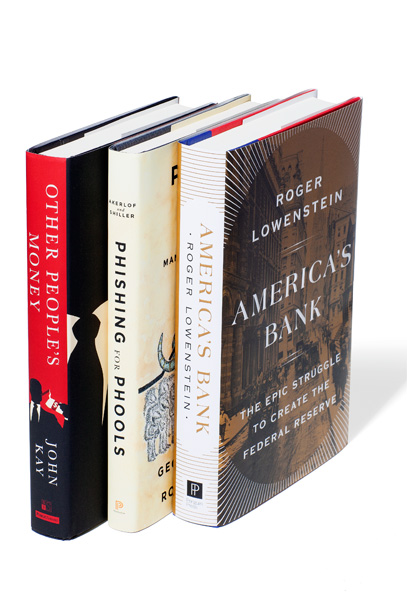
Other People’s Money
By John Kay

Kay doesn’t care what the markets think. “Any notion that traders have interesting insights into the formation of economic policy is quickly dispelled by the slightest contact with them,” the U.K. economist writes in a typically droll paragraph in his devastating new book about the world financial system. The problem, Kay says, is that the industry represents a huge segment of the world economy, and yet its actual contributions to it are impossible to discern, thanks to a mind-boggling complexity that fosters instability and too often ignores the actual customers (you know, those “other people”). The solution, he argues, is not increased regulation, already too voluminous, but a rethinking of the entire financial order. With a flair for metaphor, Kay’s occasionally academic prose is well worth the time. Wall Street, it’s safe to say, will not like it.

Phishing for Phools
By George A. Akerlof and Robert J. Shiller

The protagonist in the latest book from Nobel Prize-winning economists Akerlof and Shiller is a fundamentally good, endlessly engaging idea-generating machine. The character is also a treacherous and, at times, cruel huckster—the evidence of which grows with each passing page. This flawed hero is the free-market economy, and in this slim, readable volume, the authors make it come frighteningly alive. Building on rather traditional economic theory and behavioral finance, Akerlof and Shiller show how the same market forces that create opportunity also provide an opening (and incentive) for duplicity and fraud. And, it seems, most of us are only too willing to bite at the myriad schemes and bad deals being phished to us—from overhyped stocks to dangerous drugs to slippery politicians. No question, Phishing for Phools is a radical book. It may also be a radically important one.

America’s Bank: The Epic Struggle To Create the Federal Reserve
By Roger Lowenstein

We’re all Fed watchers today, nervously eyeing Janet Yellen & Co. as they manipulate interest rates to shepherd the economy. So it’s bracing to be reminded that before 1913 the U.S. didn’t have a Federal Reserve—or a unified banking system or even a uniform currency—and that consequently America was a global laggard, subject to constant economic panics that crippled businesses and farms. Depicting the effort to create a central bank, Fortune contributor Lowenstein tells a gripping tale with a trove of vivid characters and period details; you can almost see the handlebar mustaches and smell the oyster stuffing. And the broader cultural conflicts he describes—-distrust of centralized authority, tension between Main Street and Wall Street—are just as relevant now as they were in the era of Taft, Teddy, and Woodrow Wilson.

A version of this article appears in the October 1, 2015 issue of Fortune magazine.

About the Authors
By Anne VanderMey
See full bioRight Arrow Button Icon
By Clifton Leaf
See full bioRight Arrow Button Icon
Matthew Heimer
By Matthew HeimerExecutive Editor, Features
Instagram iconTwitter icon

Matt Heimer oversees Fortune's longform storytelling in digital and print and is the editorial coordinator of Fortune magazine. He is also a co-chair of the Fortune Global Forum and the lead editor of Fortune's annual Change the World list.

See full bioRight Arrow Button Icon

Latest in Leadership

Nicholas Thompson
C-SuiteBook Excerpt
I took over one of the most prestigious media firms while training for an ultramarathon. Here’s what I learned becoming CEO of The Atlantic
By Nicholas ThompsonDecember 13, 2025
20 hours ago
Lauren Antonoff
SuccessCareers
Once a college dropout, this CEO went back to school at 52—but she still says the Gen Zers who will succeed are those who ‘forge their own path’
By Preston ForeDecember 13, 2025
21 hours ago
Asiathe future of work
The CEO of one of Asia’s largest co-working space providers says his business has more in common with hotels
By Angelica AngDecember 12, 2025
1 day ago
Donald Trump
HealthHealth Insurance
‘Tragedy in the making’: Top healthcare exec on why insurance will spike to subsidize a tax cut to millionaires and billionaires
By Nick LichtenbergDecember 12, 2025
1 day ago
three men in suits, one gesturing
AIBrainstorm AI
The fastest athletes in the world can botch a baton pass if trust isn’t there—and the same is true of AI, Blackbaud exec says
By Amanda GerutDecember 12, 2025
2 days ago
Brainstorm AI panel
AIBrainstorm AI
Creative workers won’t be replaced by AI—but their roles will change to become ‘directors’ managing AI agents, executives say
By Beatrice NolanDecember 12, 2025
2 days ago

Most Popular

placeholder alt text
Success
Apple cofounder Ronald Wayne sold his 10% stake for $800 in 1976—today it’d be worth up to $400 billion
By Preston ForeDecember 12, 2025
2 days ago
placeholder alt text
Economy
Tariffs are taxes and they were used to finance the federal government until the 1913 income tax. A top economist breaks it down
By Kent JonesDecember 12, 2025
2 days ago
placeholder alt text
Success
40% of Stanford undergrads receive disability accommodations—but it’s become a college-wide phenomenon as Gen Z try to succeed in the current climate
By Preston ForeDecember 12, 2025
2 days ago
placeholder alt text
Economy
The Fed just ‘Trump-proofed’ itself with a unanimous move to preempt a potential leadership shake-up
By Jason MaDecember 12, 2025
1 day ago
placeholder alt text
Success
Apple CEO Tim Cook out-earns the average American’s salary in just 7 hours—to put that into context, he could buy a new $439,000 home in just 2 days
By Emma BurleighDecember 12, 2025
2 days ago
placeholder alt text
Economy
For the first time since Trump’s tariff rollout, import tax revenue has fallen, threatening his lofty plans to slash the $38 trillion national debt
By Sasha RogelbergDecember 12, 2025
1 day ago
Rankings
  • 100 Best Companies
  • Fortune 500
  • Global 500
  • Fortune 500 Europe
  • Most Powerful Women
  • Future 50
  • World’s Most Admired Companies
  • See All Rankings
Sections
  • Finance
  • Leadership
  • Success
  • Tech
  • Asia
  • Europe
  • Environment
  • Fortune Crypto
  • Health
  • Retail
  • Lifestyle
  • Politics
  • Newsletters
  • Magazine
  • Features
  • Commentary
  • Mpw
  • CEO Initiative
  • Conferences
  • Personal Finance
  • Education
Customer Support
  • Frequently Asked Questions
  • Customer Service Portal
  • Privacy Policy
  • Terms Of Use
  • Single Issues For Purchase
  • International Print
Commercial Services
  • Advertising
  • Fortune Brand Studio
  • Fortune Analytics
  • Fortune Conferences
  • Business Development
About Us
  • About Us
  • Editorial Calendar
  • Press Center
  • Work At Fortune
  • Diversity And Inclusion
  • Terms And Conditions
  • Site Map

© 2025 Fortune Media IP Limited. All Rights Reserved. Use of this site constitutes acceptance of our Terms of Use and Privacy Policy | CA Notice at Collection and Privacy Notice | Do Not Sell/Share My Personal Information
FORTUNE is a trademark of Fortune Media IP Limited, registered in the U.S. and other countries. FORTUNE may receive compensation for some links to products and services on this website. Offers may be subject to change without notice.