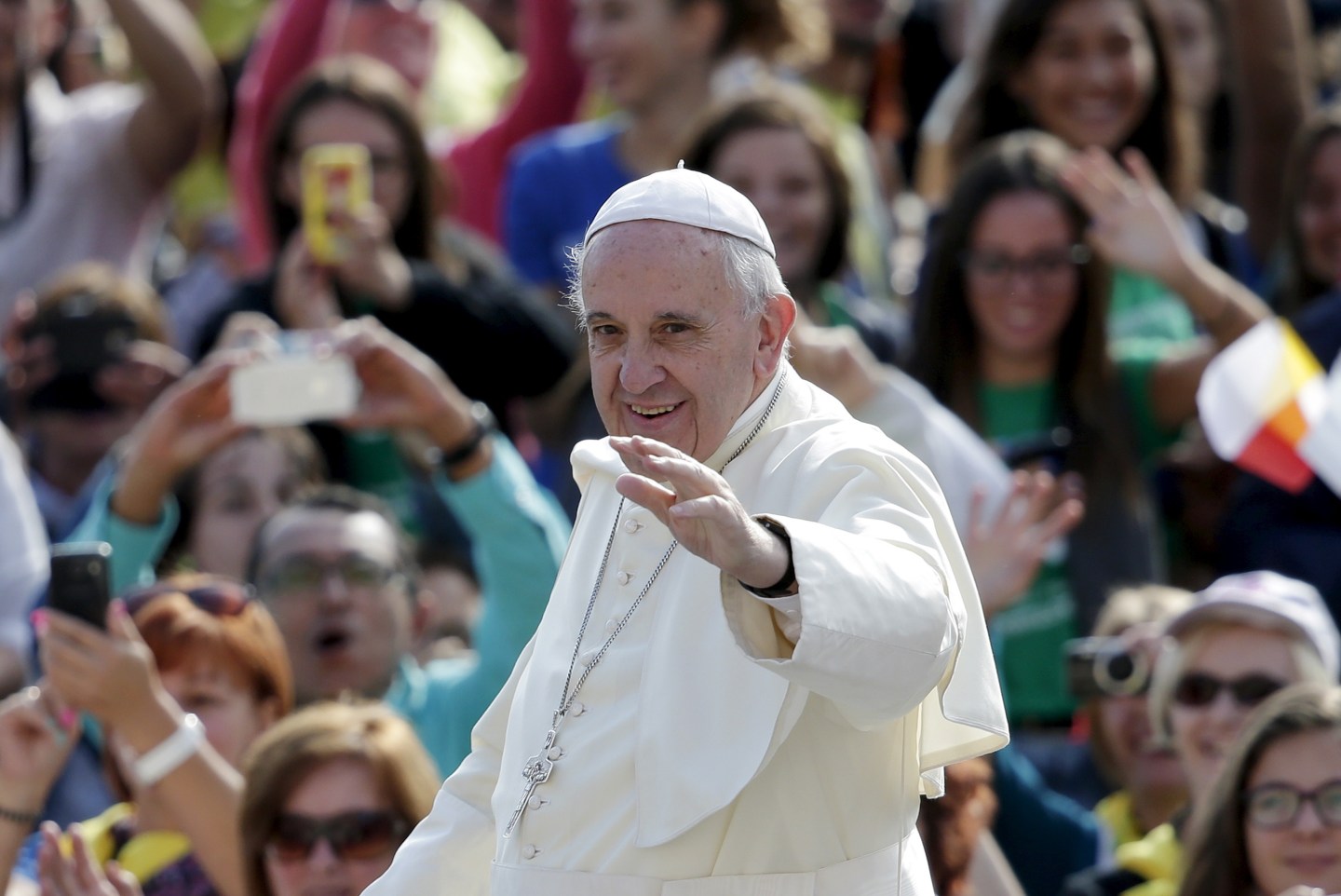
Pope Francis has famously described the unrestrained pursuit of profit as “the dung of the devil’;” “a new tyranny” He also noted that, money must serve, not rule.
When he arrives in the United States this week, there’s no doubt that we’ll hear more criticism of market economics and economies. But where’s Pope Francis coming from when he speaks so strongly against capitalism?
And what is he saying, really?
In my view, Pope Francis is not as radical as some might expect. But he’s also more radical than what many might imagine.
The first things to remember about Pope Francis are that he’s from Latin America, he’s Argentinian, and he’s a member of the Society of Jesus.
Not only is Francis familiar with Latin America’s colonial history, he’s seen first hand the great gap that exists between the rich and poor in many Latin American countries. As an Argentinian, Pope Francis remembers well the Argentine “great depression” of 1998-2003 that saw widespread unemployment and riots in the streets as the peso collapsed and Argentina defaulted on its debt. As a Jesuit, Francis has been formed by a religious order that is often on the cutting edge of Catholic responses to pressing social problems. Not all Jesuits are radical, of course, but there always has been a strong tradition of social activism in Jesuit circles.
But when stepping back a bit, and seeing Pope Francis approach to capitalism as a whole, it’s clear that the Pontiff is emphasizing standard, even conventional, Christian themes.
Pope Francis’s main criticisms of capitalism come under two headings: exclusion and idolatry.
One of his major concerns is that contemporary capitalist systems create an “economy of exclusion.” By this he means that full participation in capitalism is often limited to the few—and so only a small minority can enjoy its benefits. For evidence of this, one need look no further than the widespread inequality in many “developed” countries.
But Pope Francis also goes further and calls profit-making “idolatry.” Idolatry, simply put, is setting up something—or someone —other than God as God. The prime image of this in the Judeo-Christian tradition is the golden calf worshipped by Israelites, as told in the book of Exodus.
Setting up money, or wealth, as the ultimate good inevitably deforms our relationship with God and with one other, Pope Francis would argue. The pope has called capitalism a “faceless economy” that directs people to devote themselves to the project of capital accumulation and not the dignity of human persons.
As an alternative to a worldview based upon profit, Pope Francis argues for economies based upon solidarity and care for creation. Solidarity within the Catholic tradition refers to the idea that “all are responsible for all” and that we have a positive obligation to seek the common good, not just what benefits us as individuals. In his most recent encyclical, Laudato Si’ [http://w2.vatican.va/content/francesco/en/encyclicals/documents/papa-francesco_20150524_enciclica-laudato-si.html], Pope Francis has argued that we must work in harmony with the natural world as opposed to exploiting it and extracting its resources for profit.
None of what Pope Francis has said departs from broad themes established in Catholic social teaching. And his two predecessors, Benedict XVI and John Paul II made similar points, albeit not in media-ready sound bites.
So, in that sense, Pope Francis is not a socialist or communist—he’s simply being Catholic.
It is true, however, that Pope John Paul II had a more favorable view of the market than Pope Francis does. And in some Catholic circles, Pope Francis has been heavily criticized for not appreciating how capitalism does indeed metaphorically “raise all boats” by making the water level higher. If critics have labeled Pope Francis as naïve or simplistic in his economic thinking, the Pontiff has lambasted visions of “trickle down economic” growth as being truly naïve, especially considering the reality of human sinfulness.
It’s one thing to take Pope Francis conventional Christian criticism of money as a useful talking point—the kind I might use to playfully chide my college friends who now work in the financial sector.
It’s quite another thing to take what Pope Francis says seriously, because the implications are truly radical—for all of us.
It’s a little too easy to take what Pope Francis says and condemn the usual suspects: investment bankers, venture capitalists, and hedge fund managers. Instead, Pope Francis is drawing attention to how many of us in the developed world—from Asia through Europe to North and South America—are privileged in ways that we often do not realize.
In coming to the United States, Pope Francis is going to ask all of us to recognize the suffering of millions of people we don’t see—people we don’t see because they are hidden from us, or because we quickly look away.
Then Pope Francis will ask us Americans—individually and collectively—to take a hard look in the mirror and to be honest about what we see.
Mathew N. Schmalz is an associate professor of religious studies at The College of the Holy Cross.