• Home
  • News
  • Fortune 500
  • Tech
  • Finance
  • Leadership
  • Lifestyle
  • Rankings
  • Multimedia
FinanceFederal Reserve

Has the Fed lost control of the economy?

By
Chris Matthews
Chris Matthews
Down Arrow Button Icon
By
Chris Matthews
Chris Matthews
Down Arrow Button Icon
September 16, 2015, 5:00 AM ET
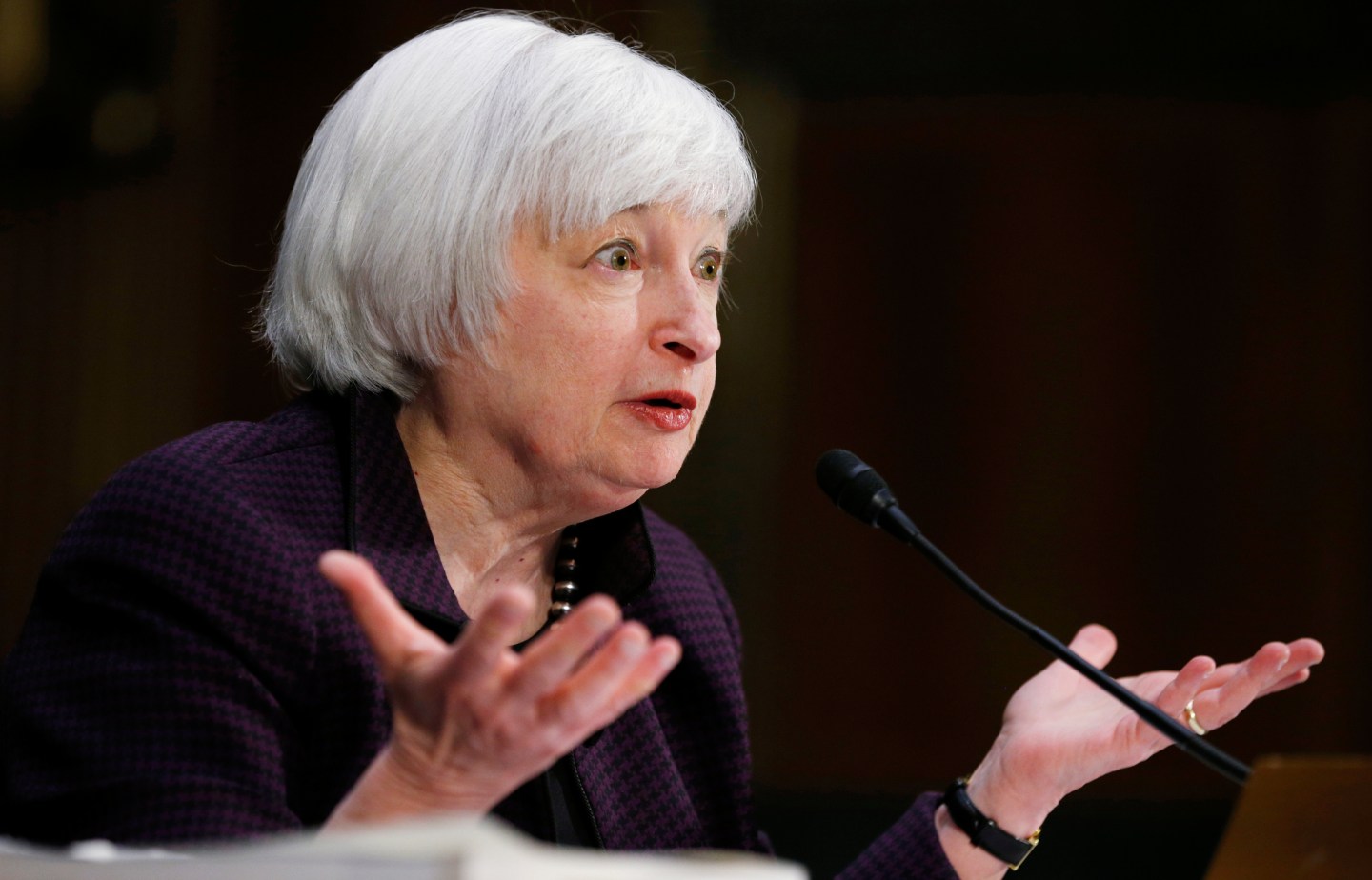
Janet Yellen testifies on Capitol Hill in Washington
Federal Reserve Chair Janet Yellen testifies at a Senate Banking, Housing and Urban Affairs Committee hearing on "Semiannual Monetary Policy Report to Congress" on Capitol Hill in Washington, February 24, 2015. World shares held near record highs on Tuesday after Greece produced a list of proposed economic reforms, and the dollar rose on expectations Federal Reserve chair Janet Yellen would signal the Fed was still moving towards raising interest rates. REUTERS/Kevin Lamarque (UNITED STATES - Tags: POLITICS BUSINESS) - RTR4QZ9EPhotograph by Kevin Lamarque — Reuters

Thursday’s meeting of the Federal Open Market Committee (FOMC), the body within the Federal Reserve that sets monetary policy, is the most anticipated in at least seven years.

For months now, Fed officials have been hinting to the public that economic conditions have improved to the point that the economy can handle a small increase in interest rates, and that a small increase will be needed to prevent inflation from rising to harmful levels.

But recent data coming out of China and stock market declines across the globe have called into question just how strong the global economy is. Analysts are even wondering whether the Federal Reserve has the capacity to guide interest rates slowly upwards, or even set rates where it wants them.

On his blog Tuesday, former Treasury Secretary Larry Summers argued that the Fed shouldn’t raise rates because it would come as a shock to financial markets. He writes:

Monetary policy should seek to avoid major surprises. Right now the fed funds futures market is assigning only a 28 percent chance to a September tightening. In the last 20 years, the Fed has never tightened without guiding the futures market to at least a 70 percent chance of a tightening. So a move now, given how expectations have been managed, would be an extraordinary shock at a highly uncertain time.

The last time the Fed moved to raise rates when the markets weren’t prepared for the move was back in 1994. Fortune called the subsequent market hysteria the Bond Market Massacre. As Summers describes it, “Over the ensuing nine months, the interest rate on the 10-year bond rose by 2.2 percentage points — nearly twice as big an increase as any subsequently — with mortgage rates rising in tandem. Volatility spiked dramatically across the world, and Orange County, CA, had the then-largest municipal bankruptcy in U.S. history. Mexico and Argentina moved towards financial crisis.”

In other words, the Fed can’t simply raise rates unless it’s laid the groundwork through effective communication of it’s intentions, and in recent weeks, it has not done that.

Another reason the Fed might not be able to raise rates is that the economic situation of the United States will simply not justify a federal funds rate above near-zero. This is the implication of a recent article in the Wall Street Journal, which showed that more than a dozen central banks have tried raising rates in the past, only to be forced to lower them again as the economies they were supposed to be managing tanked.

This gets at the central question of whether the Fed should raise rates. Traditional measures of an accelerating recovery, like a falling unemployment rate, say that the answer is yes. But there is also reason to believe that, post-crisis, the new rate of “full employment” is much lower than it used to be. Others argue that fears of rising inflation are overstated, and weakness abroad makes deflation the bigger risk.

Finally, there is the question of whether the Fed has the technical tools to force interest rates to rise. In normal times, the Fed would control rates by adding or subtracting “reserves” to the banking system. If it wanted to raise rates, it would sell Treasury bills to banks in exchange for these reserves. But after years of quantitative easing, the system has been flooded by reserves, and therefore it must use new and untested tools, like adjusting the interest rates it pays on reserves kept at the bank, or using reverse repo agreements, whereby it sells bonds to a counter party with an agreement to repurchase that same security at a specified price at a specific time in the future. This will, theoretically, enable the Fed to set an interest rate floor, because promise to repurchase a bond the next day at a high enough price will be like setting an overnight interest rate, and be a transaction that bondholders can’t afford to forgo.

Nonetheless, these methods are untested. Janet Yellen is often referred to as the most powerful woman in the global economy, but not even she can override the will of global markets. We may see Thursday just how far her power extends.


About the Author
By Chris Matthews
See full bioRight Arrow Button Icon

Latest in Finance

Scott Bessent speaks with Andrew Ross Roskin at Dealbook Summit
LawTariffs
Treasury Secretary Bessent insists Trump’s tariff agenda is ‘permanent,’ saying the White House can recreate it even with a Supreme Court loss
By Marco Quiroz-GutierrezDecember 5, 2025
24 minutes ago
C-SuiteFortune 500 CEO Interview
Bristol Myers Squibb CEO Chris Boerner says company culture was the missing piece of his ‘patent cliff’ plan
By Diane BradyDecember 5, 2025
1 hour ago
Four years ago, BKV started buying up the two Temple power plants in Texas—located between Austin and Dallas—which now total 1.5 gigawatts of electricity generation capacity—enough to power more than 1.1 million homes, or a major data center campus. There is room to expand.
Energypower
How a Texas gas producer plans to exploit the ‘mega trend’ of power plants for AI hyperscalers
By Jordan BlumDecember 5, 2025
3 hours ago
Personal Financemortgages
Current mortgage rates report for Dec. 5, 2025: Rates remain relatively stable
By Glen Luke FlanaganDecember 5, 2025
3 hours ago
Personal FinanceReal Estate
Current ARM mortgage rates report for Dec. 5, 2025
By Glen Luke FlanaganDecember 5, 2025
3 hours ago
Personal FinanceReal Estate
Current refi mortgage rates report for Dec. 5, 2025
By Glen Luke FlanaganDecember 5, 2025
3 hours ago

Most Popular

placeholder alt text
Economy
Two months into the new fiscal year and the U.S. government is already spending more than $10 billion a week servicing national debt
By Eleanor PringleDecember 4, 2025
24 hours ago
placeholder alt text
Success
‘Godfather of AI’ says Bill Gates and Elon Musk are right about the future of work—but he predicts mass unemployment is on its way
By Preston ForeDecember 4, 2025
19 hours ago
placeholder alt text
Success
Nvidia CEO Jensen Huang admits he works 7 days a week, including holidays, in a constant 'state of anxiety' out of fear of going bankrupt
By Jessica CoacciDecember 4, 2025
19 hours ago
placeholder alt text
Success
Nearly 4 million new manufacturing jobs are coming to America as boomers retire—but it's the one trade job Gen Z doesn't want
By Emma BurleighDecember 4, 2025
20 hours ago
placeholder alt text
North America
Jeff Bezos and Lauren Sánchez Bezos commit $102.5 million to organizations combating homelessness across the U.S.: ‘This is just the beginning’
By Sydney LakeDecember 2, 2025
3 days ago
placeholder alt text
Health
Bill Gates decries ‘significant reversal in child deaths’ as nearly 5 million kids will die before they turn 5 this year
By Nick LichtenbergDecember 4, 2025
1 day ago
Rankings
  • 100 Best Companies
  • Fortune 500
  • Global 500
  • Fortune 500 Europe
  • Most Powerful Women
  • Future 50
  • World’s Most Admired Companies
  • See All Rankings
Sections
  • Finance
  • Leadership
  • Success
  • Tech
  • Asia
  • Europe
  • Environment
  • Fortune Crypto
  • Health
  • Retail
  • Lifestyle
  • Politics
  • Newsletters
  • Magazine
  • Features
  • Commentary
  • Mpw
  • CEO Initiative
  • Conferences
  • Personal Finance
  • Education
Customer Support
  • Frequently Asked Questions
  • Customer Service Portal
  • Privacy Policy
  • Terms Of Use
  • Single Issues For Purchase
  • International Print
Commercial Services
  • Advertising
  • Fortune Brand Studio
  • Fortune Analytics
  • Fortune Conferences
  • Business Development
About Us
  • About Us
  • Editorial Calendar
  • Press Center
  • Work At Fortune
  • Diversity And Inclusion
  • Terms And Conditions
  • Site Map

© 2025 Fortune Media IP Limited. All Rights Reserved. Use of this site constitutes acceptance of our Terms of Use and Privacy Policy | CA Notice at Collection and Privacy Notice | Do Not Sell/Share My Personal Information
FORTUNE is a trademark of Fortune Media IP Limited, registered in the U.S. and other countries. FORTUNE may receive compensation for some links to products and services on this website. Offers may be subject to change without notice.