A bit past the welcome banner for Walt Disney World, there’s a part of the theme park expanse where tourists never tread. It’s reserved for the 100 tons—eight to 10 truckloads’ worth—of uneaten food delivered here daily from around the 40-plus-square-mile property and beyond. The site is far enough from the likes of Splash Mountain and the Cinderella Castle to keep the aroma of rotting lettuce and onions from disrupting the magic of the Magic Kingdom.
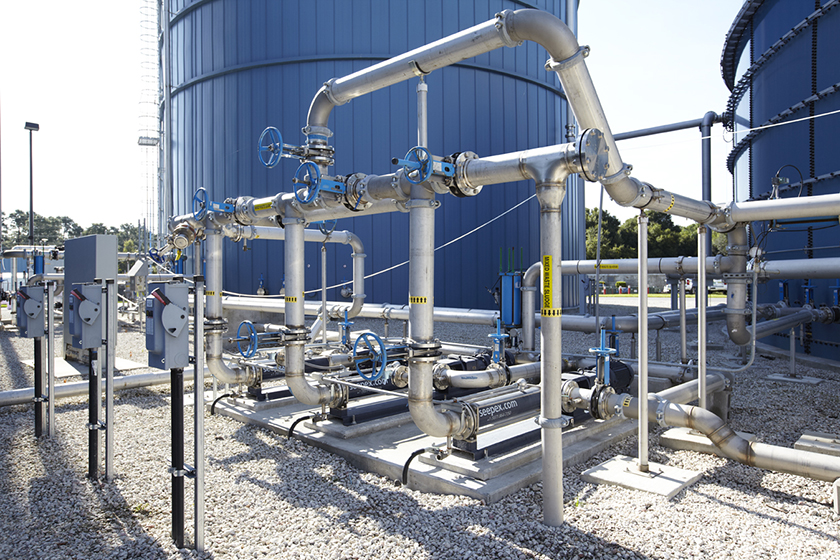
To Kathleen Ligocki (Most Innovative Women in Food and Drink, No. 2) the pungent odor smells like money. Ligocki, 59, is the CEO of Harvest Power, a $145-million-revenue startup that turns food waste into fuel. Here at the company’s Energy Garden in Orlando, Harvest has constructed an anaerobic digester (with two massive domed tanks) whose processes emulate those in a cow’s stomach. “It’s biomimicry,” Ligocki says, “but more efficient.”

The digesters use microbes to break down a mixture of 20% food waste; 20% fats, oils, and grease; and 60% treated sewage (euphemistically called biosolids) from Disney’s (DIS) nearby wastewater treatment plant. “When you add food waste to biosolids, it’s like crack—biogas crack,” Ligocki says. “You just produce a lot more energy.” After 26 to 28 days in the digester tanks, the resulting biogas—enough to power 3,000 homes for a year—is captured and sold back to Disney.
Till now, food has largely escaped the recycling revolution that has taken plastics, glass, metals, and garden waste out of landfills. Edibles still make up 15% of municipal solid waste, with the vast majority of all consumer food trash heading straight for the dump. Food has lagged in recycling because it’s difficult to deal with—it’s wet and sticky, making it tough to separate. (Because it’s mixed with other types of waste, it can be tricky to obtain predictable quantities. Biosolids are another matter. “It’s the most secure stream there is,” Ligocki says with a laugh. “If you’re near a population, you can pretty much guarantee it. And there’s no competition.”) “Clean” food waste—say, items thrown out by supermarkets and never touched by consumers—is easier to handle but also in higher demand. Farmers want it as pig or cow feed.
Harvest Power is able to process “dirty” food waste, which is contaminated with things like plastic and silverware. Before going through Harvest’s digester tanks, food gets pushed through screens with half-inch holes to keep out foreign objects.

What we eat—or rather don’t eat—is the next frontier of recycling, and Harvest is in a unique position to capitalize. Right now the U.S. and Canada have about 30 anaerobic digesters breaking down food. Ligocki thinks hundreds more will be built in the next decade. Considering Germany alone has about 7,000, it’s hardly impossible.
Harvest’s edge comes from sitting at the intersection of three converging industries: waste, energy, and soil-related products (including organic compost and fertilizers). Each has its own distinct profit stream. Tipping fees, or the money paid to Harvest for receiving the waste, is the biggest driver. Next comes the sale of biogas, and third is the sale of organic fertilizers made from the leftovers of the digestion process. In Florida, for example, the resulting fertilizer is sold to orange growers.
Ligocki was no expert in food waste when she took the CEO job a year and a half ago. She recycled and composted at home, but that was about it. An auto-industry veteran with stints at General Motors (GM), United Technologies (UTX), and Ford (F), she became the CEO of auto parts supplier Tower (TOWR). She helped Tower get through bankruptcy before leading a T. Boone Pickens-backed fuel-efficient-vehicle startup called Next Autoworks. She then headed to Kleiner Perkins, which is an investor in Harvest. Ligocki was an observer to the Harvest board when the company started to look for a new CEO. Its founder, Paul Sellew, had led the startup through a period of rapid revenue growth, but it needed to focus on profits. “I’m a person who looks at how do you scale, not how do you one-off, but how do you create a hundred of these or 500?” Ligocki says. “That’s really the next question.”

Ligocki thinks the answer will be using the extra capacity of U.S. wastewater treatment plants—about half of which have digesters to treat biosolids. Harvest is working on such a project with East Bay Municipal Utility District in Oakland. Consider this: The Orlando facility cost about $30 million to build; had the digesters and infrastructure already been in place, it would have reduced costs by at least $10 million and sped construction.
“We think it is one of the next trends,” Ligocki says. Indeed, momentum is building. A growing number of states and cities have banned commercial food waste from landfills. And New York City’s mayor recently proposed mandating such recycling for large food enterprises, providing another catalyst. “We are at a real turning of the market,” Ligocki says. “I think food diversion will be very different in 10 years.”
To see the full Most Innovative Women in Food and Drink list, visit fortune.com/food-drink-women-innovators.
A version of this article appears in the September 15, 2015 issue of Fortune magazine with the headline “Harnessing the energy of uneaten vegetables.”