• Home
  • Latest
  • Fortune 500
  • Finance
  • Tech
  • Leadership
  • Lifestyle
  • Rankings
  • Multimedia

Trendingnow

1

Jensen Huang says ‘a lot’ of six-figure jobs in plumbing and construction will soon be unlocked because someone needs to build new AI centers

2

The labor market could become so backward that the economy will have to shed jobs to keep unemployment steady

3

Millennials say they’ll refuse to care for aging boomer parents—but they’ll be forced to as their inheritance shrinks to 40 cents on the dollar

1

Jensen Huang says ‘a lot’ of six-figure jobs in plumbing and construction will soon be unlocked because someone needs to build new AI centers

2

The labor market could become so backward that the economy will have to shed jobs to keep unemployment steady

3

Millennials say they’ll refuse to care for aging boomer parents—but they’ll be forced to as their inheritance shrinks to 40 cents on the dollar
TechFuture of Work

Will tech manufacturing stay in China?

By
David Z. Morris
David Z. Morris
Down Arrow Button Icon
By
David Z. Morris
David Z. Morris
Down Arrow Button Icon
August 27, 2015, 2:41 PM ET
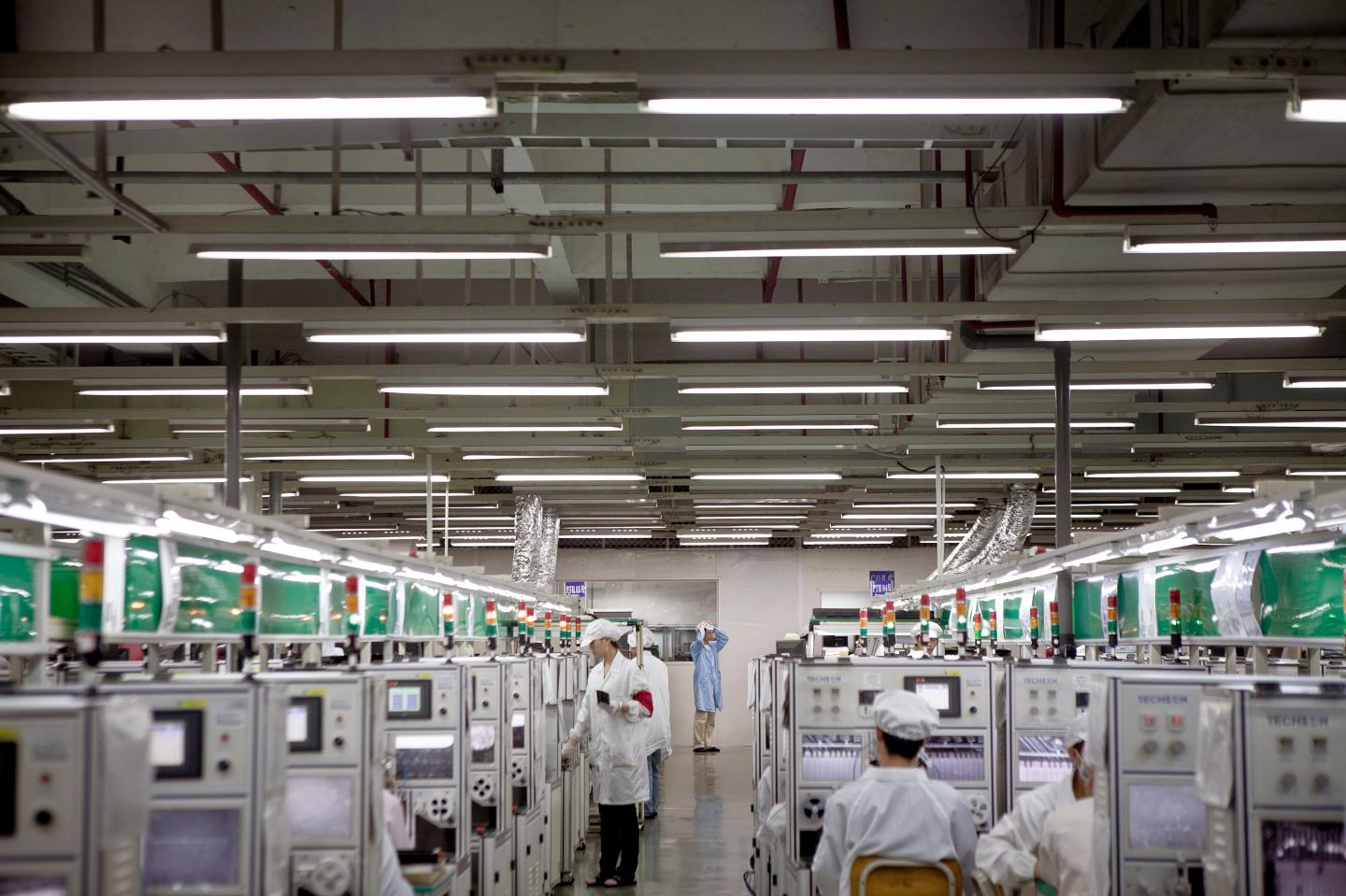
Tour Of The Foxconn Complex And Interview With CEO Terry Guo
Employees of Hon Hai Precision Industry Co. Ltd. work along a production line in the Longhua Science and Technology Park, also known as Foxconn City, in Shenzhen, China, on Saturday, Sept. 4, 2010. Foxconn Technology Group Chairman Terry Gou cut his long-term growth target for the world's largest contract manufacturer of electronics by 50 percent as demand for Apple Inc. iPhones and iPads fails to offset slowing computer sales. Photographer: Thomas Lee/Bloomberg via Getty ImagesPhotograph by Thomas Lee — Bloomberg via Getty Images
Add Fortune on Google for similar content.

In the past few weeks, the world has been clearly alerted to the many ills of the Chinese economy. But China watchers have been eyeing one worrisome strain for years—labor. The low labor costs that fueled Chinese growth have more than quadrupled since 2006, and labor unrest has also been growing.

That has led some manufacturers, following the same logic that brought them to China in the first place, to move towards still-lower labor cost countries, like Bangladesh and Laos. More surprising, the Boston Consulting Group found in 2014 that more than 50% of manufacturing executives were at least considering shifting manufacturing back to the U.S., whose low-wage regions BCG projects to move within 10 to 15% of cost parity with China, while allowing for better service of the American market.

It’s widely believed that the recent devaluation of the yuan was a move to keep costs down for international producers.

“They’re trying to make sure they don’t have a mass exodus,” says Mickey North Rizza, VP at BravoSolution. “That’s only going to be controlled for so long.”

Low-cost, low-capital manufacturers, such as apparel producers, have already left China in droves, moving not just to southeast Asia, but increasingly the Middle East and Africa. Labor is a larger portion of their costs, and it’s more affordable for them to maintain high inventories to insulate against disruptions. And the move itself is a snap.

“They take some basic machinery, they put it in a shipping container, and they set up again,” explains Shay Scott, managing director of the Global Supply Chain Institute at the University of Tennessee.

Tech manufacturers, though, face a more complex calculation. Observers say that for them, the next ten years may be less about chasing cheap labor, than about diversifying sources and serving regional markets.

“If you rewind 15 or 20 years, companies were using the low labor cost to make what we have always argued were oversimplified business cases,” says Scott. “I think companies are learning from experience that there are a number of other factors that are a bit harder to quantify.”

One of those is infrastructure. Sundar Kanak of SAP’s Ariba supplier network, says that the first global companies to set up shop in China spent years dealing with shoddy roads and electrical grids.

“China has overcome some of those challenges,” says Kanak, “But at the expense of cost.”

Electricity, for instance, has become both more reliable, and more expensive, ratcheting up 15% annually for the last six years, according to Kanak. That’s a particular headache for power-hungry tech manufacturers—but not as much of a headache as the unreliable grids of less-developed countries.

Those rising wages, too, have their own counterintuitive pull. For a start, they reflect greater worker skill. And as more Chinese enter the middle class, they become consumers of the devices they’re producing. In early 2015, Apple sold more iPhones in China than in the U.S. for the first time, one more good reason to keep making them in China.

For a time, manufacturers explored splitting the difference by pushing further into inland China, where labor costs are lower—but the greater risks, Scott says, have kept that experiment from gaining serious traction. It’s a particular nonstarter in tech, where transportation risk greatly increases inventory costs.

And a chip fabrication plant isn’t as easy to relocate as an apparel factory. Moving makes the most sense when technology cycles demand major plant changes—but those cycles can be ten years long. There are also choices to be made, though, when companies expand production, and that seems to be where China is now most vulnerable.

The recent Tianjin port disaster says less about problems particular to China, than about the inherently risky nature of manufacturing too far away from the market. Rather than chasing low cost, tech manufacturers are thinking about operating regionally and keeping supply chains shorter—for instance, manufacturing North American goods in Mexico or South America.

“Some companies call it ‘best sourcing,’” says North Rizza.

But even regionalization may not be the full extent of future manufacturing shifts. Improving global communication infrastructure, including more flexible cloud-based inventory solutions, are making it easier for companies to find and integrate new sources. That’s one factor contributing to the rise of contract manufacturing, helping companies build supply chains that can change much more rapidly than ever before.

All of which may mean not only that Chinese high-tech growth is at an end, but that there will be no more regional manufacturing booms as concentrated, powerful and sustained as China’s has been.

Sign up for Data Sheet, Fortune’s daily newsletter about the business of technology.

About the Author
By David Z. Morris
See full bioRight Arrow Button Icon
Add Fortune on Google for similar content.

Latest in Tech

Finance
Lorem ipsum dolor sit amet, consectetur adipiscing elit, sed do eiusmod tempor incididunt ut labore et dolore magna aliqua. Ut enim ad minim veniam
By Fortune Editors
October 20, 2025
Finance
Lorem ipsum dolor sit amet, consectetur adipiscing elit, sed do eiusmod tempor incididunt ut labore et dolore magna aliqua. Ut enim ad minim veniam
By Fortune Editors
October 20, 2025
Finance
Lorem ipsum dolor sit amet, consectetur adipiscing elit, sed do eiusmod tempor incididunt ut labore et dolore magna aliqua. Ut enim ad minim veniam
By Fortune Editors
October 20, 2025
Finance
Lorem ipsum dolor sit amet, consectetur adipiscing elit, sed do eiusmod tempor incididunt ut labore et dolore magna aliqua. Ut enim ad minim veniam
By Fortune Editors
October 20, 2025
Finance
Lorem ipsum dolor sit amet, consectetur adipiscing elit, sed do eiusmod tempor incididunt ut labore et dolore magna aliqua. Ut enim ad minim veniam
By Fortune Editors
October 20, 2025
Finance
Lorem ipsum dolor sit amet, consectetur adipiscing elit, sed do eiusmod tempor incididunt ut labore et dolore magna aliqua. Ut enim ad minim veniam
By Fortune Editors
October 20, 2025

Most Popular

Finance
Lorem ipsum dolor sit amet, consectetur adipiscing elit, sed do eiusmod tempor incididunt ut labore et dolore magna aliqua. Ut enim ad minim veniam
By Fortune Editors
October 20, 2025
Finance
Lorem ipsum dolor sit amet, consectetur adipiscing elit, sed do eiusmod tempor incididunt ut labore et dolore magna aliqua. Ut enim ad minim veniam
By Fortune Editors
October 20, 2025
Finance
Lorem ipsum dolor sit amet, consectetur adipiscing elit, sed do eiusmod tempor incididunt ut labore et dolore magna aliqua. Ut enim ad minim veniam
By Fortune Editors
October 20, 2025
Finance
Lorem ipsum dolor sit amet, consectetur adipiscing elit, sed do eiusmod tempor incididunt ut labore et dolore magna aliqua. Ut enim ad minim veniam
By Fortune Editors
October 20, 2025
Finance
Lorem ipsum dolor sit amet, consectetur adipiscing elit, sed do eiusmod tempor incididunt ut labore et dolore magna aliqua. Ut enim ad minim veniam
By Fortune Editors
October 20, 2025
Finance
Lorem ipsum dolor sit amet, consectetur adipiscing elit, sed do eiusmod tempor incididunt ut labore et dolore magna aliqua. Ut enim ad minim veniam
By Fortune Editors
October 20, 2025
Fortune Secondary Logo
Rankings
  • 100 Best Companies
  • Fortune 500
  • Global 500
  • Fortune 500 Europe
  • Most Powerful Women
  • World's Most Admired Companies
  • See All Rankings
  • Lists Calendar
Sections
  • Finance
  • Fortune Crypto
  • Features
  • Leadership
  • Health
  • Commentary
  • Success
  • Retail
  • Mpw
  • Tech
  • Lifestyle
  • CEO Initiative
  • Asia
  • Politics
  • Conferences
  • Europe
  • Newsletters
  • Personal Finance
  • Environment
  • Magazine
  • Education
Customer Support
  • Frequently Asked Questions
  • Customer Service Portal
  • Privacy Policy
  • Terms Of Use
  • Single Issues For Purchase
  • International Print
Commercial Services
  • Advertising
  • Fortune Brand Studio
  • Fortune Analytics
  • Fortune Conferences
  • Business Development
  • Group Subscriptions
About Us
  • About Us
  • Press Center
  • Work At Fortune
  • Terms And Conditions
  • Site Map
  • About Us
  • Press Center
  • Work At Fortune
  • Terms And Conditions
  • Site Map
  • Facebook icon
  • Twitter icon
  • LinkedIn icon
  • Instagram icon
  • TikTok icon
  • YouTube icon

Latest in Tech

lp
SuccessEntrepreneurship
‘It’s really not for the faint of heart’: This 29-year-old CEO became a business owner, doubled revenue in 3 years, and learned what car not to drive
By Nick LichtenbergAugust 2, 2026
20 minutes ago
Hudson Leogrande, the founder and CEO of popular hoodie brand Comfrt
SuccessEntrepreneurs
He was homeless at 16. Now, he sits on the board of David Beckham’s wellness company and his business is about to hit $1 billion in revenue
By Emma BurleighAugust 2, 2026
50 minutes ago
SpaceX’s record IPO is helping spur a new wave of startups aiming for orbit and opening a vast new market beyond Earth
Startups & VentureAerospace
SpaceX’s record IPO is helping spur a new wave of startups aiming for orbit and opening a vast new market beyond Earth
By Marco Quiroz-GutierrezAugust 2, 2026
2 hours ago
SpaceAI could be Southeast Asia’s edge against El Niño—if governments actually use it
AsiaSatellites
SpaceAI could be Southeast Asia’s edge against El Niño—if governments actually use it
By Karryl Kim Sagun Trajano and Iuna TsyrulnevaAugust 2, 2026
7 hours ago
Amid fears of Iranian cyberattacks, Michigan joins Minnesota in reporting hackers targeted water systems. The FBI is now investigating
CybersecurityFBI
Amid fears of Iranian cyberattacks, Michigan joins Minnesota in reporting hackers targeted water systems. The FBI is now investigating
By Michael Casey and The Associated PressAugust 1, 2026
14 hours ago
Elon Musk’s fortune slumps to pre-SpaceX IPO levels after rout
Big TechWealth
Elon Musk’s fortune slumps to pre-SpaceX IPO levels after rout
By Tom Maloney and BloombergAugust 1, 2026
21 hours ago

Most Popular

Jensen Huang says ‘a lot’ of six-figure jobs in plumbing and construction will soon be unlocked because someone needs to build new AI centers
Success
Jensen Huang says ‘a lot’ of six-figure jobs in plumbing and construction will soon be unlocked because someone needs to build new AI centers
By Preston ForeAugust 1, 2026
22 hours ago
The labor market could become so backward that the economy will have to shed jobs to keep unemployment steady
Economy
The labor market could become so backward that the economy will have to shed jobs to keep unemployment steady
By Jason MaAugust 1, 2026
13 hours ago
Millennials say they’ll refuse to care for aging boomer parents—but they’ll be forced to as their inheritance shrinks to 40 cents on the dollar
Personal Finance
Millennials say they’ll refuse to care for aging boomer parents—but they’ll be forced to as their inheritance shrinks to 40 cents on the dollar
By Nick LichtenbergJuly 31, 2026
2 days ago
Jensen Huang says this is the greatest time in history to start a business—and his advice is to stop overthinking it: 'How hard can it be?’
Success
Jensen Huang says this is the greatest time in history to start a business—and his advice is to stop overthinking it: 'How hard can it be?’
By Preston ForeJuly 31, 2026
2 days ago
The rise of 'conspicuous waiting': The 19th-century economic theory that explains why Gen Z posts their place in line
Retail
The rise of 'conspicuous waiting': The 19th-century economic theory that explains why Gen Z posts their place in line
By Tatiana SatauaJuly 31, 2026
2 days ago
'Retiring backwards': How cold economic reality forced Gen X into something like the reverse of baby boomers' golden years
Success
'Retiring backwards': How cold economic reality forced Gen X into something like the reverse of baby boomers' golden years
By Nick LichtenbergJuly 31, 2026
2 days ago

© 2026 Fortune Media IP Limited. All Rights Reserved. Use of this site constitutes acceptance of our Terms of Use and Privacy Policy | CA Notice at Collection and Privacy Notice | Do Not Sell/Share My Personal Information
FORTUNE is a trademark of Fortune Media IP Limited, registered in the U.S. and other countries. FORTUNE may receive compensation for some links to products and services on this website. Offers may be subject to change without notice.