
• Home
  • Latest
  • Fortune 500
  • Finance
  • Tech
  • Leadership
  • Lifestyle
  • Rankings
  • Multimedia

Trendingnow

1

Analysts expected oil to surge above $200 but China has quietly kept prices half of that—and can’t for much longer

2

Pentagon accuses Alibaba, Baidu and BYD, three of China's biggest companies, of supporting the Chinese military

3

Marc Lore’s robots make 500 burrito bowls an hour. A human can make 45

1

Analysts expected oil to surge above $200 but China has quietly kept prices half of that—and can’t for much longer

2

Pentagon accuses Alibaba, Baidu and BYD, three of China's biggest companies, of supporting the Chinese military

3

Marc Lore’s robots make 500 burrito bowls an hour. A human can make 45

The teenage dream of owning a car is dying

By
Mark Penn
Mark Penn
Down Arrow Button Icon
By
Mark Penn
Mark Penn
Down Arrow Button Icon
July 22, 2015, 9:59 AM ET
Photograph by Muriel de Seze — Getty Images

Detroit has seen a lot of changes through the years—the rise of Japanese manufacturing, the growth of SUVs and trucks replacing the station wagon, and now the birth of the electric car. But there is one change they probably were not expecting: that people would just stop driving. That’s right—what was once the dream of every teenager—getting a driver’s license—has fallen off dramatically in the last few decades.

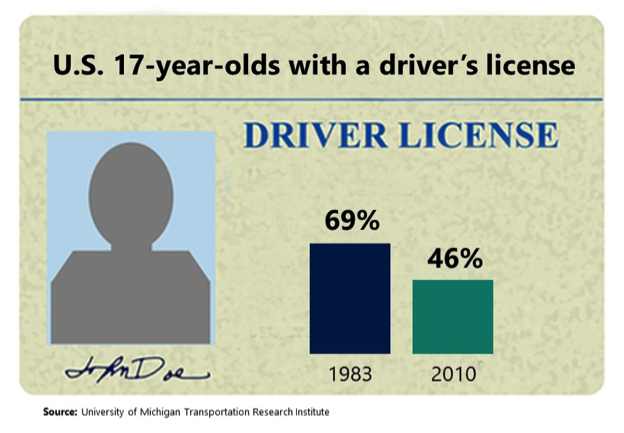
In 1983, nine in 10 19-year-olds had a license, but that number has now fallen to about two-thirds. The decline is even more severe among 17-year-olds. Just 30 years ago, nearly seven in 10 of those kids had a license; now that has dropped to less than half, 46%. And no license means no car. Not only are demographics changing so that there are fewer teenagers than ever before relative to the rest of us, fewer of them will be able to drive. On the good side, that should correspond to a significant decrease in teenage deaths from drunk driving, because they won’t even be driving.

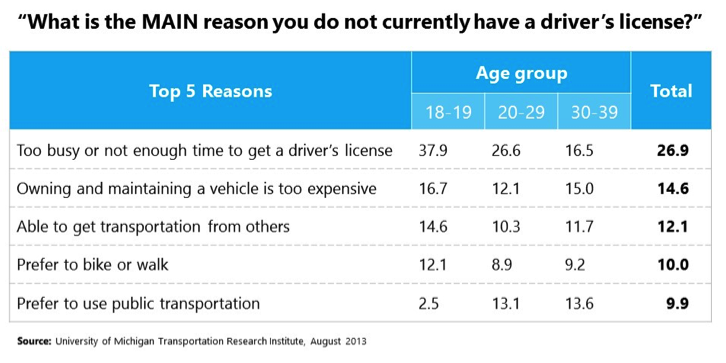
Why have teens dropped driving? According to a 2013 survey by the University of Michigan Transportation Institute, the No. 1 reason unlicensed 18- and 19-year-olds don’t have a license is “too busy or not enough time” (40%), followed by “owning and maintaining a vehicle is too expensive” (17%). The No. 3 reason is also notable: 15% say they are “able to get transportation from others.” What exactly are kids “too busy” with to get a license? It’s unlikely they are going to school or studying more, which suggests driving has just become a much lower priority because getting around doesn’t require a license anymore. First, mothers and fathers have become drivers. Today’s helicopter parents are only too willing to provide chauffeur service for kids who never leave the house alone until they are well into their teens. Second, smartphones mean other parents are more available for easy ride coordination, and of course the growth of services like Uber and Lyft lets kids call a car and charge it to their folks.
teens-drivers-license

The shift during this period from rural areas to the suburbs and cities also made driving less of a necessity and more of a luxury. Between 1980 and 2010, the rural population of America went from 26% to 19%, suggesting that many young people went from outlying areas to college and then to cities where cars are prohibitively expensive. In 2011, for the first time in almost a century, the rate of urban population growth outpaced suburban population growth. Millennials in particular are staying single longer and having smaller families, making urban living—with all its walking, busing, and bike-sharing—much more appealing. The distances kids needed to travel started shrinking.

Automakers don’t seem to have panicked quite yet. They have been busy selling cars in China and selling a lot of new cars to women who entered the workforce and needed to commute. Still, one wonders why the Big Three have not been trying to make driver’s ed a mandatory course in high schools or funding the courses directly.

Some effects of the drop in teen drivers have been quite beneficial: Between 1986 and 2012, teen motor vehicle deaths in the U.S. dropped from 36.8 to 12.9 per 100,000 teens. Similarly, young non-drivers have done their part to lower U.S. gas consumption and carbon emissions: Between 2001 and 2009, Americans aged 16 to 34 dropped their average annual driving miles by 23%, a greater decline than among any other age group. This was a cure for climate change no one even conceived of—just let people tire of driving and move closer together, and instead of more fuel-efficient cars, you wind up with more fuel-efficient people.

The statistics show that there are some other things teens aren’t doing as much of anymore. Shortly after they started snubbing driver’s licenses, teen pregnancy rates dropped from 116.9 pregnancies per 1,000 girls in 1990 to 57.4 in 2010, the lowest rate ever reported. Similarly, the juvenile arrest rate started dropping in 1994 and hit a historic low in 2012. Perhaps there’s no relationship between these changes, but without a doubt, we are seeing a revolution in the teenage lifestyle.
license-survey

The percentage of teens with smartphones now exceeds the percentage with a license, and the smartphone—not the car—is the defining gadget of teenage life. It has ushered in an era of greater communication, greater sharing, less driving, less alcohol, less drugs (except maybe e-cigarettes), and more collaboration. It gives teens the ability to be together without driving across town, and to get across town without even taking a driver’s license test. A 2013 U.S. PIRG Education Fund report predicted that if the millennial-led decline in per-capita driving continues for another dozen years, total vehicle travel in the U.S. could remain well below its 2007 peak through at least 2040, despite a 21% increase in population.

But the future remains unknown as tech companies experiment with driverless cars. This will be the first generation in a long time with a huge part of the population unable to drive themselves, and either this is going to set off a boom in adult driving schools as people have families and move to the suburbs, or it will fuel the growth of shared driverless cars and greater urban living out of necessity, and change the character and landscape of the country.

Mark Penn is EVP and Chief Insights Officer at Microsoft. Previously, he served as worldwide CEO of Burson-Marsteller, CEO of Penn Schoen Berland, and White House pollster to President Bill Clinton; and he is the author of the bestselling book Microtrends: The Small Forces Behind Tomorrow’s Big Changes.

About the Author
By Mark Penn
See full bioRight Arrow Button Icon

Latest in

Finance
Lorem ipsum dolor sit amet, consectetur adipiscing elit, sed do eiusmod tempor incididunt ut labore et dolore magna aliqua. Ut enim ad minim veniam
By Fortune Editors
October 20, 2025
Finance
Lorem ipsum dolor sit amet, consectetur adipiscing elit, sed do eiusmod tempor incididunt ut labore et dolore magna aliqua. Ut enim ad minim veniam
By Fortune Editors
October 20, 2025
Finance
Lorem ipsum dolor sit amet, consectetur adipiscing elit, sed do eiusmod tempor incididunt ut labore et dolore magna aliqua. Ut enim ad minim veniam
By Fortune Editors
October 20, 2025
Finance
Lorem ipsum dolor sit amet, consectetur adipiscing elit, sed do eiusmod tempor incididunt ut labore et dolore magna aliqua. Ut enim ad minim veniam
By Fortune Editors
October 20, 2025
Finance
Lorem ipsum dolor sit amet, consectetur adipiscing elit, sed do eiusmod tempor incididunt ut labore et dolore magna aliqua. Ut enim ad minim veniam
By Fortune Editors
October 20, 2025
Finance
Lorem ipsum dolor sit amet, consectetur adipiscing elit, sed do eiusmod tempor incididunt ut labore et dolore magna aliqua. Ut enim ad minim veniam
By Fortune Editors
October 20, 2025

Most Popular

Finance
Lorem ipsum dolor sit amet, consectetur adipiscing elit, sed do eiusmod tempor incididunt ut labore et dolore magna aliqua. Ut enim ad minim veniam
By Fortune Editors
October 20, 2025
Finance
Lorem ipsum dolor sit amet, consectetur adipiscing elit, sed do eiusmod tempor incididunt ut labore et dolore magna aliqua. Ut enim ad minim veniam
By Fortune Editors
October 20, 2025
Finance
Lorem ipsum dolor sit amet, consectetur adipiscing elit, sed do eiusmod tempor incididunt ut labore et dolore magna aliqua. Ut enim ad minim veniam
By Fortune Editors
October 20, 2025
Finance
Lorem ipsum dolor sit amet, consectetur adipiscing elit, sed do eiusmod tempor incididunt ut labore et dolore magna aliqua. Ut enim ad minim veniam
By Fortune Editors
October 20, 2025
Finance
Lorem ipsum dolor sit amet, consectetur adipiscing elit, sed do eiusmod tempor incididunt ut labore et dolore magna aliqua. Ut enim ad minim veniam
By Fortune Editors
October 20, 2025
Finance
Lorem ipsum dolor sit amet, consectetur adipiscing elit, sed do eiusmod tempor incididunt ut labore et dolore magna aliqua. Ut enim ad minim veniam
By Fortune Editors
October 20, 2025
Fortune Secondary Logo
Rankings
  • 100 Best Companies
  • Fortune 500
  • Global 500
  • Fortune 500 Europe
  • Most Powerful Women
  • World's Most Admired Companies
  • See All Rankings
  • Lists Calendar
Sections
  • Finance
  • Fortune Crypto
  • Features
  • Leadership
  • Health
  • Commentary
  • Success
  • Retail
  • Mpw
  • Tech
  • Lifestyle
  • CEO Initiative
  • Asia
  • Politics
  • Conferences
  • Europe
  • Newsletters
  • Personal Finance
  • Environment
  • Magazine
  • Education
Customer Support
  • Frequently Asked Questions
  • Customer Service Portal
  • Privacy Policy
  • Terms Of Use
  • Single Issues For Purchase
  • International Print
Commercial Services
  • Advertising
  • Fortune Brand Studio
  • Fortune Analytics
  • Fortune Conferences
  • Business Development
  • Group Subscriptions
About Us
  • About Us
  • Press Center
  • Work At Fortune
  • Terms And Conditions
  • Site Map
  • About Us
  • Press Center
  • Work At Fortune
  • Terms And Conditions
  • Site Map
  • Facebook icon
  • Twitter icon
  • LinkedIn icon
  • Instagram icon
  • Pinterest icon

Latest in

American taxpayers have spent $33 billion on sports stadiums. They got fewer seats—and higher prices
SuccessSports
American taxpayers have spent $33 billion on sports stadiums. They got fewer seats—and higher prices
By Catherina GioinoJune 11, 2026
52 minutes ago
Dr. Shiv Rao speaks
Startups & VentureHealth
Abridge wants to be the operating system for medicine—and NVIDIA and Eli Lilly are helping build it
By Lily Mae LazarusJune 11, 2026
59 minutes ago
Silicon Valley insiders warn U.S. defense supply chain is unprepared for modern warfare
AIBrainstorm Tech
Silicon Valley insiders warn U.S. defense supply chain is unprepared for modern warfare
By Sebastian HerreraJune 11, 2026
2 hours ago
Exclusive: Consumer device giant LG Electronics to launch blockchain to place and sell ads
CryptoBlockchain
Exclusive: Consumer device giant LG Electronics to launch blockchain to place and sell ads
By Jack Kubinec and Ben WeissJune 11, 2026
2 hours ago
As SpaceX goes public, a $100 billion shadow market faces a reckoning
Startups & VentureSpaceX
As SpaceX goes public, a $100 billion shadow market faces a reckoning
By Allie GarfinkleJune 11, 2026
2 hours ago
The real hurdle to enterprise AI isn’t fixing productivity KPIs. It’s ‘unlearning’ old habits, experts say
Future of WorkBrainstorm Tech
The real hurdle to enterprise AI isn’t fixing productivity KPIs. It’s ‘unlearning’ old habits, experts say
By Sebastian HerreraJune 11, 2026
2 hours ago

Most Popular

Analysts expected oil to surge above $200 but China has quietly kept prices half of that—and can’t for much longer
Energy
Analysts expected oil to surge above $200 but China has quietly kept prices half of that—and can’t for much longer
By Sasha RogelbergJune 10, 2026
1 day ago
Pentagon accuses Alibaba, Baidu and BYD, three of China's biggest companies, of supporting the Chinese military
Asia
Pentagon accuses Alibaba, Baidu and BYD, three of China's biggest companies, of supporting the Chinese military
By Kate O'Keeffe and BloombergJune 8, 2026
3 days ago
Marc Lore’s robots make 500 burrito bowls an hour. A human can make 45
Innovation
Marc Lore’s robots make 500 burrito bowls an hour. A human can make 45
By Amanda GerutJune 9, 2026
2 days ago
Costco CEO Ron Vachris rose from forklift driver to the C-suite without a college degree: ‘Don’t chase a title’ is the career advice that got him there
Success
Costco CEO Ron Vachris rose from forklift driver to the C-suite without a college degree: ‘Don’t chase a title’ is the career advice that got him there
By Preston ForeJune 8, 2026
3 days ago
Current price of oil as of June 10, 2026
Personal Finance
Current price of oil as of June 10, 2026
By Joseph HostetlerJune 10, 2026
1 day ago
Corporate America has been draining the world's water. Matt Damon's new campaign calls on Gap, Starbucks, and Amazon to help give it back
Environment
Corporate America has been draining the world's water. Matt Damon's new campaign calls on Gap, Starbucks, and Amazon to help give it back
By Catherina GioinoJune 9, 2026
2 days ago

© 2026 Fortune Media IP Limited. All Rights Reserved. Use of this site constitutes acceptance of our Terms of Use and Privacy Policy | CA Notice at Collection and Privacy Notice | Do Not Sell/Share My Personal Information
FORTUNE is a trademark of Fortune Media IP Limited, registered in the U.S. and other countries. FORTUNE may receive compensation for some links to products and services on this website. Offers may be subject to change without notice.