
• Home
  • Latest
  • Fortune 500
  • Finance
  • Tech
  • Leadership
  • Lifestyle
  • Rankings
  • Multimedia
TechFuture of Work

Are noncompete agreements hurting tech innovation?

Claire Zillman
By
Claire Zillman
Editor, Leadership
Down Arrow Button Icon
Claire Zillman
By
Claire Zillman
Editor, Leadership
Down Arrow Button Icon
July 1, 2015, 8:00 AM ET
HBO Silicon Valley
handoutPhotograph by Frank Masi—HBO

California is knownfor its sandy shores, soaring sequoias, and—if you’re an employment-law wonk—its ban on enforcing noncompete agreements. The state’s prohibition on fine print that prevents employees (not owners) from working for a competitor in their next job seems to sync with California’s wild-and-free attitude. “Go, man. Jump from job to job. Experiment!”

It’s ironic, then, that the section of California’s professional code that disallows post-employment restrictions was originally written for New York State in 1865. New York never enacted the code, but in 1872, when California wanted to impose some order in its fledgling state, it adopted the language originally intended for its Eastern peer, including the ban on noncompetes. Today just three states have anti-noncompete language on the books. California, home to some of the world’s largest technology companies, is by far the one with the most economic might.

That could soon change. Massachusetts, Rhode Island, and Washington also want to prohibit the noncompete. Bill sponsors draw a straight line between California’s unregulated job market and the accelerating fortunes of Silicon Valley. Get rid of such restrictions to unleash local talent, they seem to suggest, and spark a tech boom. Opponents argue that the elimination of noncompetes would leave companies vulnerable to trade-secret theft, since employees could easily take their knowledge to a competitor. And there’s evidence that the move could create unintended consequences as companies compete for unrestricted talent. Exhibit A: the escalating wages and proliferating perks for software developers in the Valley.

“This whole noncompete scenario stifles innovation. Without the ability to take what you’ve learned and apply it somewhere else, you have no ability to make your own destiny.”

—Damien Patton, CEO, Banjo

Which system better encourages innovation? The battle over the answer to that question has played out most prominently in Massachusetts, which has debated a bill to ban noncompetes at least four times in the past six years (and for which memories of a miraculous 1980s tech-industry heyday still linger). Lori Ehrlich, a state representative who introduced a recent bill earlier this year, says she wants to eliminate noncompetes because they have an “overall impact of stifling innovation.” It’s a question of fairness, she says, especially when such agreements appear as requirements for jobs in low-wage, low-skill industries. Noncompetes “are being used to control and intimidate in a realm where the power already favors the employer,” she says. It’s not a matter of preserving trade secrets, she adds; there are already nondisclosure agreements to protect against such theft.

The Associated Industries of Massachusetts, a trade group, is one vocal opponent of the bill. Testifying before a state committee on economic development and emerging technologies, John Regan, executive vice president of government affairs for the group, said that Massachusetts’s case law “strikes the right balance” between employee interests, such as career flexibility and financial incentives, and those of employers, like protection of intellectual property, trade secrets, and confidential information.

In 2007, Bijan Sabet, a general partner at Spark Capital in Boston, eliminated a company requirement that the startups in which his firm invested include noncompete clauses in their employee contracts. They have a chilling effect on the proliferation of ideas and innovation, he says. “If you’re a graduate of MIT who studied a specialty like robotics and a Massachusetts company says, ‘Come here and sign this noncompete,’ and a San Francisco company says, ‘We know this isn’t your last job—do whatever you want,’ which would you choose?” Noncompetes are one reason Boston startups have trouble finding talent, he says.

Matthew Marx, an MIT professor focused on tech innovation and entrepreneurship, says it’s premature to conclude that the elimination of noncompetes results in more innovation. “I don’t think we have the definitive answer,” he says. But there is research that suggests that information flows more freely in places without noncompetes.

“Our view is that this is a debate in search of an issue. Companies that use noncompetes still attract the biggest and brightest.”

—Christopher Geehern, EVP, Associated Industries of Massachusetts

But so does money. The average salary of a software engineer in the San Francisco Bay Area is well over $100,000 a year, and companies must have the capital to compete. The absence of noncompetes means runaway salaries and a grab-bag recruiting scene where every individual—employed or not—has the potential to be poached. Combine that with the frantic pace of technological advancement, and you have a talent war waged in an otherwise calm Eden overflowing with tech ideas and talent ripe for the picking.

Damien Patton, CEO of Banjo, a social media analysis startup with offices in Las Vegas and Redwood City, Calif., says he recently interviewed (and hired) an engineer who had been wooed by 28 other companies. If the candidate’s decision had depended mostly on salary and incumbent tech firms were in the mix, the battle would have been over quickly. “We don’t try to compete,” Patton says—on the basis of cash, anyway. Startups beat the giants for talent by luring recruits with equity and change-the-world passion. Once they’re hired, ensuring that there’s “upward momentum” keeps them onboard, Patton says. Employees look for other opportunities when their work gets stale.

That’s how it should be, argues Orly Lobel, a professor at the University of San Diego School of Law. “If there was ever a competitive market,” she says, “it should be applied to our greatest resource today: talent.”
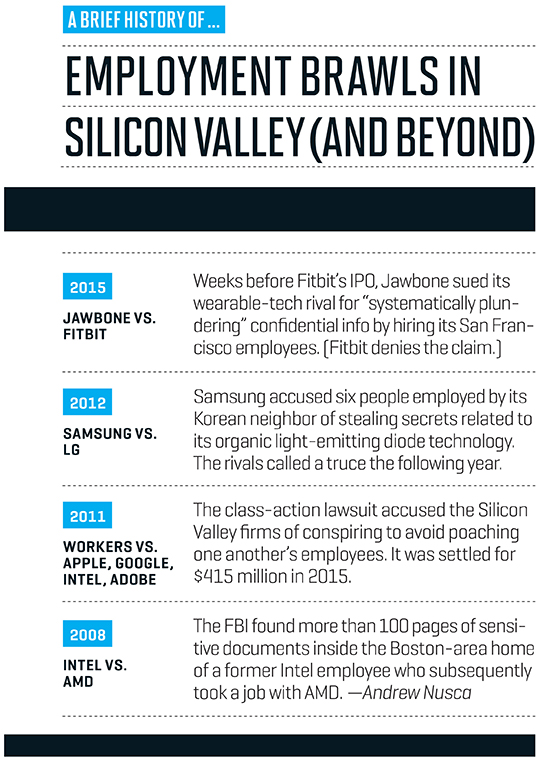

FUT.07.BriefHistory


A version of this article appears in the July 1, 2015 issue of Fortune magazine with the headline “Tech Talent: Play Defense, or Take Up Arms?”


About the Author
Claire Zillman
By Claire ZillmanEditor, Leadership
LinkedIn iconTwitter icon

Claire Zillman is a senior editor at Fortune, overseeing leadership stories. 

See full bioRight Arrow Button Icon

Latest in Tech

Finance
Lorem ipsum dolor sit amet, consectetur adipiscing elit, sed do eiusmod tempor incididunt ut labore et dolore magna aliqua. Ut enim ad minim veniam
By Fortune Editors
October 20, 2025
Finance
Lorem ipsum dolor sit amet, consectetur adipiscing elit, sed do eiusmod tempor incididunt ut labore et dolore magna aliqua. Ut enim ad minim veniam
By Fortune Editors
October 20, 2025
Finance
Lorem ipsum dolor sit amet, consectetur adipiscing elit, sed do eiusmod tempor incididunt ut labore et dolore magna aliqua. Ut enim ad minim veniam
By Fortune Editors
October 20, 2025
Finance
Lorem ipsum dolor sit amet, consectetur adipiscing elit, sed do eiusmod tempor incididunt ut labore et dolore magna aliqua. Ut enim ad minim veniam
By Fortune Editors
October 20, 2025
Finance
Lorem ipsum dolor sit amet, consectetur adipiscing elit, sed do eiusmod tempor incididunt ut labore et dolore magna aliqua. Ut enim ad minim veniam
By Fortune Editors
October 20, 2025
Finance
Lorem ipsum dolor sit amet, consectetur adipiscing elit, sed do eiusmod tempor incididunt ut labore et dolore magna aliqua. Ut enim ad minim veniam
By Fortune Editors
October 20, 2025

Most Popular

Finance
Lorem ipsum dolor sit amet, consectetur adipiscing elit, sed do eiusmod tempor incididunt ut labore et dolore magna aliqua. Ut enim ad minim veniam
By Fortune Editors
October 20, 2025
Finance
Lorem ipsum dolor sit amet, consectetur adipiscing elit, sed do eiusmod tempor incididunt ut labore et dolore magna aliqua. Ut enim ad minim veniam
By Fortune Editors
October 20, 2025
Finance
Lorem ipsum dolor sit amet, consectetur adipiscing elit, sed do eiusmod tempor incididunt ut labore et dolore magna aliqua. Ut enim ad minim veniam
By Fortune Editors
October 20, 2025
Finance
Lorem ipsum dolor sit amet, consectetur adipiscing elit, sed do eiusmod tempor incididunt ut labore et dolore magna aliqua. Ut enim ad minim veniam
By Fortune Editors
October 20, 2025
Finance
Lorem ipsum dolor sit amet, consectetur adipiscing elit, sed do eiusmod tempor incididunt ut labore et dolore magna aliqua. Ut enim ad minim veniam
By Fortune Editors
October 20, 2025
Finance
Lorem ipsum dolor sit amet, consectetur adipiscing elit, sed do eiusmod tempor incididunt ut labore et dolore magna aliqua. Ut enim ad minim veniam
By Fortune Editors
October 20, 2025
Rankings
  • 100 Best Companies
  • Fortune 500
  • Global 500
  • Fortune 500 Europe
  • Most Powerful Women
  • Future 50
  • World’s Most Admired Companies
  • See All Rankings
Sections
  • Finance
  • Leadership
  • Success
  • Tech
  • Asia
  • Europe
  • Environment
  • Fortune Crypto
  • Health
  • Retail
  • Lifestyle
  • Politics
  • Newsletters
  • Magazine
  • Features
  • Commentary
  • Mpw
  • CEO Initiative
  • Conferences
  • Personal Finance
  • Education
Customer Support
  • Frequently Asked Questions
  • Customer Service Portal
  • Privacy Policy
  • Terms Of Use
  • Single Issues For Purchase
  • International Print
Commercial Services
  • Advertising
  • Fortune Brand Studio
  • Fortune Analytics
  • Fortune Conferences
  • Business Development
About Us
  • About Us
  • Editorial Calendar
  • Press Center
  • Work At Fortune
  • Diversity And Inclusion
  • Terms And Conditions
  • Site Map

Latest in Tech

Paramount
BankingM&A
Warner Bros. is blockbuster finale to $4.5 trillion M&A haul
By Michelle F. Davis, David Carnevali, Ryan Gould, Swetha Gopinath and BloombergDecember 15, 2025
3 hours ago
slop
CybersecurityCulture
The word of the year is ‘slop,’ Merriam-Webster says
By Anna Furman and The Associated PressDecember 15, 2025
4 hours ago
C-Suitechief financial officer (CFO)
‘2026 has to be a year of execution’: AI investment pressures, supply-chain risks, and strategy misalignment are all on the line for CFOs
By Alex Zank and CFO BrewDecember 15, 2025
5 hours ago
Photo of Jim Farley
North AmericaAutos
Ford writes down $19.5 billion as it pivots electric Lighting line of vehicles
By Sasha RogelbergDecember 15, 2025
5 hours ago
InnovationElectric vehicles
Rivian CEO says the EV maker’s new large driving model will one day allow for fully autonomous driving—and maybe a spot in the robotaxi race
By Jordyn Grzelewski and Tech BrewDecember 15, 2025
5 hours ago
Big TechMeta
Former Meta integrity chief says new report reveals ‘disappointing’ ad fraud epidemic at the social media giant
By Lily Mae LazarusDecember 15, 2025
7 hours ago

Most Popular

placeholder alt text
Success
'I had to take 60 meetings': Jeff Bezos says 'the hardest thing I've ever done' was raising the first million dollars of seed capital for Amazon
By Dave SmithDecember 15, 2025
9 hours ago
placeholder alt text
Success
Meetings are not work, says Southwest Airlines CEO—and he’s taking action, by blocking his calendar every afternoon from Wednesday to Friday 
By Preston ForeDecember 15, 2025
11 hours ago
placeholder alt text
Success
Sorry, six-figure earners: Elon Musk says that money will 'disappear' in the future as AI makes work (and salaries) irrelevant
By Orianna Rosa RoyleDecember 15, 2025
13 hours ago
placeholder alt text
AI
Deloitte's CTO on a stunning AI transformation stat: Companies are spending 93% on tech and only 7% on people
By Nick LichtenbergDecember 15, 2025
16 hours ago
placeholder alt text
Uncategorized
Transforming customer support through intelligent AI operations
By Lauren ChomiukNovember 26, 2025
19 days ago
placeholder alt text
North America
Ford writes down $19.5 billion as it pivots electric Lighting line of vehicles
By Sasha RogelbergDecember 15, 2025
5 hours ago

© 2025 Fortune Media IP Limited. All Rights Reserved. Use of this site constitutes acceptance of our Terms of Use and Privacy Policy | CA Notice at Collection and Privacy Notice | Do Not Sell/Share My Personal Information
FORTUNE is a trademark of Fortune Media IP Limited, registered in the U.S. and other countries. FORTUNE may receive compensation for some links to products and services on this website. Offers may be subject to change without notice.