• Home
  • Latest
  • Fortune 500
  • Finance
  • Tech
  • Leadership
  • Lifestyle
  • Rankings
  • Multimedia
Commentary

Jobless? Blame corporate America’s borrowing binge

By
Xavier Giroud
Xavier Giroud
Down Arrow Button Icon
By
Xavier Giroud
Xavier Giroud
Down Arrow Button Icon
May 27, 2015, 5:00 AM ET
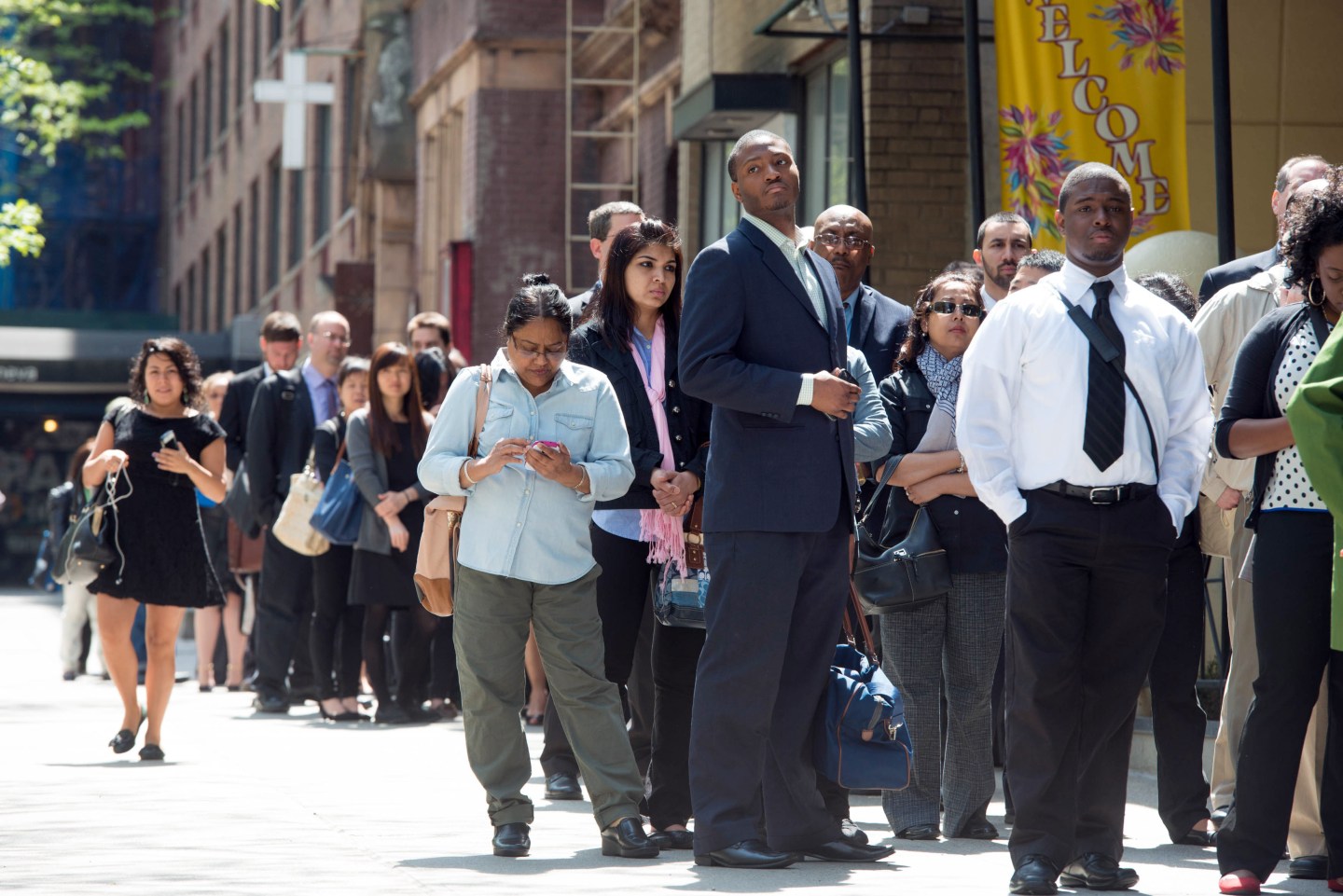
Job Seekers Inside The New York Career Fair Ahead Of Jobless Claims Figures
Job seekers line up outside at Choice Career Fairs' New York career fair at the Holiday Inn Midtown in New York, U.S., on Tuesday, May 13, 2014. The U.S. Department of Labor is scheduled to release initial and continuing jobless claims data on May 15. Photographer: Craig Warga/Bloomberg via Getty ImagesBloomberg Bloomberg via Getty Images

What led to the Great Recession? Was it all the fault of consumers? Did they borrow recklessly because money was cheap and mortgages were too easy to get? And then, when house prices collapsed, were they so overly burdened with household debt that they couldn’t afford to maintain their level of consumption?

While it’s true that high levels of consumer debt helped lay the groundwork for the long economic slump that followed the financial crisis, other factors—including high levels of corporate debt—also played an important role.

The U.S. unemployment rate has steadily fallen to 5.4%, but anyone who has been jobless for months or years likely feel the lingering effects of the 2008 financial crisis. So it’s worth taking a look back at those dark days in America’s economy. According to my research, the more debt a company had going into the Great Recession, the more likely it was to close down stores and lay off workers. By contrast, companies that were less constrained by debt were better able to maintain their workforces.

Let’s back up for a moment. In the run-up to the crisis—otherwise known as the boom—the economy was strong and credit was easy to come by. Many Americans went on a borrowing binge.

But when the property bubble burst, Americans in many parts of the country were caught having to repay large debts against assets—their homes—that had sunk in value. They did not have money to spend on new products and services, and they certainly weren’t in a position to take out new debt to do so. As a result, overall consumption fell.

How did companies react to the housing crash? It depends on their level of indebtedness. Companies that levered up before the recession had no choice but to lay off workers and close shops in towns and cities where local home prices had fallen, whereas companies with healthy balance sheets weathered the storm, even in places where the housing crash was most severe.

My colleague, Holger Mueller at NYU Stern School of Business, and I looked at a combination of data: employment data at the establishment level from the U.S. Census Bureau, house prices from Zillow, and balance sheet and income statements from public companies (excluding financial companies and utilities).

In all, we looked at 2,800 businesses, which, as of 2006, employed 11.2 million people and ran 284,000 “establishments,” our shorthand for outlets of chain retailers or restaurants. We then sorted these businesses by changes in their ratio of debt to equity between 2002 and 2006. The leverage for the typical firm was unchanged during that time, but we found very large changes within the broader sample.

About half of all establishments belonged to firms that entered into the Great Recession having levered up during the boom, while the other half belonged to firms that had cut their debt. Since there were virtually no geographical differences between these two groups, they experienced the same changes in house prices. (To put this in more tangible terms we compared establishments in the same ZIP code and industry—say a local Macy’s versus Nordstrom department store, a local Safeway versus Kroger supermarket, or a local Target versus Kmart discount retailer—where some establishments belong to high-leverage firms and others belong to low-leverage firms.)

We found that all of the job losses associated with falling house prices during the Great Recession are concentrated among establishments of companies that increased their leverage during the go-go years. Put another way: Employees who had the bad luck of living in towns with a relatively high concentration of debt-laden companies were more likely to get laid off than people who lived elsewhere.

What’s more, we found that the highly indebted businesses acted like financially constrained firms during the Great Recession: not only did they lay off employees they also closed stores and slashed investment. Other data—including a CFO survey conducted in 2008—backs this up. A team of economists asked 574 U.S. CFOs whether they perceived their firms as being financially constrained and what they are planning to do in 2009. The majority of CFOs said that they were either somewhat or very affected by difficulties in accessing credit markets. Notably, firms classified as financially constrained said they would reduce their capital spending by 9% in 2009, while financially unconstrained firms said they would keep their capital spending rates largely unchanged. Furthermore, financially constrained firms planned to cut their employment by 11% in 2009, whereas financially unconstrained firms planned to cut their employment only by 3%.

There is a tendency to view big public firms as robust institutions, incapable of experiencing financial constraints, such as too much debt. But of course that’s not true. Even large companies deal with these problems.

Xavier Giroud is the Ford International Career Development Professor of Finance at MIT Sloan School of Management.


About the Author
By Xavier Giroud
See full bioRight Arrow Button Icon

Latest in Commentary

Finance
Lorem ipsum dolor sit amet, consectetur adipiscing elit, sed do eiusmod tempor incididunt ut labore et dolore magna aliqua. Ut enim ad minim veniam
By Fortune Editors
October 20, 2025
Finance
Lorem ipsum dolor sit amet, consectetur adipiscing elit, sed do eiusmod tempor incididunt ut labore et dolore magna aliqua. Ut enim ad minim veniam
By Fortune Editors
October 20, 2025
Finance
Lorem ipsum dolor sit amet, consectetur adipiscing elit, sed do eiusmod tempor incididunt ut labore et dolore magna aliqua. Ut enim ad minim veniam
By Fortune Editors
October 20, 2025
Finance
Lorem ipsum dolor sit amet, consectetur adipiscing elit, sed do eiusmod tempor incididunt ut labore et dolore magna aliqua. Ut enim ad minim veniam
By Fortune Editors
October 20, 2025
Finance
Lorem ipsum dolor sit amet, consectetur adipiscing elit, sed do eiusmod tempor incididunt ut labore et dolore magna aliqua. Ut enim ad minim veniam
By Fortune Editors
October 20, 2025
Finance
Lorem ipsum dolor sit amet, consectetur adipiscing elit, sed do eiusmod tempor incididunt ut labore et dolore magna aliqua. Ut enim ad minim veniam
By Fortune Editors
October 20, 2025

Most Popular

Finance
Lorem ipsum dolor sit amet, consectetur adipiscing elit, sed do eiusmod tempor incididunt ut labore et dolore magna aliqua. Ut enim ad minim veniam
By Fortune Editors
October 20, 2025
Finance
Lorem ipsum dolor sit amet, consectetur adipiscing elit, sed do eiusmod tempor incididunt ut labore et dolore magna aliqua. Ut enim ad minim veniam
By Fortune Editors
October 20, 2025
Finance
Lorem ipsum dolor sit amet, consectetur adipiscing elit, sed do eiusmod tempor incididunt ut labore et dolore magna aliqua. Ut enim ad minim veniam
By Fortune Editors
October 20, 2025
Finance
Lorem ipsum dolor sit amet, consectetur adipiscing elit, sed do eiusmod tempor incididunt ut labore et dolore magna aliqua. Ut enim ad minim veniam
By Fortune Editors
October 20, 2025
Finance
Lorem ipsum dolor sit amet, consectetur adipiscing elit, sed do eiusmod tempor incididunt ut labore et dolore magna aliqua. Ut enim ad minim veniam
By Fortune Editors
October 20, 2025
Finance
Lorem ipsum dolor sit amet, consectetur adipiscing elit, sed do eiusmod tempor incididunt ut labore et dolore magna aliqua. Ut enim ad minim veniam
By Fortune Editors
October 20, 2025
Rankings
  • 100 Best Companies
  • Fortune 500
  • Global 500
  • Fortune 500 Europe
  • Most Powerful Women
  • Future 50
  • World’s Most Admired Companies
  • See All Rankings
Sections
  • Finance
  • Leadership
  • Success
  • Tech
  • Asia
  • Europe
  • Environment
  • Fortune Crypto
  • Health
  • Retail
  • Lifestyle
  • Politics
  • Newsletters
  • Magazine
  • Features
  • Commentary
  • Mpw
  • CEO Initiative
  • Conferences
  • Personal Finance
  • Education
Customer Support
  • Frequently Asked Questions
  • Customer Service Portal
  • Privacy Policy
  • Terms Of Use
  • Single Issues For Purchase
  • International Print
Commercial Services
  • Advertising
  • Fortune Brand Studio
  • Fortune Analytics
  • Fortune Conferences
  • Business Development
About Us
  • About Us
  • Editorial Calendar
  • Press Center
  • Work At Fortune
  • Diversity And Inclusion
  • Terms And Conditions
  • Site Map

Latest in Commentary

AsiaTariffs and trade
Countries must move beyond seeing AI as a race, where one side must beat the other
By Boris Babic and Brian WongJanuary 3, 2026
2 days ago
trump
CommentaryVenezuela
5 takeaways on Venezuela in the aftermath of Maduro: a memo to CEOs
By Jeffrey SonnenfeldJanuary 3, 2026
2 days ago
Bhargava
CommentaryPasswords
You probably use the same password for 30 different websites. It’s time for a passkey. 
By Rishi BhargavaJanuary 3, 2026
2 days ago
Sweden
CommentarySweden
Meet Sweden, the unicorn factory chasing America in the AI race
By Oscar TäckströmJanuary 3, 2026
2 days ago
Eric Simons
Commentarystart-ups
15 years after skipping college to launch 3 startups, I believe the taboo around questioning higher ed is holding an entire generation back
By Eric SimonsJanuary 2, 2026
3 days ago
MGI
CommentaryProductivity
The world is awash in wealth but starved for productivity—and that imbalance is distorting growth, debt, and opportunity. We need AI to come through
By Jan Mischke, Olivia White and Rebecca J. AndersonDecember 31, 2025
5 days ago

Most Popular

placeholder alt text
C-Suite
CEO of $90 billion Waste Management hauled trash and went to 1 a.m. safety briefings—‘It’s not always just dollars and cents’
By Amanda GerutJanuary 3, 2026
2 days ago
placeholder alt text
Future of Work
Bosses are fighting a new battle in the RTO wars: It's not about where you work, but when you work
By Nick LichtenbergJanuary 4, 2026
1 day ago
placeholder alt text
Economy
Mitt Romney says the U.S. is on a cliff—and taxing the rich is now necessary 'given the magnitude of our national debt'
By Dave SmithDecember 22, 2025
14 days ago
placeholder alt text
Future of Work
Bank of America CEO says he hired 2,000 recent Gen Z grads from 200,000 applications, and many are scared about the future
By Ashley LutzJanuary 3, 2026
2 days ago
placeholder alt text
Politics
People in Venezuela didn't celebrate Maduro's capture out of fear of government repression, construction worker says
By Regina Garcia Cano, Megan Janetsky, Juan Arraez and The Associated PressJanuary 4, 2026
20 hours ago
placeholder alt text
Future of Work
Meet the 'empowered non-complier': A certain kind of valuable worker who flouts return to office whenever they feel like it
By Nick LichtenbergJanuary 3, 2026
2 days ago

© 2025 Fortune Media IP Limited. All Rights Reserved. Use of this site constitutes acceptance of our Terms of Use and Privacy Policy | CA Notice at Collection and Privacy Notice | Do Not Sell/Share My Personal Information
FORTUNE is a trademark of Fortune Media IP Limited, registered in the U.S. and other countries. FORTUNE may receive compensation for some links to products and services on this website. Offers may be subject to change without notice.