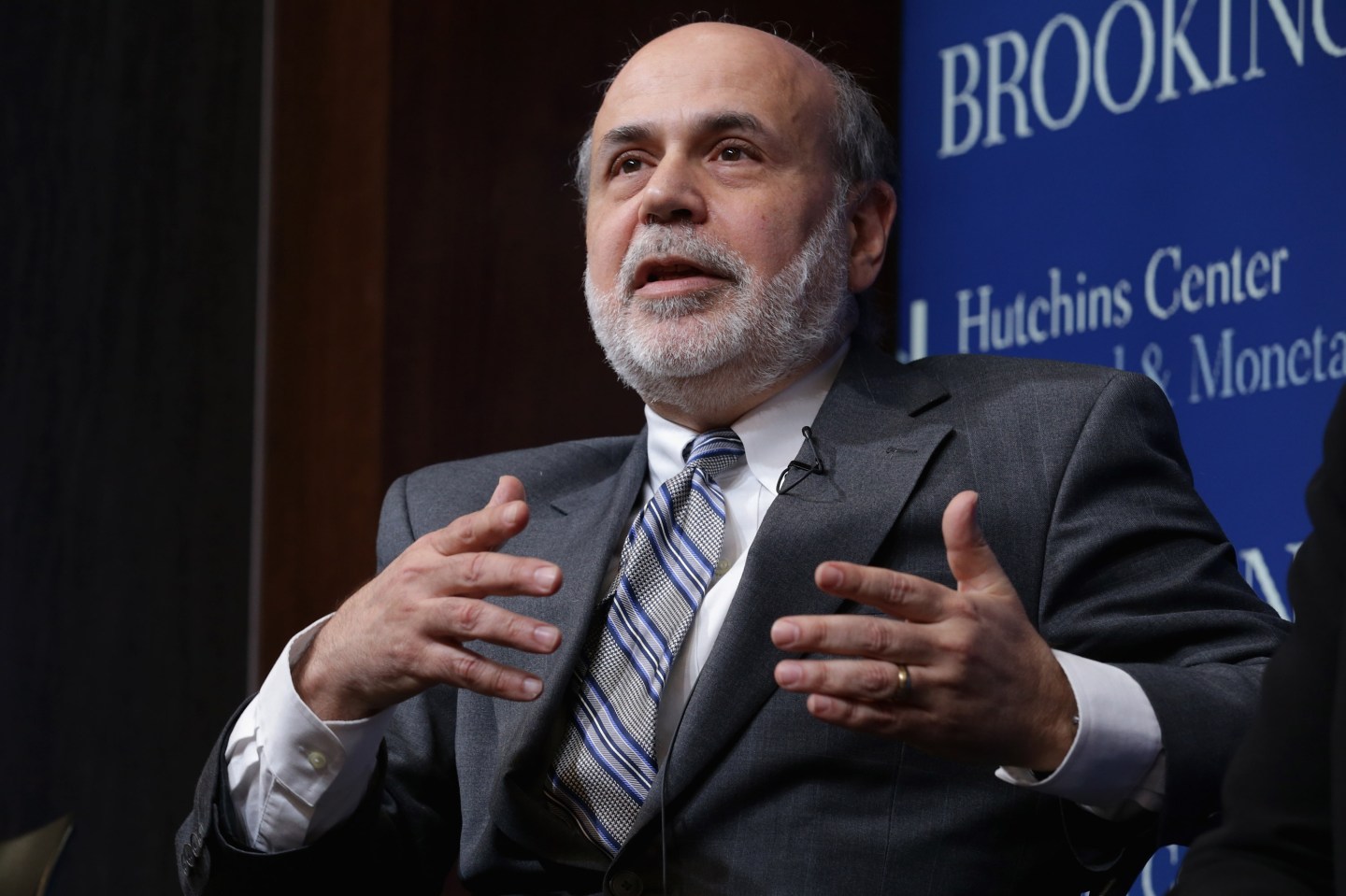
The Wall Street Journal opinion page has a long history of taking shots at Ben Bernanke and his use of unprecedented monetary stimulus, a policy stance that remains intact today.
The latest swipe came Wednesday evening, when the Journal published an opinion piece called, “The Slow Growth Fed,” in which it chastised the central bank for its overly optimistic growth projections and laid blame for sluggish growth in the past two quarters at least partially at its feet. Wrote the Journal’s editorial board:
Economic forecasting isn’t easy, but it’s striking how consistently the Fed has been wrong in a single direction. Our guess is that the Fed gurus have been wrong because like so many in Washington and Wall Street they have overestimated the power of monetary policy to propel the real economy.
The Fed has been able to lift asset prices, but the expectations that this would lead to faster growth in the larger economy have never been realized. Yet the default policy when growth stays slow is always to keep doing more of what isn’t working.
It’s heresy to say so, but maybe after six years of zero-interest rates, and long after the financial crisis ended, the Fed should wonder if its policies haven’t become an impediment to faster growth. Maybe letting markets begin to set interest rates again would lead to a better allocation of capital and less economic uncertainty. At the very least the Fed should start analyzing why its forecasts have been so wrong for so long.
On his blog at the Brookings Institution, Bernanke fired back, arguing that while the Fed has been overly optimistic in its growth projections, so has the vast majority of private forecasters. Meanwhile, the Federal Reserve has actually been overly pessimistic in terms of how quickly the official unemployment rate would fall. Today it sits at 5.5%, while job growth over the past year has been historically strong. He continued:
The WSJ also argues that, because monetary policy has not been a panacea for our economic troubles, we should stop using it…. With short-term interest rates pinned near zero, monetary policy is not as powerful or as predictable as at other times. But the right inference is not that we should stop using monetary policy, but rather that we should bring to bear other policy tools as well. I am waiting for the WSJ to argue for a well-structured program of public infrastructure development, which would support growth in the near term by creating jobs and in the longer term by making our economy more productive.
Naturally, the Journal felt the need to respond. In a piece published on Thursday evening, the editorial board pulled no punches, sarcastically referring to Bernanke as, “The Revered One.” The Journal finds it risible that Bernanke thinks his policies are “innocent of responsibility for subpar economic growth.” It points out, accurately, that while the unemployment rate has fallen faster than mainstream forecasters have predicted, broader measures of unemployment still show a labor market with a lot of room for improvement. It continues:
We can understand that Mr. Bernanke doesn’t like being tagged with any responsibility for poor economic results. He absolved himself for any mistakes before the financial crisis too. But sooner or later he and the Fed have to stop using the financial crisis as the all-purpose excuse for slow growth. Even President Obama has stopped blaming George W. Bush for everything. Maybe Mr. Bernanke should stop blaming everyone else too.
The fight isn’t exactly a fair one. The Journal’s editorial board is fiercely political and quick to use incendiary language. The former Fed chair, on the other hand, writes like an academic. He has an incentive to protect his reputation, but he is otherwise free of the burden of pursuing a specific political aim.
The Journal editors delivered a few convincing blows, namely its assertion that the Fed has been far too optimistic in its economic projections and that Bernanke wasn’t entirely honest in his description of the labor market. Yes, the unemployment rate has fallen, but the significant amount of slack in the labor market has extended the need for near-zero interest rates. There are simply still too many long-term unemployed folks, people who have given up finding work, and people who are working part-time when they want a full-time job.
But the Journal’s suggestion that quantitative easing and zero-interest rate policy are somehow responsible for the slow growth we have had is without any cogent theoretical basis. How, exactly, would raising the Fed funds rate 100 basis points encourage firms to hire more people or raise pay? Furthermore, the suggestion that we’ve moved away from “monetary normalcy that lets markets set rates and allocate capital,” is also a head scratcher. For more than 100 years, the Federal Reserve has worked with markets to set interest rates, regardless of whether the Fed funds rate is at 0% or 20%.
Government policy can only affect economic growth so much — which is what you would expect in an economy that is composed mostly of privately owned businesses. The economic literature in recent years has been filled with explanations for why productivity and economic growth have been slowing. These explanations range from the petering out of revolutionary technological changes to the lasting effects of a financial crisis. The public would be served if we could broaden our discussion of the economy to include non-political causes of growth and stagnation.