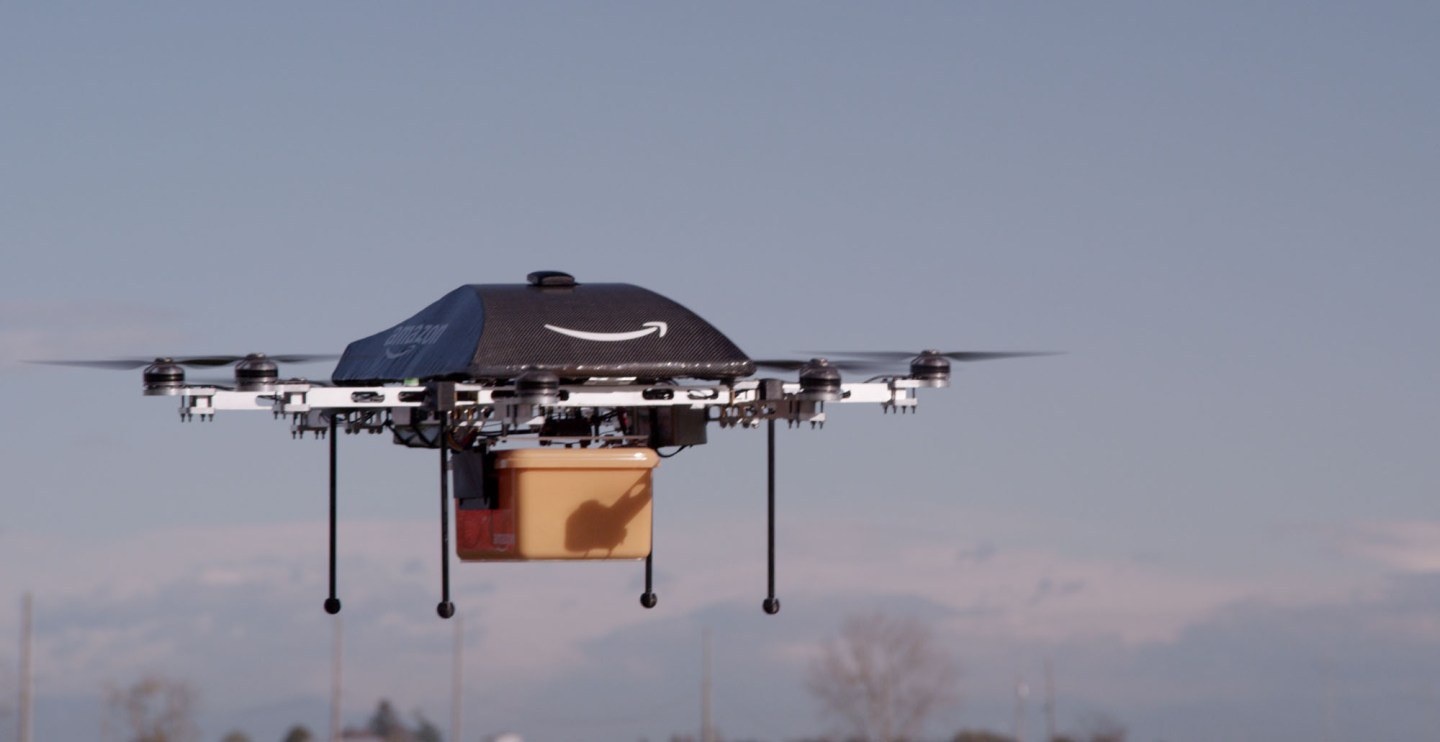
Companies big and small think drones could be the answer to their problems. Internet giants are testing pilotless aircraft to make home deliveries to online shoppers, energy companies want to use them to inspect pipelines, and Hollywood wants to send them aloft to help film big-budget movies.
But when it comes to federal regulations, the private and public sector have yet to agree on rules for using drones, which puts a damper on the technology fully getting off the ground in the business world.
On Friday, Amazon (AMZN) sent a letter to the Federal Aviation Administration (FAA) to complain about the FAA’s newly proposed drone regulations as being too harsh and a roadblock to its planned drone delivery service. Paul Misener, Amazon’s vice president for global public policy, wrote that the FAA should take into account the rapid advancement in drone technology in its rules. By overlooking new technical developments, Amazon is basically saying that the FAA is stifling innovation.
At the heart of the dispute is language in the rules that calls for drone operators to fly aircraft only within their line of sight. Such a requirement would effectively prohibit Amazon’s Prime Air service, a sci-fi initiative unveiled last year that would use drones to deliver online orders to customers in thirty minutes within ten miles of an Amazon fulfillment center.
Rather than ban drone deliveries, Amazon wants a regulatory system that would let it prove to the FAA that it’s safe to fly the machines at long distances, beyond the line of sight of its employees. Amazon’s letter echoes a similar note sent to the FAA by the Small UAV Coalition, a trade association focused on drones.
Last week, the group—whose members include Amazon, Google, and several new drone companies—sent a note to the FAA pointing out that countries the Czech Republic, France, Poland, Sweden, and Norway already allow drones to be flown beyond an operator’s line of sight.
Another sore point for Amazon is the FAA’s requirement that an operator only be allowed to fly one drone at a time. Again, Amazon wants the chance to prove to the FAA that it can do this safely rather than being prevented from doing it at all.
This is part of a long-running battle between Amazon and the FAA. For almost a year, they have been going back and forth about Amazon getting a permit to test its drones. In March, the FAA finally relented and allowed the e-commerce titan to test its drones under a series of restrictions, including only flying drones during the day and never above 400 feet. Amazon has complained about those limitations, and its recent letter to the FAA exemplifies its continued frustration.
Jonathan Evans, CEO of Skyward, a startup working on software for managing drone traffic, explained in an interview with Fortune that there’s disconnect between how the FAA wants to regulate drones and how it currently regulates aircraft like a standard Boeing 747. Because the FAA has decades of experience using airplane traffic control technology and relatively little experience with drone technology, the agency is being very careful about regulating drones.
Evan’s startup is creating a wireless network for drones that can keep track of them and help companies ensure that their drones are flying on government-approved routes, similar to how airplanes must fly through approved lanes in the sky. With the network, drone operators would be able to get up-to-date flight information like the outbreak of a forest fire that could cause regulators to set up emergency no-fly zones, Evans said.
“There hasn’t been a system like this that has been purpose-built for drones,” Evans said. He explained that technology for monitoring conventional aircraft flying at up to 30,000 feet is useless to drones, which he said are more akin to flying cell phones than small airplanes.
It’s technology like this that has put the FAA at a crossroads with drone companies over regulations. In one way, the type of networking technology that Skywards is developing would seem to address some of the FAA’s concerns about managing multiple drones that could fly far distances. Operators would be able to keep track of the machines similar to how air traffic controllers keep track airplanes.
Whether the FAA would be willing to entrust drones to such a network is unclear. The technology is still early in its development and hasn’t been implemented on a large scale.
Amazon (AMZN) is basically accusing the FAA getting in the way of innovation, not just for its drone delivery program, but also other companies. What Amazon and its allies envision is a sky filled with thousands of drone flying simultaneously without the need for scores of people to pilot each one individually.
It will be up to the FAA to determine whether Amazon, the Small UAV Coalition, and people who submitted 4,400 comments to the agency, made enough of a compelling argument to warrant altering the proposed drone rules. With the FAA expected to take roughly 18 to 24 months to sift through all of those notes, USA Today reports, expect a lot more back and forth between Amazon and the administration in the next year or so.
To view Amazon’s letter, click on the following link:
Amazon FAA Small UAS NPRM Comments
For more about Amazon and drones, watch this Fortune video: