
• Home
  • News
  • Fortune 500
  • Tech
  • Finance
  • Leadership
  • Lifestyle
  • Rankings
  • Multimedia
Tech

China has weaponized its Internet with the ‘Great Cannon’

Robert Hackett
By
Robert Hackett
Robert Hackett
Down Arrow Button Icon
Robert Hackett
By
Robert Hackett
Robert Hackett
Down Arrow Button Icon
April 13, 2015, 1:22 PM ET
A local tourist takes pictures of a thre
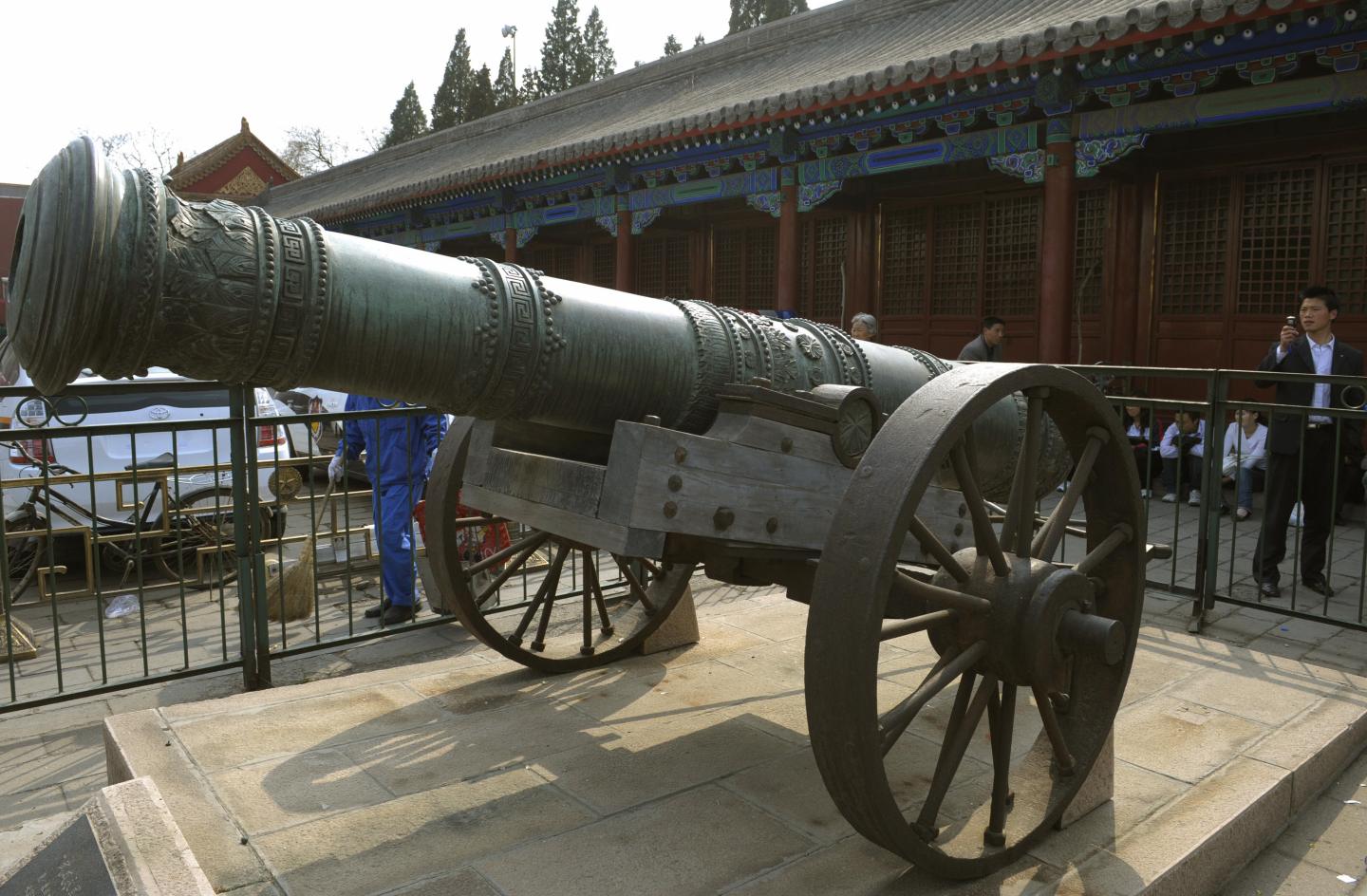
A local tourist takes pictures of a three-hundred year old ancient cannon in Beijing, on April 09, 2008. The six parties to the North Korean nuclear disarmament agreement gathered in Beijing on April 09 for discussions aimed at jump-starting the denuclearisation process. AFP PHOTO/LIU Jin (Photo credit should read LIU JIN/AFP/Getty Images)Photograph by Liu Jin — AFP/Getty Images

China has debuted an accessory to its wryly nicknamed “Great Firewall”—the apparatus through which the country effectuates Internet censorship. And this one goes on the offensive.

Dubbed the “Great Cannon” by researchers at the Citizen Lab, a research and development arm at the University of Toronto, Canada, who released a report revealing the attack tool on Friday, China’s new weapon has the power to blitz websites with traffic hijacked from unsuspecting Internet users. With a simple modification, the tool can even disseminate malware, the report says.

“The operational deployment of the Great Cannon represents a significant escalation in state-level information control: the normalization of widespread use of an attack tool to enforce censorship by weaponizing users,” the report says. The researchers compare the tool’s capabilities to the United States’ National Security Agency’s QUANTUM program, “affording China the opportunity to deliver exploits targeting any foreign computer that communicates with any China-based website not fully utilizing HTTPS,” a protocol (aka Hyper-Text Transfer Protocol Secure) that encrypts web page requests and content between users and servers.

China’s “Great Cannon” was launched a highly public way, the researchers allege, in recent attacks against the anti-censorship project GreatFire as well as those of the San Francisco-based code-sharing site GitHub, which hosts pages featuring links to content restricted in China such as the Chinese language version of the New York Times. The country’s electronic artillery appears to have blasted those sites’ servers with unencrypted traffic redirected from the Chinese search engine Baidu. (While Baidu has claimed no involvement, the Chinese government has not denied involvement.)

The days-long distributed denial of service attack, as such raids are known, lasted until early April, the report says. It was the largest attack of its kind in GitHub’s history.

Based on the weapon’s network position across different Chinese Internet service providers and based on similarities in its source code to the “Great Firewall,” the researchers “believe there is compelling evidence that the Chinese government operates the GC,” an abbreviation for their nickname “Great Cannon.” Given how loudly the weapon seems to have been inaugurated, the researchers further ponder its political intent:

We remain puzzled as to why the GC’s operator chose to first employ its capabilities in such a publicly visible fashion. Conducting such a widespread attack clearly demonstrates the weaponization of the Chinese Internet to co-opt arbitrary computers across the web and outside of China to achieve China’s policy ends. The repurposing of the devices of unwitting users in foreign jurisdictions for covert attacks in the interests of one country’s national priorities is a dangerous precedent — contrary to international norms and in violation of widespread domestic laws prohibiting the unauthorized use of computing and networked systems.

The report adds: “Deployment of the GC may also reflect a desire to counter what the Chinese government perceives as US hegemony in cyberspace.”

Lately, China appears somewhat to be tipping its hand in cyber space, having recently indirectly admitted to having cyber warfare forces. The “Great Cannon” announcement seems to have gone off with more of a bang (though, again, the Chinese government has neither confirmed nor denied responsibility).

Still most official statements issued by Chinese government representatives are less than forthcoming. In responding to a FireEye (FEYE) report on Monday alleging that China has been spying on Southeast Asian and Indian governments and businesses for a decade, a spokesman for the foreign ministry said: “I want to stress that the Chinese government resolutely bans and cracks down on any hacking acts. This position is clear and consistent. Hacking attacks are a joint problem faced by the international community and need to be dealt with cooperatively rather than via mutual censure.” (Since taking office in fall 2012, Chinese President Xi Jinping has been cracking down on at least one thing: the press.)

The Citizen Lab report builds on previous analyses of the so-called DDoS attacks against GreatFire and GitHub, including research performed by security organizations such as Insight Labs, Netresec, and Errata Security. The latest report delineates in greater detail the differences between this new addition to China’s digital arsenal—the “Great Cannon”—and its already well-known counterpart, the “Great Firewall.”

To prevent your Internet browsing sessions from being co-opted for the purposes of a “Great Cannon”-style attack, ensure that your destination URL begins with “https.” For more technical details, read Citizen Lab’s full analysis here.

Watch more business news from Fortune:

About the Author
Robert Hackett
By Robert Hackett
Instagram iconLinkedIn iconTwitter icon
See full bioRight Arrow Button Icon

Latest in Tech

Facebook CEO Mark Zuckerberg adjusts an avatar of himself during a company event in New York City on Thursday, Oct. 28, 2021. (Photo: Michael Nagle/Bloomberg/Getty Images)
NewslettersFortune Tech
Meta may unwind metaverse initiatives with layoffs
By Andrew NuscaDecember 5, 2025
40 minutes ago
C-SuiteFortune 500 CEO Interview
Bristol Myers Squibb CEO Chris Boerner says company culture was the missing piece of his ‘patent cliff’ plan
By Diane BradyDecember 5, 2025
2 hours ago
Co-founder and chief executive officer of Nvidia Corp., Jensen Huang attends the 9th edition of the VivaTech trade show at the Parc des Expositions de la Porte de Versailles on June 11, 2025, in Paris.
C-SuiteNvidia
Before running the world’s most valuable company, Jensen Huang was a 9-year-old janitor in Kentucky
By Eva RoytburgDecember 5, 2025
2 hours ago
Future of WorkBrainstorm Design
The workplace needs to be designed like an ‘experience,’ says Gensler’s Ray Yuen, as employees resist the return to office
By Angelica AngDecember 5, 2025
4 hours ago
Four years ago, BKV started buying up the two Temple power plants in Texas—located between Austin and Dallas—which now total 1.5 gigawatts of electricity generation capacity—enough to power more than 1.1 million homes, or a major data center campus. There is room to expand.
Energypower
How a Texas gas producer plans to exploit the ‘mega trend’ of power plants for AI hyperscalers
By Jordan BlumDecember 5, 2025
4 hours ago
Big TechSpotify
Spotify users lamented Wrapped in 2024. This year, the company brought back an old favorite and made it less about AI
By Dave Lozo and Morning BrewDecember 4, 2025
14 hours ago

Most Popular

placeholder alt text
Economy
Two months into the new fiscal year and the U.S. government is already spending more than $10 billion a week servicing national debt
By Eleanor PringleDecember 4, 2025
24 hours ago
placeholder alt text
Success
‘Godfather of AI’ says Bill Gates and Elon Musk are right about the future of work—but he predicts mass unemployment is on its way
By Preston ForeDecember 4, 2025
19 hours ago
placeholder alt text
Success
Nvidia CEO Jensen Huang admits he works 7 days a week, including holidays, in a constant 'state of anxiety' out of fear of going bankrupt
By Jessica CoacciDecember 4, 2025
19 hours ago
placeholder alt text
Success
Nearly 4 million new manufacturing jobs are coming to America as boomers retire—but it's the one trade job Gen Z doesn't want
By Emma BurleighDecember 4, 2025
20 hours ago
placeholder alt text
North America
Jeff Bezos and Lauren Sánchez Bezos commit $102.5 million to organizations combating homelessness across the U.S.: ‘This is just the beginning’
By Sydney LakeDecember 2, 2025
3 days ago
placeholder alt text
Health
Bill Gates decries ‘significant reversal in child deaths’ as nearly 5 million kids will die before they turn 5 this year
By Nick LichtenbergDecember 4, 2025
1 day ago
Rankings
  • 100 Best Companies
  • Fortune 500
  • Global 500
  • Fortune 500 Europe
  • Most Powerful Women
  • Future 50
  • World’s Most Admired Companies
  • See All Rankings
Sections
  • Finance
  • Leadership
  • Success
  • Tech
  • Asia
  • Europe
  • Environment
  • Fortune Crypto
  • Health
  • Retail
  • Lifestyle
  • Politics
  • Newsletters
  • Magazine
  • Features
  • Commentary
  • Mpw
  • CEO Initiative
  • Conferences
  • Personal Finance
  • Education
Customer Support
  • Frequently Asked Questions
  • Customer Service Portal
  • Privacy Policy
  • Terms Of Use
  • Single Issues For Purchase
  • International Print
Commercial Services
  • Advertising
  • Fortune Brand Studio
  • Fortune Analytics
  • Fortune Conferences
  • Business Development
About Us
  • About Us
  • Editorial Calendar
  • Press Center
  • Work At Fortune
  • Diversity And Inclusion
  • Terms And Conditions
  • Site Map

© 2025 Fortune Media IP Limited. All Rights Reserved. Use of this site constitutes acceptance of our Terms of Use and Privacy Policy | CA Notice at Collection and Privacy Notice | Do Not Sell/Share My Personal Information
FORTUNE is a trademark of Fortune Media IP Limited, registered in the U.S. and other countries. FORTUNE may receive compensation for some links to products and services on this website. Offers may be subject to change without notice.