• Home
  • Latest
  • Fortune 500
  • Finance
  • Tech
  • Leadership
  • Lifestyle
  • Rankings
  • Multimedia
FinanceWall Street

The Wall Street fight Elizabeth Warren just lost was pretty small

By
Stephen Gandel
Stephen Gandel
Down Arrow Button Icon
By
Stephen Gandel
Stephen Gandel
Down Arrow Button Icon
December 15, 2014, 1:17 PM ET
Elizabeth Warren, Maxine Waters
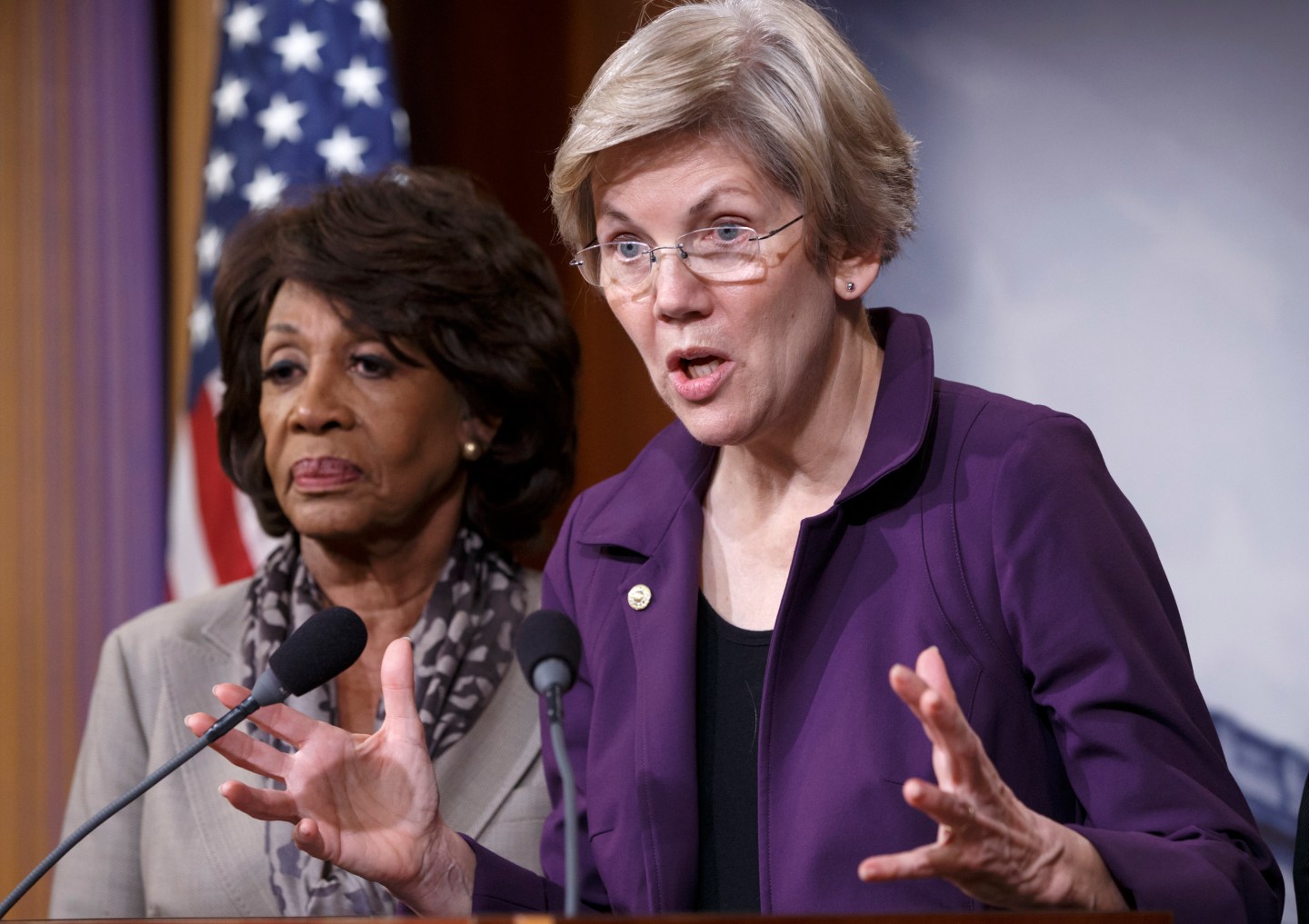
Sen. Elizabeth Warren, D-Mass., a member of the Senate Banking Committee, and Rep. Maxine Waters, D-Calif., left, ranking member of the House Financial Services Committee, express their outrage to reporters that a huge, $1.1 trillion spending bill passed by the Republican-controlled House yesterday contains changes to the 2010 Dodd-Frank law that regulates complex financial instruments known as derivatives, at the Capitol in Washington, Wednesday, Dec. 10, 2014. Democratic support for the omnibus bill funding every corner of government faded Wednesday as liberal lawmakers erupted over a provision that weakens the regulation of risky financial instruments and another that allows more money to flood into political parties. (AP Photo/J. Scott Applewhite)Photograph by J. Scott Applewhite — AP

How big of a loss did financial reformers sustain in its latest battle with Wall Street? It comes to 0.5% of bank assets. Put another way, if JPMorgan Chase was an average American household and not a bank, regulators just made it legal for the Chases to risk an additional $400 at the races. Have fun.

To many, last week offered more evidence that in the post-crisis fight to rein in the financial sector, Wall Street has once again come out on top.

This weekend, Congress approved a spending bill that will roll back a provision of the Dodd-Frank financial reform law known as the swaps push out rule, something Wall Street has long sought to repeal. The victory—or defeat, depending on where you stand—is a lot smaller than it appears.

In theory, the swaps push out rule was going to move complicated and sometimes risky derivatives out of federally insured banks and into entities that would not be protected by Uncle Sam if they were to fail. No more bailouts of bad derivatives bets was the way the provision was marketed. But that’s not really how it was going to work, even if the rule had not been rolled back.

First of all, the swaps rule had huge loopholes. Even as Dodd-Frank was originally worded, plenty of derivatives got to avoid the push out. Interest rate swaps, for instance, which is by far the biggest swaps market, weren’t included in the rule. Those were going to stay at the banks, on the theory that banks deal with interest rate risk all the time, and it’s not all that risky. Meanwhile, Fannie Mae and Freddie Mac lost billions on interest rate swaps in the run up to the financial crisis. Currency derivatives, another large market, were also largely immune from the rule.

This fight was primarily about credit default swaps, which are the insurance-like contracts on bonds and other debt that are bought and sold in over-the-counter markets on Wall Street. CDS contracts did a lot of damage during the financial crisis, and probably would have put AIG, among other firms, under if the government hadn’t offered a bail out.

But here’s the thing: the CDS market has shrunk dramatically since the financial crisis. I am not a big fan of the CDS market. I think it’s a deeply flawed financial product, one of the worst cases of “financial innovation.” But the market has figured that out, and, in a number of areas, CDS trading has essentially disappeared.

In all, there are now $17 trillion in outstanding CDS contracts, according to clearing firm DTCC. That sounds like a lot, but that’s down from $58 trillion in late 2007. And it’s tiny compared to the nearly $250 trillion in outstanding interest rate swaps, which, again, were always going to stay with the banks.

And that’s the total value of all the stuff tied to those CDS contracts. The market value of those contracts, which is what could be lost, had diminished to $700 billion by the end of 2013, according to the Bank for International Settlements. And that doesn’t take into account the fact that a lot of banks have offsetting bets. Factoring that in, the amount of money that was at risk at the end of 2013 in the CDS market shrinks to $139 billion. And it has probably gotten even smaller since then.

Even in CDS land, there were exceptions to the push out rule. All CDS contracts that are centrally cleared—meaning, they have been guaranteed by a third party—were allowed to stay on the banks’ books, even before the recent change. That was a small percentage of trades at the time of the financial crisis. But it’s climbed rapidly since then. At the end of last year, 26% of CDS trades were centrally cleared.

So, what we are talking about? Seventy-four percent of $139 billion in potentially risky trades, or $102 billion. And that’s for the entire U.S. banking system, which has nearly $15 trillion in assets. It’s peanuts of peanuts.

Okay. “But that’s just for now,” some might say. What happens when the market heats up again, and banks start to trade CDS again on, say, synthetic CDOs of MBS debt (it’s risky stuff take, my word for it). Well, that stuff isn’t coming back to the banks. Even under the latest Washington spending bill, derivatives contracts based on structured products are still going to get pushed out of the banks.

So, why was Wall Street fighting so hard? Likely because the CDS trading business is very profitable, and they don’t want to lose it to hedge funds or other firms. Putting their derivatives trading in separate divisions, completely separate from the cash that the firms get from depositors, would have been costly to set up and perhaps not even workable. In a crisis, corporate lines between divisions quickly disappear.

The fact that this market is small, relatively, has the pro-financial reform cohort saying that the roll back on the rule is yet another sign that the banks are slowly chipping away at Dodd-Frank. But in the grand scheme of things, it didn’t change much. Banks still have to hold much more capital then they used to. Their ability to make risky bets has been significantly limited. And there is a new regulatory body that tries to make sure that individuals aren’t being taken advantage of by banks and other financial firms.

If banks pick a narrow, obscure rule and spend lots of money to fight it for four years, they can win a small victory. If that’s the state of affairs, as it appears to be, I think the crowd looking to rein in Wall Street has a lot to be pleased about.


About the Author
By Stephen Gandel
See full bioRight Arrow Button Icon

Latest in Finance

Finance
Lorem ipsum dolor sit amet, consectetur adipiscing elit, sed do eiusmod tempor incididunt ut labore et dolore magna aliqua. Ut enim ad minim veniam
By Fortune Editors
October 20, 2025
Finance
Lorem ipsum dolor sit amet, consectetur adipiscing elit, sed do eiusmod tempor incididunt ut labore et dolore magna aliqua. Ut enim ad minim veniam
By Fortune Editors
October 20, 2025
Finance
Lorem ipsum dolor sit amet, consectetur adipiscing elit, sed do eiusmod tempor incididunt ut labore et dolore magna aliqua. Ut enim ad minim veniam
By Fortune Editors
October 20, 2025
Finance
Lorem ipsum dolor sit amet, consectetur adipiscing elit, sed do eiusmod tempor incididunt ut labore et dolore magna aliqua. Ut enim ad minim veniam
By Fortune Editors
October 20, 2025
Finance
Lorem ipsum dolor sit amet, consectetur adipiscing elit, sed do eiusmod tempor incididunt ut labore et dolore magna aliqua. Ut enim ad minim veniam
By Fortune Editors
October 20, 2025
Finance
Lorem ipsum dolor sit amet, consectetur adipiscing elit, sed do eiusmod tempor incididunt ut labore et dolore magna aliqua. Ut enim ad minim veniam
By Fortune Editors
October 20, 2025

Most Popular

Finance
Lorem ipsum dolor sit amet, consectetur adipiscing elit, sed do eiusmod tempor incididunt ut labore et dolore magna aliqua. Ut enim ad minim veniam
By Fortune Editors
October 20, 2025
Finance
Lorem ipsum dolor sit amet, consectetur adipiscing elit, sed do eiusmod tempor incididunt ut labore et dolore magna aliqua. Ut enim ad minim veniam
By Fortune Editors
October 20, 2025
Finance
Lorem ipsum dolor sit amet, consectetur adipiscing elit, sed do eiusmod tempor incididunt ut labore et dolore magna aliqua. Ut enim ad minim veniam
By Fortune Editors
October 20, 2025
Finance
Lorem ipsum dolor sit amet, consectetur adipiscing elit, sed do eiusmod tempor incididunt ut labore et dolore magna aliqua. Ut enim ad minim veniam
By Fortune Editors
October 20, 2025
Finance
Lorem ipsum dolor sit amet, consectetur adipiscing elit, sed do eiusmod tempor incididunt ut labore et dolore magna aliqua. Ut enim ad minim veniam
By Fortune Editors
October 20, 2025
Finance
Lorem ipsum dolor sit amet, consectetur adipiscing elit, sed do eiusmod tempor incididunt ut labore et dolore magna aliqua. Ut enim ad minim veniam
By Fortune Editors
October 20, 2025
Fortune Secondary Logo
Rankings
  • 100 Best Companies
  • Fortune 500
  • Global 500
  • Fortune 500 Europe
  • Most Powerful Women
  • Future 50
  • World’s Most Admired Companies
  • See All Rankings
Sections
  • Finance
  • Fortune Crypto
  • Features
  • Leadership
  • Health
  • Commentary
  • Success
  • Retail
  • Mpw
  • Tech
  • Lifestyle
  • CEO Initiative
  • Asia
  • Politics
  • Conferences
  • Europe
  • Newsletters
  • Personal Finance
  • Environment
  • Magazine
  • Education
Customer Support
  • Frequently Asked Questions
  • Customer Service Portal
  • Privacy Policy
  • Terms Of Use
  • Single Issues For Purchase
  • International Print
Commercial Services
  • Advertising
  • Fortune Brand Studio
  • Fortune Analytics
  • Fortune Conferences
  • Business Development
  • Group Subscriptions
About Us
  • About Us
  • Editorial Calendar
  • Press Center
  • Work At Fortune
  • Diversity And Inclusion
  • Terms And Conditions
  • Site Map
Fortune Secondary Logo
  • About Us
  • Editorial Calendar
  • Press Center
  • Work At Fortune
  • Diversity And Inclusion
  • Terms And Conditions
  • Site Map
  • Facebook icon
  • Twitter icon
  • LinkedIn icon
  • Instagram icon
  • Pinterest icon

Latest in Finance

AIJobs
Nobel laureate Joe Stiglitz says not only can AI take your job, it’ll make the ‘tech bro’ class richer while doing so
By Catherina GioinoMarch 6, 2026
3 hours ago
Personal FinanceCertificates of Deposit (CDs)
Best certificates of deposit (CDs) for March 2026
By Glen Luke FlanaganMarch 6, 2026
5 hours ago
AIdisruption
OpenAI investor Vinod Khosla believes AI will be able to do 80% of all jobs by 2030. Here’s how life could be affordable after mass unemployment
By Nick LichtenbergMarch 6, 2026
5 hours ago
Startups & VentureVenture Capital
February was the biggest month in venture history, thanks to OpenAI, Anthropic, and Waymo in particular
By Lily Mae LazarusMarch 6, 2026
6 hours ago
Future of WorkElectric vehicles
Nearly 1,000 workers laid off at SK Battery plant in Georgia as companies cancel EVs and Trump Admin eliminates auto company incentives
By The Associated Press, Jeff Amy and Alexa St. JohnMarch 6, 2026
6 hours ago
EconomyICE
A Minneapolis Fed report details how much Trump’s immigration crackdown hurt businesses and workers: ‘There are not any people to hire’
By Jason MaMarch 6, 2026
6 hours ago

Most Popular

placeholder alt text
Economy
The Treasury may need to borrow an extra $1.6 trillion to cover the hole left by tariff ruling and pay a further $400 billion in debt interest
By Eleanor PringleMarch 6, 2026
14 hours ago
placeholder alt text
Success
Chinese billionaire who has fathered more than 100 children hopes to have dozens of U.S.-born boys to one day take over his business
By Emma BurleighMarch 5, 2026
2 days ago
placeholder alt text
Politics
Iran is turning out to be a more effective enemy than many thought, and U.S. allies are losing their patience with the war
By Jim EdwardsMarch 6, 2026
13 hours ago
placeholder alt text
Politics
Meet Markwayne Mullin, the new multimillionaire head of DHS, who owns a cattle ranch in Oklahoma
By Jacqueline MunisMarch 5, 2026
1 day ago
placeholder alt text
AI
OpenAI investor Vinod Khosla predicts today’s 5-year-olds won’t ever need to get jobs thanks to AI
By Sasha RogelbergMarch 4, 2026
3 days ago
placeholder alt text
Middle East
The Iran conflict will be the ’straw that breaks the camel’s back’ for the U.S. economy if it goes on much longer, Nobel laureate Paul Krugman warns
By Tristan BoveMarch 6, 2026
17 hours ago

© 2026 Fortune Media IP Limited. All Rights Reserved. Use of this site constitutes acceptance of our Terms of Use and Privacy Policy | CA Notice at Collection and Privacy Notice | Do Not Sell/Share My Personal Information
FORTUNE is a trademark of Fortune Media IP Limited, registered in the U.S. and other countries. FORTUNE may receive compensation for some links to products and services on this website. Offers may be subject to change without notice.