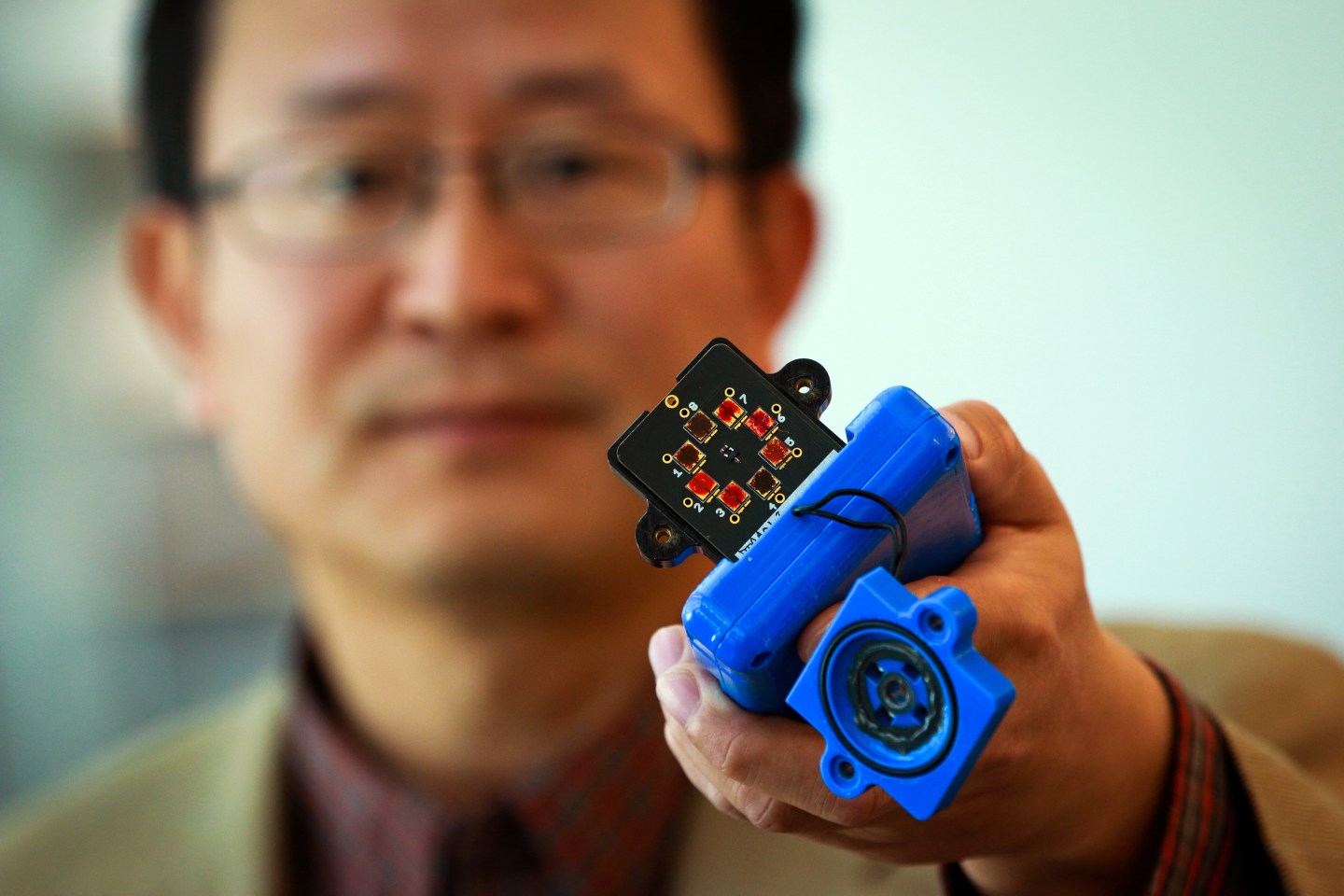
After living through 9-11 in New York, Ling Zang considered how he might use his material science and engineering experience to help prevent another terror attack.
More than a decade later, Zang and several other scientists at the University of Utah say they have created a device that detects explosives, drugs and two dozen different toxic gases quicker and more accurately than what is currently used at airports. The gadget, which weighs less than a pound and is about the size of a clunky smart phone, could also be deployed on the battlefield to detect chemical weapons or other explosives.
“I wanted to come up with a device that detects explosives and any other dangerous chemicals that could pose a threat to our nation, to our people,” Zang said. “I saw the increasing threat from terrorists.”
Zang described what he and his team came up with in a paper published Tuesday in the online, peer-reviewed journal Advanced Materials.
Since 9-11, airport security has been completely overhauled – much to the consternation of many passengers. They are questioned, patted down and forced to pass through imaging scanners that screen for the presence of metallic and non-metallic items including weapons and explosives. Some passengers also have their hands or carry on bags swabbed, using a system that analyzes ions molecules to identify any potential explosive material.
Zang said he believes his device, developed with funding from Department of Homeland Security and the Defense Department, could do a better job of identifying dangerous chemicals. Rather than depending on what ions are captured or images from an x-ray, Zang’s hand-held unit “sniffs” out dangerous substances. It uses a new type of carbon nanotube material known for being incredibly light and strong, and that is used in everything from baseball bats to lithium batteries.
“A lot of explosives, dangerous chemicals are pretty difficult to be detected or screened,” said Zang, who has patented his discovery and co-founded a company Vaporsens that plans to develop a hand-held prototype scanner by the end of the year and hopes to bring to a commercial scanner to the market in 2015.
“The luggage screening system or x-ray based imaging system is based on imaging contrasts,” he said. “Let’s say you have a small bag of milk powder and another small bag of explosives. They are all white powder. With the traditional x-ray based imaging, it’s pretty difficult to distinguish them.”
But Zang says his device detects “the chemicals released” so it could differentiate between the molecules from milk powder and those from explosives. Different molecules change the electric current passing through the carbon nanotube, thus providing a signal that something is amiss.
“Our system will be based on direct sniffing,” Zang said. “We don’t swab your hand. We don’t swab your purse. We sniff it like a dog because sampling of the surface always depends on how much you swab and where you swab. But for sniffing, the molecule hanging around in the air will make a lot of difference.”
Tom Webster, chair of the Department of Chemical Engineering at Northeastern and expert in nanotechnology and nanomaterials, said he thought Zang’s device had potential.
“I think its pretty neat,” Webster said. “I think it sounds like a great idea to me. If you had some gun power residue or chemical in the air, the idea they propose is that the carbon nanotubes can actually measure the conductivity of the air.”
Ken Mickiewicz, vice president of operations for Front Range Training and Consulting which trains both law enforcement and Department of Defense personnel, also said the scanner appeared “to offer attractive benefits” over what is on the market.
“The promise of accuracy, speed, and sensitivity of detection cover most of the needs to satisfy prevention and public relations,” Mickiewicz said in an e-mail interview. “In addition, the portability and method of operation suggests that the devices could be more covertly deployed, thereby preventing a terrorist from detonating a device in anticipation of, or to avoid, being scanned. The device … also suggests that such sensors could be deployed in larger areas, such as corridors or passageways, increasing the covert nature and timely coverage of the scans.”
But Webster said he worried the device may come up against some of the same problems he has encountered making sensors out of carbon nanotubes for use to monitor functions inside the body. Because they are charged and have a high surface area, things can glom onto a carbon nanotube easily which might eventually “make it useless” to measure degree which TNT, for example, conducts electricity.
“You have other chemicals you don’t want to measure but they are there and they absorb to your carbon nanotube,” he said. “That makes it impossible for it to measure conductivity of something else. So you have something that fouls it, cover it up and keeps it from doing its job.”
Zang said his team has addressed this concern by equipping their detector with a “front-end device … for air sampling” which also filters out the particles.