“It’s pretty amazing to hold leather that no pig or cow died for,” says Lindy Fishburne, an officer of the Thiel Foundation. She is describing a slightly creepy “biofabricated” product made by a startup the foundation funded with a $350,000 donation. The company, named Modern Meadow, makes leather and, indeed, meat by taking skin or muscle samples from animals via biopsy and then growing them in vitro. Modern Meadow is just one of 19 futuristic startups that have received donations from the Thiel Foundation over the past two years as part of an unusual program called Breakout Labs. Though it is rare, if not unheard-of, for a charitable foundation to donate tax-advantaged dollars to for-profit companies, the Thiel Foundation is no ordinary charity. It was set up in 2006 by billionaire investor Peter Thiel, who crafts his gifts to make a point, as he explains to Fortune in an interview. “You want to pick an issue where it both does some good on its own,” he says, “and at the same time helps draw awareness to a broader set of issues.”
Breakout Labs shines a spotlight on a contrarian contention Thiel has been advancing in essays, talks, and debates since about 2008, which has come to be known as the “tech stagnation thesis.” Thiel contends that the amazing advances we have seen in computer science and communications have masked ominously disappointing progress in energy, transportation, biotech, disease prevention, and space travel. That slowdown, he maintains, accounts for the near stagnation in real incomes and wages we have experienced since 1973, and for widening inequality in wealth distribution.
“In the last 40 years in the technology world,” as Thiel puts it, “we’ve had enormous progress in the world of bits, but not as much in the world of atoms.” The notion is encapsulated in the tag line of Thiel’s venture capital firm, Founders Fund: “We wanted flying cars, instead we got 140 characters.”
To address this problem, his Breakout Labs supports only “hard tech” startups—ventures that aren’t focusing on websites, social media, or information technology—and those that are too speculative to attract angel investors or even government grants. He gives these companies a shot of capital with which to try to prove that their technology works in hopes that they will then be able to attract conventional VC funding—as Modern Meadow managed to do this past June.
A gifted rhetorician and provocateur with a bottomless pocketbook, Thiel has drawn upon his wide-ranging and idiosyncratic readings in philosophy, history, economics, anthropology, and culture to become perhaps America’s leading public intellectual today, assuming a mantle once held by the likes of Thorstein Veblen or Norman Mailer. The conspicuous difference is that Thiel—a libertarian, gay Christian—espouses views that are far harder to anticipate, and he has earned his pulpit largely through commercial rather than literary or scholarly masterworks.
In 1998, Thiel co-founded the pioneering e-commerce payments company PayPal, which was sold to eBay in 2002 for $1.5 billion. Among students of business, PayPal may be known less for its own success than for the subsequent achievements of the people Thiel helped attract to build it. Those individuals, now known as the PayPal mafia, went on to launch a raft of companies that have become household names, including at least seven now valued at more than $1 billion: Tesla (TSLA) and SpaceX (co-founded by Elon Musk), LinkedIn (LNKD) (Reid Hoffman), YouTube (Steve Chen, Chad Hurley, and Jawed Karim), Yelp (YELP) (Jeremy Stoppelman and Russel Simmons), Yammer (David O. Sacks), and the data-mining company Palantir (co-founded by Thiel himself in 2004).

Though Thiel has, thus, personally co-founded a pair of billion-dollar companies, he may be still better known for his investments. In 2004 he famously gave the 20-year-old Mark Zuckerberg, a Harvard sophomore who had never held a steady job, $500,000 in exchange for 10.2% of the company then called Thefacebook. The investment has so far netted Thiel more than $1 billion in cash; he retains a $200 million stake and remains a Facebook director. Other notable Thiel investments, either individually or through Founders Fund, have included LinkedIn; Spotify; a $120 million stake in Musk’s rocket-ship company, SpaceX; and more recently Airbnb.
Thiel’s public profile began extending beyond the Valley in 2010, when he was depicted in the movie The Social Network. This year HBO’s Silicon Valley television series introduced the world to a brilliant eccentric named Peter Gregory, who is widely understood to have been inspired by Thiel. In the first episode Gregory delivers a speech promoting a program almost identical to Thiel’s controversial “20 Under 20” project, launched in late 2010, which annually offers 20 young tech phenoms $100,000 if they’ll drop out of school to launch a startup.

Later this month Thiel’s fame will probably balloon further when he publishes Zero to One: Notes on Startups, or How to Build the Future. The title refers to the distinction Thiel draws between transformative, “vertical” change—going from zero to one—and incremental, “horizontal” change—going from one to n. “If you take one typewriter and build 100, you have made horizontal progress,” he explains in the book’s first chapter. “If you have a typewriter and build a word processor, you have made vertical progress.” (Read excerpt here.)
“The book is nominally about entrepreneurship,” Zuckerberg observes in an interview with Fortune, “but what I actually think it’s about is the philosophy of how you go about creating value in the world.”
Zero to One is based on what Silicon Valley digerati knowingly refer to as “CS183”—the catalogue designation for the undergraduate computer science course Thiel taught during Stanford’s spring 2012 trimester. Thiel’s lectures became an online sensation after Stanford law student Blake Masters, then 25, began posting—originally without permission—reconstructions of each one on his Tumblr blog.
After his fourth installment became the subject of a New York Times op-ed column by David Brooks, Masters recalls, he decided to check with Thiel to see if he minded. “Go ahead and keep posting,” Thiel emailed back. Masters’ blog has since received close to 2.4 million page views from 560,000 unique visitors.
“The course notes have had a huge impact,” venture capitalist Marc Andreessen tells me. “Every entrepreneur we meet has read those back to back.” Andreessen co-wrote the code for the first modern web browser and co-founded the VC firm Andreessen Horowitz.
When Thiel decided to write the current book—a pared-down, more elegant treatment of the same material, with some additions—he turned for help to Masters, who is now listed as the book’s co-author.
Needless to say, perhaps, Masters has also now founded his own startup, a software-turbocharged legal analytics tool. Thiel led its $2 million seed round.
Thiel, 46, is more youthful, energetic, and fit than his on-screen impersonators. At our first interview he is dressed in a black V-neck sweater, khakis, and high-end sneakers. He has invited me to breakfast—a vegetable omelet for me, just fresh berries for him—prepared by his private chef at his airy, contemporary headquarters amid the eucalyptus-scented hills of San Francisco’s Presidio. Picture windows afford views of the Palace of Fine Arts against the backdrop of the Golden Gate Bridge, Angel Island, and Alcatraz.
Though Thiel has become a living emblem of Silicon Valley, he has actually lived and worked in San Francisco since late 2002. He moved here from Mountain View, after selling PayPal, to chart a new beginning.
“Entrepreneurs who are very successful always run the risk of competing with their past selves,” he says. “If you win a gold medal in the Olympics, my bias would be you should quit swimming that day.”
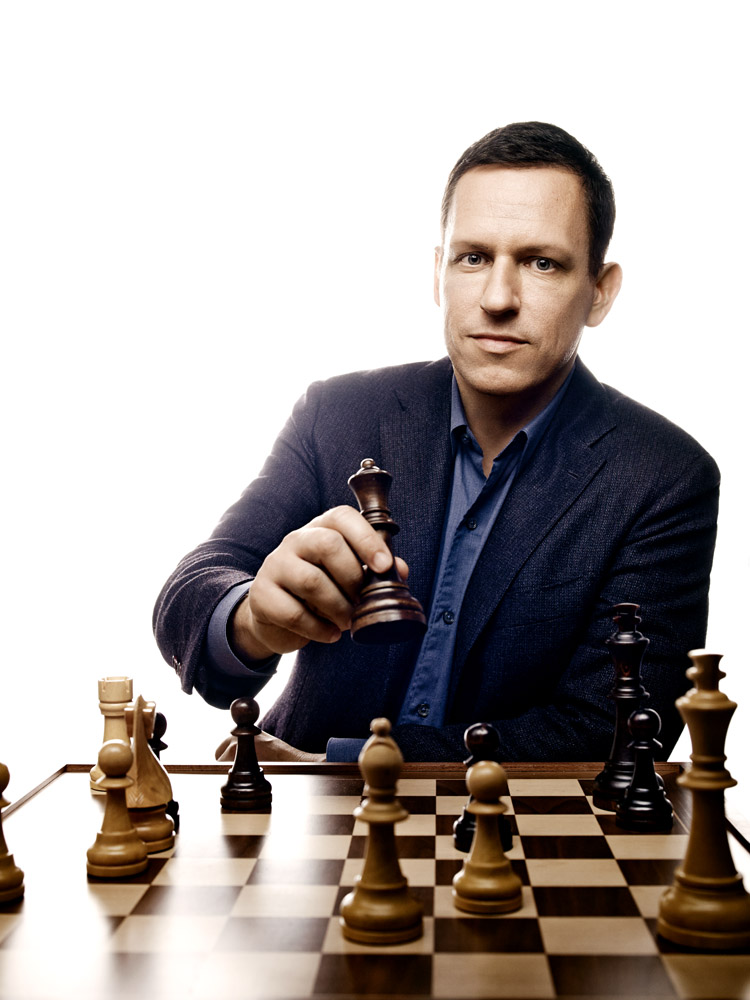
It’s an extraordinary statement from someone who has so obviously thrived on competition all his life. A couple of chess sets stand at the ready barely 10 yards from where we’re chatting. These are not the intricately carved, ornamental keepsakes of a collector, but rather the regulation Staunton sets of a master-level player, with timer clocks alongside.
Nevertheless, devaluing competition is a central theme of Thiel’s new book. He asserts that “capitalism and competition are opposites,” because “under perfect competition, all profits get competed away.” He exhorts entrepreneurs to seek out monopolies, concluding, “All happy companies are different: Each one earns a monopoly by solving a unique problem. All failed companies are the same: They failed to escape competition.”
Andreessen, a friend and frequent co-investor with Thiel, says he agrees with “exactly half” of whatever Thiel says, and that Thiel’s denunciation of competition is a good example. “He’s right, in that you should try to do something that nobody’s competing with,” says Andreessen. “But he’s wrong in that, if it’s a good idea, there are going to be other people doing it. And then what? Gonna give up? Well, no. You’re going to compete.”
Andreessen credits Thiel with having a positive impact on Valley culture. “It’s hard to be around Peter and not think, ‘I have to get smarter,’” he says. “When it comes to philosophy, history, politics, the fate of humanity—Peter has up-leveled the discussion a lot. Before Peter, not a lot of people were thinking about these topics. People were thinking, ‘What’s the new chip?’”
Born in October 1967 in Frankfurt, West Germany, Thiel grew up as a gifted outsider. His father was an engineer whose jobs required the family to move often—to America, then to Africa, then back—forcing Thiel to change elementary schools seven times. The family took root in the Bay Area in 1977, when Thiel was 10.
Thiel began playing chess when he was 6, and by age 12 was ranked seventh in the U.S. in the under-13 category. (He continued to play tournament chess into his thirties and still plays “blitz chess”—five-minute games—over the Internet.) He also excelled in math, scoring first in a California-wide mathematics test while attending public school in San Mateo.

In high school Thiel admired the optimism and anti-communism of President Ronald Reagan, who gave him a sense that “there were sort of like all these answers that had finally been figured out and that were right.”
In 1985, when he entered Stanford as a freshman, the college was in the process of snubbing an opportunity to house the Reagan Library. It was also modifying its traditional Great Books curriculum to accommodate the then-ascendant multiculturalist critique. Pushing back against “political correctness,” in 1987, Thiel co-founded the Stanford Review, a journal of conservative and libertarian viewpoints, and was its first editor-in-chief.
In college Thiel became captivated by the teachings of the French anthropological philosopher René Girard, who was on Stanford’s faculty. Girard has written extensively about a concept he calls “mimetic desire”—our unconscious tendency to adopt the aspirations of our neighbors. In Girard’s world imitation engenders competition, and competition engenders imitation.
For Thiel, a contrarian by nature who later became a hedge fund manager, startup founder, and venture capitalist—all posts requiring an ability to reject herd mentalities, shun market bubbles, and seize overlooked opportunities—Girard’s analysis of man’s unconscious compulsion to imitate his fellow man was compelling. “It’s been a powerful way of thinking for all these different contexts I’ve found myself in over the years,” says Thiel.
Thiel now also identifies a more personal reason he was likely attracted to Girard in college: his own unconscious imitation of those around him. Thiel had then passively boarded a conveyor belt that would carry him from college to Stanford Law School, and thence to a position as a young transactional lawyer at New York’s Sullivan & Cromwell, a position near the pinnacle of that profession.
“I think it was the unhappiest period of my whole life,” recounts Thiel of his time at Sullivan. “It lasted seven months and three days.”
There he endured a “quarter-life crisis” that appears to have shaped his mistrust of higher education. “I enjoyed law school,” he says, “but I didn’t ask the question of why I was doing this nearly enough. In retrospect, I was too competitive.”
Upon leaving the law firm, Thiel became a derivatives trader at CS Financial Products, a unit of Credit Suisse. He found that more congenial, he says, but it still had a “tracked character” that felt wrong.
Around Christmas 1994, while visiting his family on the West Coast, he spent a few days with his college friend Reid Hoffman. Though Hoffman had considered Thiel “extremely right wing” at Stanford and had then counted himself a socialist, the two had become fast friends, each placing great value on their intellectual sparring over philosophy, morality, and politics.
Hoffman had aspired to become a public intellectual, by writing books and essays as a philosophy professor, but now he was tweaking his plan. “I realized,” he says in an interview, “that if you generalized what a public intellectual does to [creating] media objects”—i.e., not just books and essays—“then one could possibly create software companies that had public intellectual impact.” These would have “the strength of commercial models,” he explains, and therefore also have the advantage of letting one “play the economic thing”—i.e., make money.
As Thiel recalls the meeting, “We were thinking about all the different tech companies one could start, and there was a sense that something important was happening and it made sense to try to do something here,” that is, in Silicon Valley.
Thiel made the break in early 1996, leaving New York for Menlo Park. He raised $1 million from friends and family and started his own hedge fund, Thiel Capital.
A year later he met Luke Nosek, then 21, who was one of several engineers who’d just left the University of Illinois at Urbana-Champaign for Silicon Valley, following in the footsteps of Marc Andreessen. Hoping to launch a web-based calendar, Nosek asked Thiel for advice about fundraising. To his surprise, Thiel offered to invest $100,000 from his own fund, and did.
The company failed. Nosek was racked with guilt at having lost Thiel’s money: “I just thought, ‘Oh, my God. My friend. He offered to invest.’”
Nosek’s friend Max Levchin, another UIUC programmer, then asked Nosek to introduce him to Thiel so that he could pitch his idea for a cryptography-related company called Fieldlink. Nosek was still too ashamed to even speak to Thiel, so Levchin went behind his back, collaring Thiel after a talk he gave at Stanford. Thiel liked Levchin’s idea and proposed becoming a co-founder. He and Levchin then asked Nosek to join them too.
“And this is what’s great about Peter,” Nosek says. “He does not take friendship lightly. It’s something that lasts slightly longer than forever. I was like, ‘Oh, I screwed this thing up.’ But it didn’t matter. He didn’t like it. He was mad. But it didn’t matter.”
Fieldlink changed directions and names a couple of times and became PayPal. In picking their team, Thiel and Levchin brought in only people whom at least one of them knew very well. Thiel persuaded Reid Hoffman to become a board member and also brought in David Sacks, who had been an editor-in-chief of the Stanford Review a few years after Thiel, as chief operating officer.
“Peter was never a nuts-and-bolts operations guy,” writes Sacks in an email. “But he had a knack for identifying all the big strategic issues and getting them right.” In March 2000, he recalls, PayPal was raising a $100 million financing. Puffed up with the bravado of the dotcom bubble, most people wanted to hold out for better terms. “Peter kicked everyone’s butt to get the round closed,” Sacks continues. “A couple of days later the market crashed. Had we waited another week, the company would have died.”

In 2002, eBay (EBAY) bought PayPal for $1.5 billion. Thiel’s take was about $55 million. He then started planning his second act, which would embrace three subplots: relaunching his hedge fund, becoming a venture capitalist, and founding a new billion-dollar company.
In 2003, as Act II was getting underway, Thiel took care of an awkward task. He told some friends and associates that he was gay. Word spread quickly. “It’s still one of these things that people in our society find incredibly important and interesting about other people,” he says, with what sounds like annoyance.
Some critics have suggested that the revelation exposed hypocrisy in certain of Thiel’s earlier writings. During his years at the Review, he had been deeply skeptical of “identity politics.” In 1995 he and Sacks published a book called The Diversity Myth, in which they argued that in the campus context, “those persons complaining about oppression are generally not the ones to have experienced it firsthand.” In one disturbing passage they come to the defense of a law student friend who in 1992 had shouted an antigay slur outside the cottage of a gay resident fellow as a protest against campus speech codes. The authors argue that the law student’s near-universal execration afterward, official and unofficial, was disproportionate to his offense.
Asked about this incident in 2011, Thiel told The New Yorker that he regretted having written about it. “All the identity-related things are in my mind much more nuanced,” he told the magazine. “I think there is a gay experience, I think there is a black experience, I think there is a woman’s experience that is meaningfully different. I also think there was a tendency to exaggerate it and turn it into an ideological category.”
In our interviews, Thiel said that he had not fully realized he was gay when he wrote the book. “In retrospect, I should have known,” he says, “but I was somehow incredibly confused about it.” Thiel has had a steady boyfriend for a number of years now, he says, but he preferred not to have additional details published.
(To close the circle of pain, the former law student who shouted the antigay slur has also recently acknowledged a homosexual relationship. How does he look back at the 1992 incident? “I don’t,” he tells me. “It was 22 years ago.”)
Thiel put $10 million of his PayPal winnings into the hedge fund and relaunched it as Clarium Capital. “The big, macroeconomic idea that we had at Clarium—the idée fixe—was the peak-oil theory,” Thiel says, “which was basically that the world was running out of oil, and that there were no easy alternatives—either more oil or conservation or alternative energy.” It was the first glimmer of his tech stagnation thesis.
On the venture capital side he began angel-investing with his friend Hoffman. The two invested in social network startups, beginning with Hoffman’s own LinkedIn in 2003 and culminating in the 2004 Facebook stake.
Also in 2004, Thiel launched a new startup—one whose business model was viewed as so outré that it initially attracted no Silicon Valley funding. At first its only backer, besides Thiel, was a not-for-profit called In-Q-Tel, which is the venture arm of the U.S. Central Intelligence Agency.
“Basically,” Thiel explains, “I thought that some of the approaches that PayPal had used to fight fraud”—which at one point posed an existential threat to PayPal—“could be extended into other contexts, like fighting terrorism.” After 9/11, he says, “you end up with this ideological debate which is sort of Vice President Cheney vs. the ACLU: Will we have more security with less privacy, or less security with more privacy? And my worry is that, whenever a terrorist attack happens, the ACLU will always lose.”
What was missing from the debate, Thiel argues, was the recognition that with technological advances, “you could have more security with fewer privacy violations.”
So—and, yes, many find this a shocking project for a libertarian to embark upon—he founded Palantir, which would provide data-mining services to government intelligence agencies, but services that were, he insists, maximally unintrusive and traceable. Ten years later the market for its services has proved broader than many predicted, with more than 60% of its revenue last year coming from private sector clients. The company’s last funding round valued it at $9 billion.
After launching his venture capital firm, Founders Fund, in 2005, Thiel was ready in 2006 to kick off the Thiel Foundation, through which he channels his heuristic charitable giving. It gives away about $13 million to $15 million a year.
An early beneficiary was Aubrey de Grey, the highly controversial biogeronotologist who founded the SENS Research Foundation, which stands for Strategies for Engineered Negligible Senescence. De Grey is trying to develop regenerative therapies that can postpone aging—possibly indefinitely. In an email, De Grey confirms to me that he still believes, as he was once quoted saying, that the first human who will live to be 1,000 is probably already alive today.
Thiel’s support for anti-aging research is perhaps the most extreme manifestation of his being a “definite optimist”—a person who, as Thiel defines the term in Zero to One, believes “the future will be better than the present if he plans and works to make it better.” Thiel contrasts such a person to an indefinite optimist, someone who thinks “the future will be better, but … doesn’t know how exactly, so he won’t make any specific plans.” Thiel abhors the latter outlook, which he feels predominates in America.
A second notorious Thiel charity is the Seasteading Institute, which he co-founded in 2008 with the aim of launching floating cities outside the reach of existing governments. In our conversations, however, Thiel spoke of this project almost in the past tense, noting that “it’s quite hard to do, both technologically and culturally.”
Thiel’s most infamous charitable project has probably been his 20 Under 20 program, which provides gifted students between the ages of 18 and 20 with $100,000 to launch their own startups. The program empowers “definite optimists,” but also highlights Thiel’s view that we are in an “education bubble,” in which colleges saddle undergraduates with needless debt by tricking them into thinking their degrees will be worth more than they really will be.
There has been pushback. Former Harvard president Larry Summers called the program “the single most misdirected philanthropy in this decade,” according to TechCrunch, while Slate Group chairman Jacob Weisberg wrote in Newsweek, “Thiel fellows will have the opportunity to emulate their sponsor by halting their intellectual development around the onset of adulthood, maintaining a narrow-minded focus on getting rich as young as possible and thereby avoid the siren lure of helping others or pursuing knowledge for its own sake.”
For all the controversy, it’s a narrow program. “It’s classic Peter,” says Andreessen. “You’ve got people in the academy freaking out like it’s the death knell for organized education,” he says. “It’s 20 kids a year. Wake me up when it’s 20,000 kids.”

Since Thiel’s credibility as a public intellectual is built in part on the presumed validation imparted by his financial success, the financial crisis of 2008 posed a threat to everything he had created. Though he experienced some rough sledding, he got through it.
His hedge fund did get clobbered. Thiel’s peak-oil thesis did well by Clarium until mid-2008, as the price of oil soared from about $40 a barrel in 2002 to nearly $140. During that stretch the fund swelled in value from about $10 million to more than $6 billion as stock valuations skyrocketed and new investors flocked to his door.
But by February 2009 oil prices had temporarily fallen back to almost $40 again. And though Thiel had foreseen the real estate bubble, he still underestimated it. “We didn’t fully believe our own theories about how bad things were,” he admits.
Worse, he overreacted and missed the rebound, causing Clarium to badly underperform in 2009 and 2010. Most institutional investors fled. Today Clarium—with about $200 million under management—handles just the money of Thiel, friends and family, and a few select investors.
His flagship VC arm, on the other hand, Founders Fund, has fared very well. Its funds under management have grown from $50 million in 2005, when it closed its first fund, to $2 billion today, after its fifth fund closed in March. According to one limited partner who has been involved in every Founders Fund pool since 2007, performances have ranked in the “top quartile, if not the top decile” of all VC funds of their vintage (i.e., the category determined by the year the fund closed), with annual returns in the 35% to 45% range.
Though the 2008 financial crisis buffeted Thiel’s world, it also made people more receptive to his “tech slowdown thesis,” Thiel says. Still, Thiel’s hypothesis remains only that. Harvard economist Kenneth Rogoff, who has debated the issue with Thiel at Oxford, wrote that “the vast majority of my scientist colleagues at top universities seem awfully excited about their projects in nanotechnology, neuroscience, and energy, among other cutting-edge fields. They think they are changing the world at a pace as rapid as we have ever seen.”
At first glance, the optimism of Thiel’s Zero to One, exhorting entrepreneurs to embark upon transformative acts of creation, might seem at odds with the pessimism of his tech stagnation theory. But the latter is actually the motivational backdrop for the former.
When people look into the future, Thiel explains to me, the consensus is that globalization will take its course, with the developing world coming to look like the developed world. But people don’t focus on the dark, Malthusian reality of what that will mean, absent major technological breakthroughs not currently in any pipeline.
“If everyone in China has a gas-guzzling car, we’ll have oil at $10 per gallon and enormous pollution,” he observes.
But that’s just the start, because without growth there will also be increasing political instability. Instability will lead to global conflict, and that in turn may lead to what in a 2007 essay he referred to as” secular apocalypse”—total extinction of the human race through either thermonuclear war, biological contagion, unchecked climate change, or an array of competing Armageddon scenarios.
“That’s why,” he says, with characteristic understatement and aplomb, “I think the stakes in this are not just, ‘Are we going to have some new gadgets?’”
This story is from the September 22, 2014 issue of Fortune.