

Forget Big Brother, when it comes to keeping tabs on recent college graduates, the Department of Education is more like Big Mother, checking in every so often and interrogating them about their lives. The results of its latest inquiry were published by the National Center on Education Statistics on Tuesday. The report presents the findings of NCES’s 2012 survey, which asked 17,110 Americans who received bachelor’s degrees from July 2007 through June 2008 to self-report their employment outcomes four years after graduation. The results for graduates who entered the job market in the depths of the recession? Not too shabby.
The graduates—54% said that they were single and without children in 2012—had an overall unemployment rate of 6.7%. That’s low compared to the country as a whole, which started 2012 with an 8.2% jobless rate and ended the year at 7.9% unemployment, according to the Bureau of Labor Statistics. Sixty-nine percent of the respondents held a job four years after graduation, 10.7% held a job and attended school, 5.7% were students and didn’t work, while 7.9% were not in the labor force at all. The graduates earned a median full-time salary of $46,000 in 2012; meanwhile, per capita income that year in the U.S. overall was $42,693.
And for all the talk about the seemingly lax work ethic of Millennials—a classification that applies to this group of grads—the survey respondents reported working 41.2 hours per week, far above the 34.4 hours that most workers recorded in 2012.
But buried in the decent employment rates and okay wages are a few puzzling pieces of information. So, for now, let’s ignore the relatively good news and explore these problematic facts:
The gender pay gap starts early

Four years out of college, male graduates were already making much more than their female counterparts: men with a full-time job were making a median of $51,100 compared to the $42,000 that women earned. Just how much of that nearly $10,000 difference is attributable to gender bias and how much is due to factors like a graduate’s area of study in college and childbearing status?
Decisions that graduates make, such as what to major in at college, certainly make a difference in income. For instance, the computer and information science field pays a median salary of $66,000, compared to the field of social science, which produces median annual pay of $40,000.
As luck would have it, the NCES’s PowerStats tool lets us fiddle with those elements, and the results aren’t pretty. When controlling for field of study and for graduates who took jobs related to their majors, men who have one full-time job and aren't enrolled in school generally still earn more than women. In seven out of nine college major categories, men earned more than women, on average. A male engineer, for instance, earns $68,000, while his female peer earns $65,817. In the social sciences, men earn $47,320 versus the $35,000 that women are paid.
Before we make any rash judgments, let’s also be sure to account for the respondents who took time off to have children (a quarter of 2008 grads—men and women combined—reported having dependents.) When the salaries of men and women in the same field with no children are considered, the pay gap shrinks but doesn't entirely evaporate: women engineers, for instance, go from making nearly $2,000 less than their male colleagues to making about $800 more than men, while the $12,320 pay gap between men and women in social sciences narrows by $1,000.
For-profit college grads bring home big bucks. Really.
The Obama administration is in the midst of finalizing regulation of for-profit colleges, since its students have notoriously high dropout rates and astronomical debt loads.
With such a reputation, it’s no surprise that Americans who actually graduate from such four-year institutions (4.6% of survey takers, in this case) have a higher unemployment rate—11.9%—than graduates of private non-profit four-year and public four-year schools, who experienced 7.1% and 6.2% unemployment in 2012, respectively.
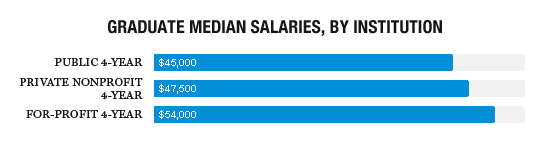
What is a shock is that the 65.2% of for-profit college grads who were employed and not in school earned a full-time median salary of $54,000. Graduates of private non-profit and public universities, on the other hand, made $47,500 and $45,000 respectively.
Before you burn that state school diploma, consider this explanation: “Traditionally, those earning degrees from for-profit college have more job experience and are older,” says Ted Socha, a mathematical statistician at NCES, which means that once they earn their diploma—even if it’s from a for-profit school—they may garner higher salaries.
Of the graduates who attended four-year for-profit colleges in 2008, 60% were over 26 years old when they received their degree. Just 16% of students at public four-year schools and 14% of students at private four-year institutions were that old when they graduated.
Meanwhile, the graduates of for-profit institutions who earned their bachelor's degree at the more common age of 22 years old or younger earn an average annual salary of $37,000—much less than the $46,000 and $45,500 earned respectively by their private non-profit and public university counterparts.
Asian graduates have it the worst
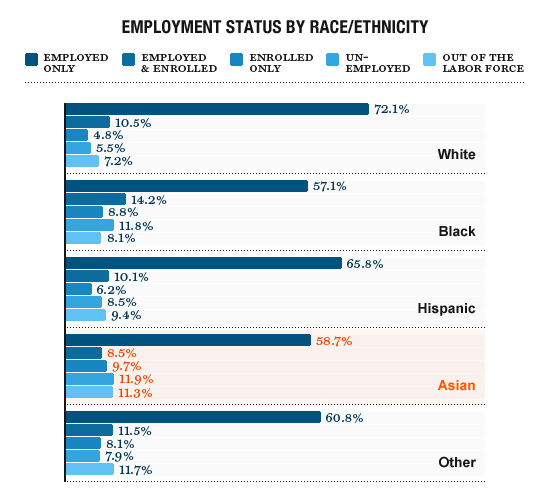
College graduates in the NCES' Asian ethnic group edged out black people with the highest unemployment rate in 2012: 11.9%. Black people reported an unemployment rate of 11.8%, while white and Hispanic people registered unemployment rates of 5.5% and 8.5%, respectively.
Socha’s team double and triple checked the high unemployment rate among Asian graduates. The rate is notable and worthy of scrutiny because, as the Pew Research Center puts it, Asian Americans are the “highest-income, best-educated, and fastest-growing racial group in the United States.”
An April 2012 study by the Economic Policy Institute that examined Asian American unemployment during the Great Recession offers this possible explanation: three-fourths of the Asian American workforce in the United States is foreign born, compared to 5% of white workers, which means language and other barriers may prevent even the most educated Asian Americans from finding jobs since employers often prefer U.S. citizens because of restrictions on hiring immigrants, the less paperwork involved, or favoritism for native-born workers, according to EPI.
Racism is also a factor, particularly for the well-educated. EPI found that Asian Americans with advanced education face more discrimination than those with less training.