FORTUNE — The wildly successful sale this week of billions of euros of newly minted Greek bonds has politicians and pundits proclaiming the end of the long-running European sovereign debt crisis. That private investors would be clamoring over each other to buy medium-term Greek notes at a measly 4.75% yield must mean that both Greece and Europe are back in fighting form and that most, if not all, of their major economic troubles are behind them.
Nothing could be further from the truth.
Thursday’s debt offering only illustrates the severity at which the global junk debt bubble has grown and how desperate investors have become in their futile search for yield. Investors have no real confidence in Greece or Europe. Either they have lost their minds or they view Greece as some sort of momentum play in which they will try to cash out right before the bottom falls out of the market. Europe remains an economic basket case, and Greece continues to be the weakest link in a brittle chain.
The Greek economy is in shambles, and the only reason it hasn’t defaulted on its debt for a third time is the European Central Bank’s low interest rate policy and the 240 billion euros in aid that have flowed into the nation’s coffers from the International Monetary Fund and the European Union over the last four years.
MORE: GM ignition recall earnings hit: $1.3 billion in first quarter
So no, the European sovereign debt crisis isn’t over. It is just taking time off from its hectic government-mandated 30-hour workweek to go on holiday.
Thursday morning in Athens started off with a real bang at the Greek Central Bank — no, literally, a bomb exploded. Thankfully, no one was hurt (the bombers called ahead and the area was evacuated by police), but the explosion did cause damage to the columned façade of the ornate building, where, up until a few years ago, monetary policy was decided by Greek officials. That role has since shifted to Frankfurt after Greece joined the euro. Now an Italian, Mario Draghi, the head of the ECB, makes those decisions for them.
The bomb was supposedly planted by Greek “anarchists,” who were protesting the country’s first big bond offering since the sovereign debt crisis broke out four years ago. Groups in opposition to the government have been labeled as such for believing that Greece should leave the euro and try to rebuild the nation’s battered economy without accumulating additional debt. Think of them like the Tea Party, but with explosives.
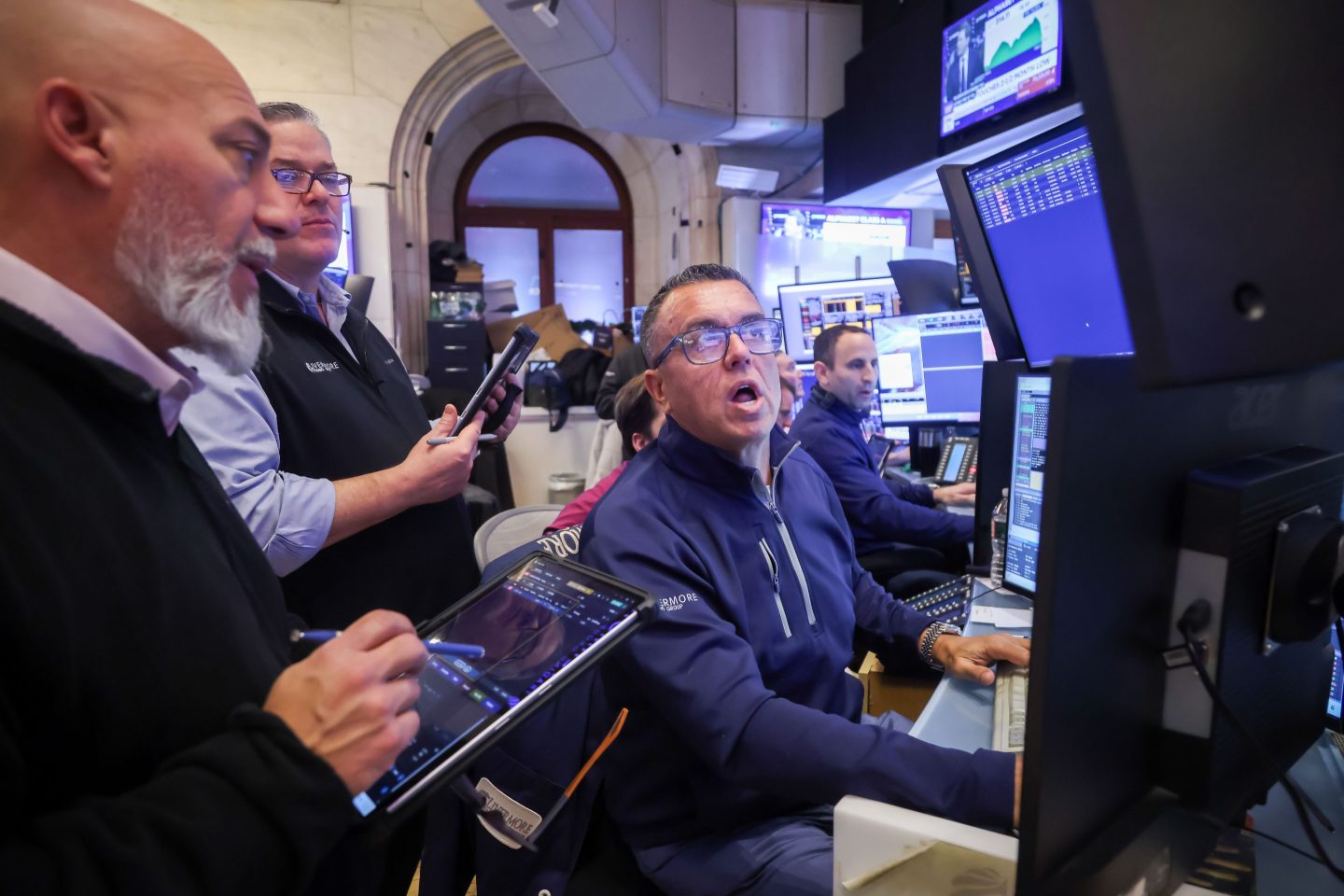
But no little bomb was going to scare off investors from throwing money at Greece, all for the chance to earn around 5% a year in interest. Many had been waiting for months for the Greek Central Bank to take the plunge and offer some longer-term notes. Up until Thursday, the central bank only offered investors very short-term 13-week and 26-week notes. Rates on that short-term paper offered investors, mostly hedge funds hopped up on risk and 5-Hour Energy shots, a chance to make a fat double-digit return on their money.
But as the global debt bubble has expanded, yields on everything from risky leveraged loans to junk bonds have fallen as fixed-income investors dial up the risk in a collective race to the bottom. They have been encouraged by the massive drop in defaults and bankruptcies across the public and private debt markets to justify their investments as sound.
Of course, bankruptcies are at an all-time low — anyone who needs funding can get it at a low rate. It is the same ridiculous justification that investors used when explaining why they bought up subprime mortgages before 2008 — foreclosures were at a near all-time low so therefore the market was safe. But as we know now, the absence of defaults and foreclosures didn’t mean that at all; it just meant that the bottom had yet to fall out of the market.
In 2010, as the U.S. was “recovering” from the housing bust, Europe was facing its biggest economic challenge since the World Wars. Investors had lent billions to nations that used the euro on the grounds that their money was safe and sound. They quickly found out that that wasn’t the case.
MORE: The worrying collapse in global trade
Greece became ground zero in this conflict. When the country had its own currency, the drachma, the Greek debt market was small, risky, illiquid, and underdeveloped — pretty much mirroring Greece’s economy. As such, there were few international investors willing to buy Greek bonds. Those that did required high returns on their investment, with interest rates well into the double-digits. So, the Greek government didn’t borrow that much cash. It kept spending at a minimum, and it financed most of its budget through taxes.
But when it joined the euro, the markets elevated Greece to first-world status, on par with nations like Germany and the Netherlands, which were also users of the single currency. With access to cheap funding, the Greeks borrowed like mad.
While some of the cash was used to build much-needed infrastructure, the bulk went to subsidizing the Greek economy. That’s because, as part of the euro, Greek exports and services suddenly became really expensive, especially to nations that weren’t on the euro, which were basically all of Greece’s neighbors.
By giving up monetary control to the ECB, the Greeks could no longer control the value of its currency or its interest rate policy. This wiped out some of Greece’s greatest strengths; namely, its cheap labor force and cheap agricultural products. Suddenly, Greece was no longer a cheap place to go on vacation — Turkey and Tunisia were just as nice, had just as much history and culture, but came at a quarter of the cost.
The Greek government used cheap debt to prop up its economy. It hired as many Greeks as it could and stuffed them in dead-end bureaucratic jobs. It built “bridges to nowhere” and white elephants. It was able to pay off the low interest on the debt pretty easily, but it never paid the principal. It just kept “rolling it over” when it came due — meaning it issued some other sucker the same amount of debt. Yes, it was a Ponzi scheme. By 2010, Greece’s debt-to-GDP ratio had reached 120%, and investors weren’t willing to play anymore. The loss of the debt machine equaled disaster.
Greece has gone through an economic depression in the last four years. Without access to the international debt markets, the country was forced to default on its debt (twice), cut government spending, and sell off assets. The IMF and EU pumped 240 billion euros into the country to keep it from descending into total chaos, but that wasn’t enough. The government had to lay off thousands, creating a chain reaction that depressed the entire economy.
Today, Greece remains an economic disaster. Even though it wiped out 100 billion euros in principal from its outstanding debt in its restructuring, it still has way too much debt on its books.
The debt wouldn’t be that big of a deal if the country had the ability to service it, but it can’t even do that. While the government has slashed spending considerably, it still runs at a deficit when factoring in the legacy debt payments, meaning that it still has to borrow money to stay afloat.
Greece’s GDP has contracted by a mind-boggling 25% in the last four years, 2.3% in the fourth quarter of 2013. It is projected to “grow” 0.5% this year, but that won’t be enough to pull the country out of its debt hole. Unemployment is running at 27%, with youth unemployment at 58%.
MORE: Golden Parachutes: Why it’s bad business
Given this scenario, would you invest in Greece? Of course not.
Simply put, Greece doesn’t stand a chance if it stays on the euro with no control over its monetary policy. Greece needs a cheaper currency to help compete with its neighbors so it can grow organically, much like it was able to do when it was on the drachma. It cannot do that if its monetary policy is being conducted in Frankfurt and its currency remains so expensive relative to the U.S. dollar and especially to the Turkish lira, its major economic rival in pretty much everything from tourism to olive production.
Some investors think that moral hazard has them covered, meaning that the EU would step in if Greece defaults, but that’s a big gamble. True, Mario Draghi, the head of the ECB, poured cold water on the overall European sovereign debt crisis in 2012 when he said he would do “whatever it takes” to back the euro, but that doesn’t mean he would be willing to fund the Greek state indefinitely. The fact that the EU allowed Greece to default shows that they aren’t too keen on paying off private investors with public money.
Greece, whose debt is rated nine notches below junk, clearly isn’t a safe investment. Real structural changes need to happen, not just inside Athens, but in Brussels, where the EU is based, for Greece to recover from this economic fiasco.