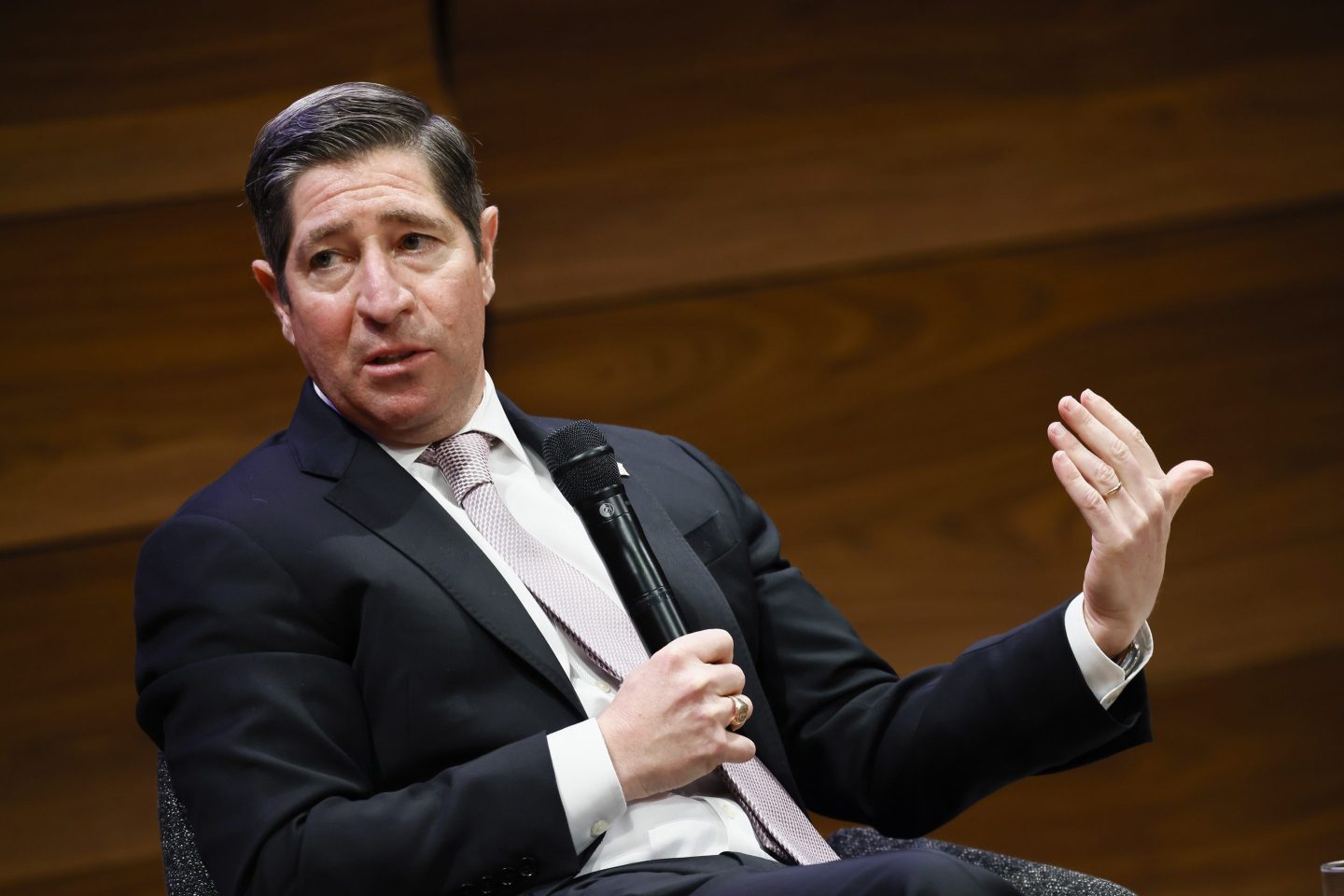

John Stumpf, CEO of Wells Fargo
FORTUNE — Can you name America’s largest bank? No, it’s not J.P. Morgan Chase (JPM) or Bank of America (BAC). It is, surprisingly, Wells Fargo (WFC), which has the highest market cap — recently $170 billion. (That has to make its largest shareholder, Warren Buffett, pretty happy.) Its secret? Focusing on loans to consumers and small to midsize businesses. It also provides one-third of all U.S. mortgages.
CEO John Stumpf, 59, took the helm at the economy’s peak in 2007, then managed through the financial crisis. He talked recently with Geoff Colvin about the reasons Americans are saving so much, Wells Fargo’s hunger for making more loans, and why it’s fighting Justice Department charges. Edited excerpts:
Q: Wells Fargo is America’s largest mortgage lender and has a larger share of the mortgage market than any bank has ever had. What’s the future of the U.S. housing market?
A: There are about 70 million homes in America. Fifty million have a mortgage on them. The average mortgage is $200,000, so you’ve got about a $10 trillion market. Today about 20% of those mortgages are underwater — they owe more than what the home is worth. But we’re starting to see values come back. I don’t know that we’ll ever be where we were or should be where we were in the last six, seven, eight years when it was just trading up. But housing is still, for two-thirds of Americans, the American dream. It’s not for everyone to own a home. But I’m bullish on housing. I’m bullish on Americans’ desire to own homes. It will be slow, but it’s healing almost everywhere.
With over 6,000 branches around the country, you have an unsurpassed window on the U.S. economy. What’s the outlook?
We’re starting a fourth year of the recovery, but it’s a very cautious recovery. People and businesses are spending money on things they need, but they’re not investing for the future in many cases. They’re putting off decisions. In fact — this is a surprise to most people — in half the mortgages that will be made this year, people will either bring money to the closing — a cash-in refi — or use the reduced rate to shorten the term and keep the payment the same. They’re paying off debt. They’re deleveraging — there’s too much uncertainty right now.

We do more small-business loans than anybody else. We have more middle-market customers, so we see a ton of customers. The approval rate is back where it was pre-recession, but the application rate is a fraction. Now it’s coming back, but we would love to have more borrowers. We typically run our company with about $1 of loans for every $1 of deposits. Today we’re in the 80% range — we’re about $200 billion short of loans. We are hungry for loans, but there’s a cautiousness because people are unsure about tax policy, about what’s going on with the fiscal cliff, regulation, and a bunch of other things. It creates this sense of uncertainty, which is a really important ingredient.
Isn’t deleveraging a good thing? There’s an argument that the financial crisis was caused in part by people having too much debt, and they need to scale it back. Is that what’s happening?
Here’s the thing that a lot of policymakers fail to understand. Consumers carry a lot more debt than they used to — in 20 years it’s gone from $4 trillion or $5 trillion to $14 trillion. But the cost of carrying that debt is back to what it was in the early ’90s because interest rates are so low. And people are saving now like they’ve never saved before.
Even at the incredibly low interest rates?
Even at incredibly low rates. In fact we think there’s something between $1.5 trillion and $2 trillion on businesses’ and consumers’ balance sheets that is sitting in our vaults. I’ve never seen it like this before. I’ve never seen the deposit growth the way we have it, and it’s not because the yields are so high. It’s security.
Does Dodd-Frank eliminate the problem of “too big to fail”?
Yes. It’s in the language. It’s in black and white. You cannot be bailed out — it’s against the law. If we screw this up, we have to fail, and management ought to get fired, and compensation ought to be clawed back. Yes!
But the worry was that if we let the really big banks fail, it would endanger the health of the whole economy. Has that changed?
No, that has not changed, but there’s a mechanism to handle that. We have $150 billion of capital. In addition to that, we have reserves set up for losses for loans. We have $12 billion of gains in our bond portfolio, plus we have about $150 billion or $160 billion of short-term and long-term debt. If you go through those steps — first hit the common-equity holders, then the preferreds, then whatever reserves — you’ll never get to the taxpayer.
Think of Wachovia [which Wells Fargo bought in 2008]. It was having challenges in the worst economic times in our generation. All bondholders got their money. All preferreds got their money. We even gave the common some money. There’s always been a mechanism for how to unwind a commercial bank that has FDIC insurance. The challenge was that when this thing hit, everybody was a bank. Fannie was a bank, Freddie was a bank, AIG (AIG) was a bank. But they weren’t truly banks. And there weren’t mechanisms for how to handle a Lehman or a Bear. Now there are.
Wells Fargo has said, “The core of our vision and strategy is cross-selling.” Every business likes cross-selling, but why is it your strategy?
Because the way we think about the business is helping customers succeed financially and satisfying all their needs. How can you do that if you only want to pick out one piece? We think that when customers have a deep, long-term relationship with us, we get to know them, they get to know us, and we can see their entire financial situation.
It’s so much easier to sell somebody the sixth product when they already have five with you and you can give them a better deal. Today we have over six products per retail household on average. A third or a fourth of our customers already have eight products or more. And we’re still scratching the surface.
It seems clear that the financial services industry has a particularly large opportunity to do this. Why are most firms so bad at it?
We always say we could leave our strategic plan on an airplane, somebody could pick it up, and it wouldn’t matter. It’s all about execution. It’s how you hire, how you inspire, your culture, how you reward, how you celebrate victories, how you deal with disappointments. This is easy to talk about, but it is all in the execution.
I remember one time a CEO of a large competitive bank, no longer there, said, “I’m going to come back from Asia. I want to stop by and buy you lunch, and tell me about this cross-sell thing.” I said, “I can’t eat that much, and I can’t eat that long.”
The Justice Department recently accused Wells of what it calls “reckless origination in the underwriting of government-backed loans.” What’s behind that?
I think they’re just wrong on that. In fact, we have filed a motion in a court in Washington for a judgment to remove that. We take these things seriously. We have been the largest originator of FHA loans for a long time. The performance speaks for itself; 93% of our customers are current. Less than 2% of our customers who own a home as primary owner go to a foreclosure. These are much better numbers than the average for the industry. We believe we’ve acted in good faith. So in some cases you just say, “No, we’re going to defend ourselves. We have lots of good defenses, and we’re going to dig our heels in.”
Over the past few years all the big banks, including Wells, have settled accusations from government about various mortgage abuses. Should consumers think, “Where there’s that much smoke, there’s fire”? Or should they think the prosecutors are hyperactive?
There’s no question our industry did not behave well in all cases, and there’s plenty of blame to go around. This could not have happened without an aggressive Fannie and Freddie. This could not have happened without people who put profits before customers, and while we didn’t do everything perfect in our company, if you look back at the numbers, we walked away from billions of dollars of originations and hundreds of millions in profits because we saw things that were not in the interest of our customers.
Did we make every right move in every case? No. But the industry I think has responded. The bad players are gone. We bought them up in many cases, and now we’re dealing with the issues of what they did. So far in our company we have helped over 3 million customers with refinancings, and we have helped 900,000 customers with modifications. We’ve forgiven over $4 billion of principal. So we are really active.
This story is from the December 3, 2012 issue of Fortune.
[cnnmoney-video vid=/video/magazines/fortune/2012/11/26/ldrshp-wells-fargo-3.fortune/]
The Leadership series This is the latest interview with a top executive by Fortune senior editor-at-large Geoff Colvin. See video excerpts of this interview at fortune.com/leadership — plus find Colvin interviews with Medtronic’s Omar Ishrak, Jack Koraleski of Union Pacific, GM’s Dan Akerson, Indra Nooyi of PepsiCo and many more.