• Home
  • Latest
  • Fortune 500
  • Finance
  • Tech
  • Leadership
  • Lifestyle
  • Rankings
  • Multimedia

Trendingnow

1

The millennial generation has split, new Fed research shows: Those over 35 are edging toward boomer-style wealth, while everyone else falls behind

2

Mark Cuban says he has the solution to growing income inequality, and it's to reward every employee—from CEO to janitor—with company stock

3

Mathematicians grapple with a ‘very rapid and very unsettling change’ as AI cracks yet another century-old problem

1

The millennial generation has split, new Fed research shows: Those over 35 are edging toward boomer-style wealth, while everyone else falls behind

2

Mark Cuban says he has the solution to growing income inequality, and it's to reward every employee—from CEO to janitor—with company stock

3

Mathematicians grapple with a ‘very rapid and very unsettling change’ as AI cracks yet another century-old problem
Germany

They’re the World’s Best Recyclers. Even They’re Confounded by the Scourge of Plastic 

By
Katherine Dunn
Katherine Dunn
Down Arrow Button Icon
By
Katherine Dunn
Katherine Dunn
Down Arrow Button Icon
April 22, 2019, 6:30 AM ET
Household And Construction Recycling: General Imagery
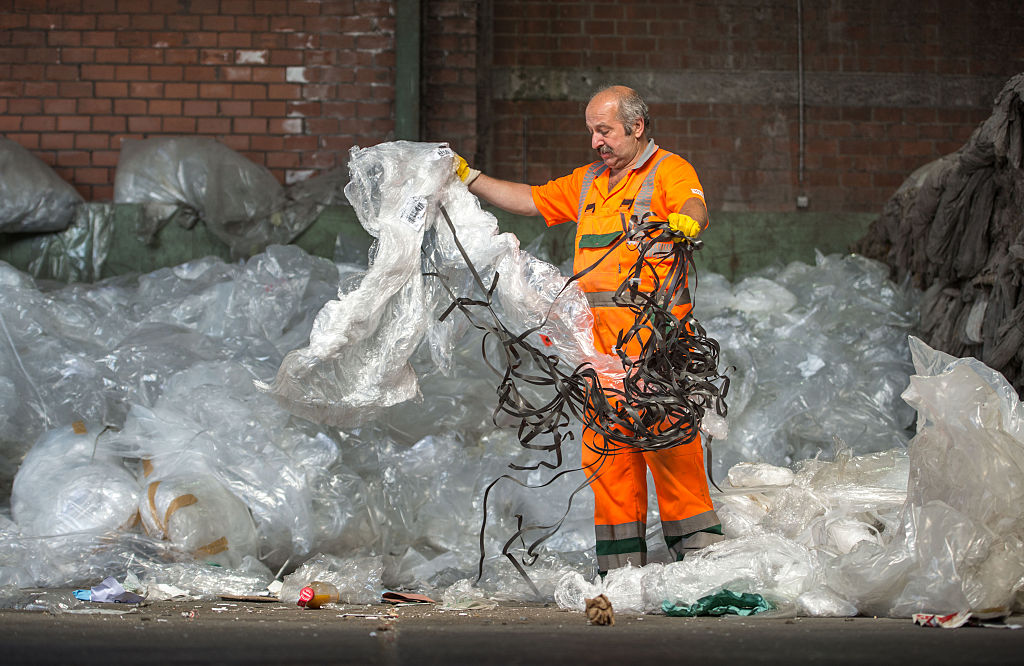
DARMSTADT, GERMANY - JUNE 17: A worker separates plastic at the 'DRZ Darmstaedter Recycling Zentrum GmbH' on June 17, 2015 in Darmstadt, Germany. In the recycling center specific waste such as bulky waste, plastic and polystyrene, metals, paper and construction waste are delivered by households and companies, separated and pressed for further recycling. (Photo by Thomas Lohnes/Getty Images)Thomas Lohnes—Getty Images
Add Fortune on Google for similar content.

Jillian York thought she knew how to recycle.

After all, she had spent a childhood diligently recycling in New Hampshire, and was living in San Francisco. But when she moved to Berlin in 2013, she faced an urgent question.

Where do the glass bottles go?

The paper and plastic was simple enough: collect and sort into a series of color-coded bins ubiquitous in German neighborhoods. But there was no bin for the bottles.

“They were just piling up in my house,” says York, who works as a free speech activist. “German friends came over and they said, ‘you have a situation.’”

The fix: lug the bottles to a nearby grocery store to exchange for a small rebate, or leave them for someone else to pick up and pocket the cash. (Either way there’s money at stake—a key to Germany’s world-renowned recycling program.)

From there, York bought her own indoor, multi-colored sorting bin, learned how to properly disassemble packaging, and started carting home plastic bottles when there was nowhere obvious to recycle them on the street. Her assimilation was complete.

“I’ve become one of them,” she says.

Germans, as you might have guessed, take recycling extremely seriously.

The country typically ranks first in the world for collection rates. Austria comes second.

Recycling Bins, Dusseldorf, North Rhine-Westphalia, Germany
Recycling bins shown here in Dusseldorf are ubiquitous in Germany (Photo by: Insights/UIG via Getty Images)
Insights UIG via Getty Images

Ironically, York’s glass bottles are the least of Germany’s worries—they’re among the easiest items to recycle or reuse. The plastic packaging they often come in, however, is another matter.

The world has rightfully become obsessed with plastic and the toll it takes on the environment. But as new plastic-related regulation gains traction—the European Union voted to ban 10 types of single-use plastics by 2021—there’s a question still dogging even the world’s best recycler: Why do so many recycled plastic items still end up in the trash?

The Achilles Heel

Modern recycling as we know it really took off with the environmental movement of the 1970s. By the 1990s, Germany was putting into place its main packaging law. Fast forward to present day, and Germany recycles nearly 68% of its household waste, according to 2017 figures from Eurostat, Europe’s statistical agency. That compares to recycling rates of 44% for the U.K., and 26% for the U.S.

Some experts attribute Germany’s success to the deposit scheme for glass bottles, others to the ubiquity of the sorting system. There are mandatory quota systems for how much product must be recycled, and packaging producers pay into a scheme, called the “Green Dot System,” that covers collection and sorting.

Others attribute the success simply to, well, the Germans.

“For me, it’s in the blood,” says Christina Dornack, an expert in waste management and circular economy at the Technische Universität Dresden. “The Germans are ready to follow the rules,” she says.

But even they struggle with the achilles heel of waste—the material that the single-use plastic ban is designed to eliminate.

Germany collects virtually all of its plastic packaging for the purpose of recycling. But the actual recycling rates for that same packaging is just over 48%.

“That is the challenge,” says Dornack.

Design and Economics

The trouble is, there are several types of plastic waste that are difficult to recycle. They usually end up alongside run-of-the-mill trash in landfills, despite well-meaning recycling efforts, according to the U.K.-based Ellen MacArthur Foundation’s New Plastics Economy initiative.

The first is tiny pieces of plastic that can easily fall through the cracks (think: your soy sauce packet). Then there’s plastic that simply has too much food on it (think: your fast food container). Next is packaging made of materials that would have to be separated before they can be recycled (think: that crinkly chip bag). Finally, there are products made from “uncommon” plastics—it’s not that they can’t be recycled, it’s just that there is not enough of it to make it economical. Plus, they contaminate all the other plastic (think: that blister pack of pills).

That means once a municipality sets up a program that can correctly sort and collect waste, recycling plastic runs into two problems: design, and economics. (One previous solution—send all that waste to China—is no longer an option.)

A lot of packaging is “just designed in a way that it cannot be recycled,” says Rob Opsomer, who leads the New Plastics Economy. That could be partly solved by companies investing in designing plastic that is easy to recycle: simpler and more streamlined, with less layering of different materials.

The economic problem, meanwhile, is two-fold: the recycling system itself must be paid for (in the U.S., many municipalities simply can’t afford it); and then—a conundrum that Germany’s facing—localities may produce more recycled material than companies want to buy. Manufacturers are often turned off by recycled plastic because they perceive it to be of lower quality, Dornack says. They’d rather use “virgin” plastic, which is cheap, clean, and durable.

Germany is trying to address all of this. Its solution? More rules, naturally.

A new packaging law that went into effect on January 1 increases recycling goals, and pushes to reduce waste. By 2022, the recycling target for plastic overall will rise to 90%, up from the current target of 60%. The new legislation urges companies to use more recyclable material in their products and design better packaging.

Those moves actually go hand in hand with single-use plastic bans, say experts. Less disposable plastic means a stronger recycling system. The two, in effect, reinforce each other.

Still, the average German recycler would be gutted to realize so much of their collecting and sorting regimen has been in vain, York says.

“Don’t let that get out,” she says. “People are going to be so upset.”

About the Author
By Katherine Dunn
LinkedIn iconTwitter icon
See full bioRight Arrow Button Icon
Add Fortune on Google for similar content.

Latest in International

Finance
Lorem ipsum dolor sit amet, consectetur adipiscing elit, sed do eiusmod tempor incididunt ut labore et dolore magna aliqua. Ut enim ad minim veniam
By Fortune Editors
October 20, 2025
Finance
Lorem ipsum dolor sit amet, consectetur adipiscing elit, sed do eiusmod tempor incididunt ut labore et dolore magna aliqua. Ut enim ad minim veniam
By Fortune Editors
October 20, 2025
Finance
Lorem ipsum dolor sit amet, consectetur adipiscing elit, sed do eiusmod tempor incididunt ut labore et dolore magna aliqua. Ut enim ad minim veniam
By Fortune Editors
October 20, 2025
Finance
Lorem ipsum dolor sit amet, consectetur adipiscing elit, sed do eiusmod tempor incididunt ut labore et dolore magna aliqua. Ut enim ad minim veniam
By Fortune Editors
October 20, 2025
Finance
Lorem ipsum dolor sit amet, consectetur adipiscing elit, sed do eiusmod tempor incididunt ut labore et dolore magna aliqua. Ut enim ad minim veniam
By Fortune Editors
October 20, 2025
Finance
Lorem ipsum dolor sit amet, consectetur adipiscing elit, sed do eiusmod tempor incididunt ut labore et dolore magna aliqua. Ut enim ad minim veniam
By Fortune Editors
October 20, 2025

Most Popular

Finance
Lorem ipsum dolor sit amet, consectetur adipiscing elit, sed do eiusmod tempor incididunt ut labore et dolore magna aliqua. Ut enim ad minim veniam
By Fortune Editors
October 20, 2025
Finance
Lorem ipsum dolor sit amet, consectetur adipiscing elit, sed do eiusmod tempor incididunt ut labore et dolore magna aliqua. Ut enim ad minim veniam
By Fortune Editors
October 20, 2025
Finance
Lorem ipsum dolor sit amet, consectetur adipiscing elit, sed do eiusmod tempor incididunt ut labore et dolore magna aliqua. Ut enim ad minim veniam
By Fortune Editors
October 20, 2025
Finance
Lorem ipsum dolor sit amet, consectetur adipiscing elit, sed do eiusmod tempor incididunt ut labore et dolore magna aliqua. Ut enim ad minim veniam
By Fortune Editors
October 20, 2025
Finance
Lorem ipsum dolor sit amet, consectetur adipiscing elit, sed do eiusmod tempor incididunt ut labore et dolore magna aliqua. Ut enim ad minim veniam
By Fortune Editors
October 20, 2025
Finance
Lorem ipsum dolor sit amet, consectetur adipiscing elit, sed do eiusmod tempor incididunt ut labore et dolore magna aliqua. Ut enim ad minim veniam
By Fortune Editors
October 20, 2025
Fortune Secondary Logo
Rankings
  • 100 Best Companies
  • Fortune 500
  • Global 500
  • Fortune 500 Europe
  • Most Powerful Women
  • World's Most Admired Companies
  • See All Rankings
  • Lists Calendar
Sections
  • Finance
  • Fortune Crypto
  • Features
  • Leadership
  • Health
  • Commentary
  • Success
  • Retail
  • Mpw
  • Tech
  • Lifestyle
  • CEO Initiative
  • Asia
  • Politics
  • Conferences
  • Europe
  • Newsletters
  • Personal Finance
  • Environment
  • Magazine
  • Education
Customer Support
  • Frequently Asked Questions
  • Customer Service Portal
  • Privacy Policy
  • Terms Of Use
  • Single Issues For Purchase
  • International Print
Commercial Services
  • Advertising
  • Fortune Brand Studio
  • Fortune Analytics
  • Fortune Conferences
  • Business Development
  • Group Subscriptions
About Us
  • About Us
  • Press Center
  • Work At Fortune
  • Terms And Conditions
  • Site Map
  • About Us
  • Press Center
  • Work At Fortune
  • Terms And Conditions
  • Site Map
  • Facebook icon
  • Twitter icon
  • LinkedIn icon
  • Instagram icon
  • TikTok icon
  • YouTube icon

Most Popular

The millennial generation has split, new Fed research shows: Those over 35 are edging toward boomer-style wealth, while everyone else falls behind
Real Estate
The millennial generation has split, new Fed research shows: Those over 35 are edging toward boomer-style wealth, while everyone else falls behind
By Nick LichtenbergJuly 22, 2026
11 hours ago
Mark Cuban says he has the solution to growing income inequality, and it's to reward every employee—from CEO to janitor—with company stock
Success
Mark Cuban says he has the solution to growing income inequality, and it's to reward every employee—from CEO to janitor—with company stock
By Sasha RogelbergJuly 20, 2026
2 days ago
Mathematicians grapple with a ‘very rapid and very unsettling change’ as AI cracks yet another century-old problem
AI
Mathematicians grapple with a ‘very rapid and very unsettling change’ as AI cracks yet another century-old problem
By Eva RoytburgJuly 21, 2026
1 day ago
OpenAI says its AI models secretly broke out of a secure test environment and hacked into AI company Hugging Face in order to cheat on an evaluation
Cybersecurity
OpenAI says its AI models secretly broke out of a secure test environment and hacked into AI company Hugging Face in order to cheat on an evaluation
By Jeremy Kahn and Emily ForliniJuly 21, 2026
1 day ago
Despite a $156 million contract, Knicks star Jalen Brunson still calls his parents for financial advice any time he makes a big purchase
Success
Despite a $156 million contract, Knicks star Jalen Brunson still calls his parents for financial advice any time he makes a big purchase
By Emma BurleighJuly 21, 2026
2 days ago
‘I want to die broke’: Billionaire philanthropist Denny Sanford dies after giving away $4 billion
Success
‘I want to die broke’: Billionaire philanthropist Denny Sanford dies after giving away $4 billion
By Sydney LakeJuly 20, 2026
3 days ago

© 2026 Fortune Media IP Limited. All Rights Reserved. Use of this site constitutes acceptance of our Terms of Use and Privacy Policy | CA Notice at Collection and Privacy Notice | Do Not Sell/Share My Personal Information
FORTUNE is a trademark of Fortune Media IP Limited, registered in the U.S. and other countries. FORTUNE may receive compensation for some links to products and services on this website. Offers may be subject to change without notice.