• Home
  • Latest
  • Fortune 500
  • Finance
  • Tech
  • Leadership
  • Lifestyle
  • Rankings
  • Multimedia
Commentary

How Megadonors Could Rescue America’s Universities

By
Jeffrey Sonnenfeld
Jeffrey Sonnenfeld
Down Arrow Button Icon
By
Jeffrey Sonnenfeld
Jeffrey Sonnenfeld
Down Arrow Button Icon
November 6, 2018, 3:25 PM ET
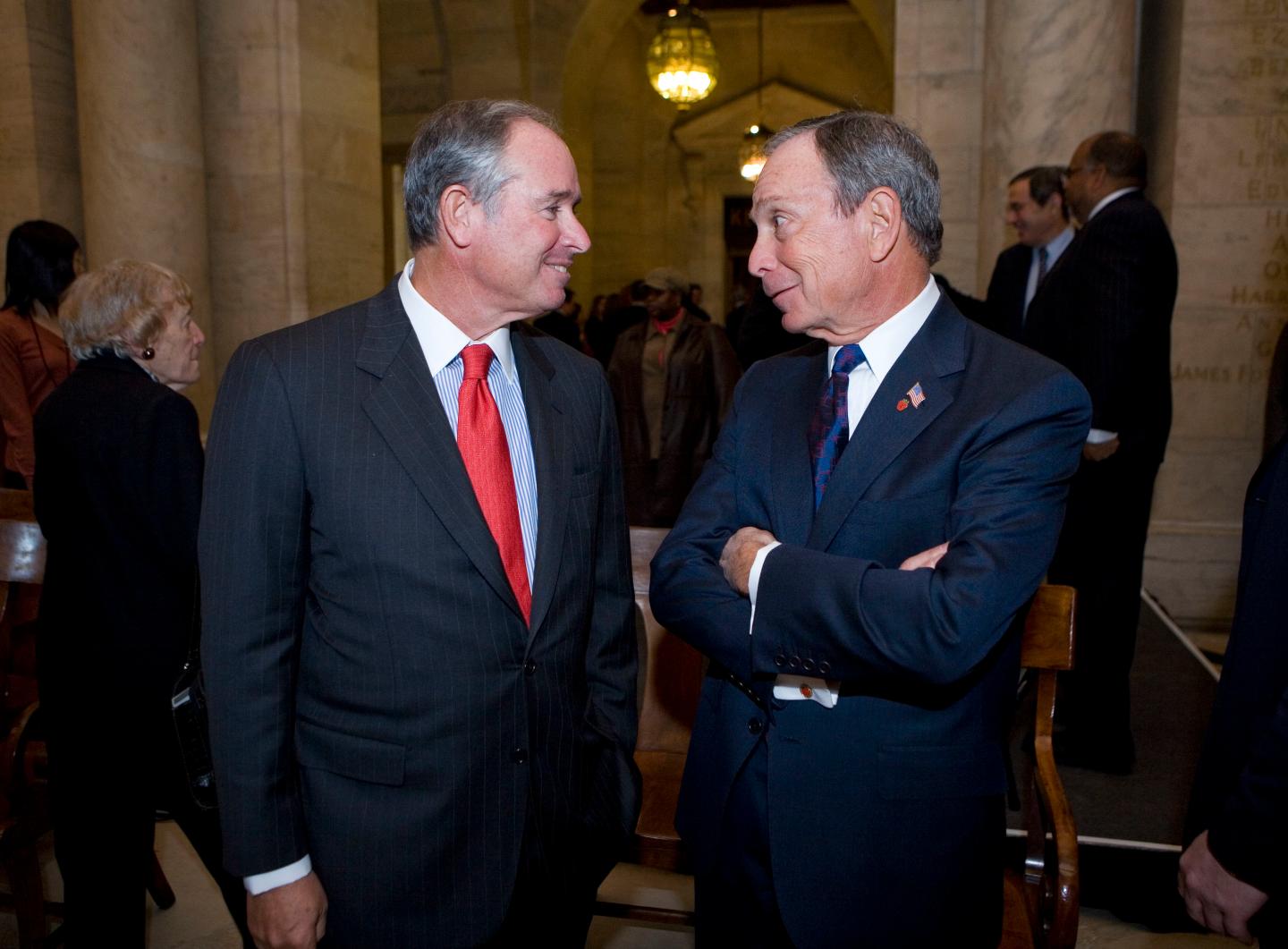
New York City Mayor Michael Bloomberg and Blackstone CEO Stephen Schwarzman talk after a news conference at the New York Public Library.
New York City Mayor Michael Bloomberg (R) and Stephen Schwarzman, Chairman and Chief Executive Officer of Blackstone Group LP, talk after a news conference at the New York Public Library's (NYPL) announcing a pledge of $100 million donation by Schwarzman to the NYPL in New York. The New York Public Library main branch on Fifth Avenue will be renamed after Schwarzman. $100 million is the largest ever guaranteed donation to a New York cultural organization. (Photo by Ramin Talaie/Corbis via Getty Images)Ramin Talaie—Corbis via Getty Images

Blackstone chief Stephen Schwarzman’s recent eye-popping gift creating MIT’s new $1 billion College of Computing is a not only a transformational contribution to a stellar institution, but an endorsement of the importance of U.S. higher education to our country’s global competitiveness.

It also signals a shift in how higher education institutions can survive in our new political and cultural climate.

Schwarzman’s enthusiasm is countered by an assault on university endowments, nationally by the Republican Party, and in fiscally starved states, by local Democratic parties. Schools are threatened by increasingly discouraging immigration policies. State spending on public universities, while recently inching higher, remains highly uncertain. And higher education has been losing the traditional support of major philanthropic foundations. The Ford Foundation, for instance, announced this summer that it had dropped all higher education strategic priorities as part of its mission.

Fortunately, Schwarzman is not alone in making huge investments in American higher education. Since 1967, wealthy individuals have donated over 200 gifts of $100 million or more to higher education.

These current donors are different from past philanthropists in important ways.

First, these donors tend to be business builders, with most of them representing first-generation entrepreneurial wealth. Schwarzman is joined by other such builders who have given $100 million or more to higher education, including Michael Bloomberg, Phil Knight, Bill Gates, John Paulson, Michael Dell, and Ken Langone. All of these men are examples of those who achieved the American dream and wanted to give back.

Second, these donors tend to give while they live rather than defer to late life or posthumous gifts. By contrast, many past industrialists such as Andrew Carnegie, Henry Ford, and John D. Rockefeller made their gifts in their final years or through their heirs—too late to help guide the paths of their beneficiaries. Furthermore, these barons were motivated to cleanse earlier career controversies.

Today’s philanthropic business leaders are not driven to counterbalance allegations of misconduct; rather, they are proud of their careers and eager to shape the impact of their gifts while they are younger. They are donating earlier to share their wisdom, relationships, and energy in real time so they can match the profound finances of each gift.

Thus rather than provide unrestricted general institutional support, these new donors are pragmatic and specific. Bloomberg’s 2016 gift of $300 million to the Johns Hopkins School of Public Health was focused on research into the decline of U.S. life expectancy. Schwarzman’s MIT gift and Paulson’s Harvard gift explicitly target the advancement of the study of artificial intelligence and its disruptive opportunities for society. Langone’s gift to NYU will provide full tuition coverage to all new medical students.

Third, these megadonors’ approach is matched by a spend-down schedule for their personal foundations, in which money is allocated with the condition that it be spent in a limited period of time, rather than in perpetuity. This differs, again, from predecessors like Ford, Rockefeller, and Carnegie.

While spend-down strategies accounted for only 5% of the total assets of America’s 50 largest foundations 50 years ago, that share rose to 24% by 2010. With the exponential growth of ultra-wealthy individuals, this approach should continue to expand.

Spending down philanthropic money helps reduce tensions between donors and school administrators when school priorities shift away from original donor intentions. One example of this drift was in the 2000s, when the descendants of the Robertsons, whose family gave a $35 million endowment in 1961 to expand Princeton’s Woodrow Wilson School of Public and International Affairs, claimed that the gift was being used to train students for different careers than the Robertsons had originally intended.

Using philanthropic contributions within donors’ lifetimes can also cut administrative overhead, enhance transparency, and contain suspected ideological biases—which some industrialists worry can trend against business on campus—since donors can see how their money is being used.

The challenge on the agendas of new donors is that they want to bet on winners; according to a 2017 survey by the Council for Aid to Education, 28% of donations went to the 20 colleges surveyed that raised the most money. Donors don’t necessarily do this to seek vanity by endowing elite institutions. They are looking to work with schools with proven track records and that are efficient in spending philanthropic contributions. This could push other schools to become more efficient and focused on social issues in order to attract new donors.

Of course, universities often do not often welcome this donor intrusion in setting administrative priorities, limiting overhead allocations, and directing more pragmatic faculty research. Additionally, they fear a pro-business ideology seeping into the classroom.

At the same time, universities need these new generous friends as traditional sources of funding retrench. They are also dealing with a public skeptical of higher education. Over 60% of Americans think higher education in the U.S. is heading in the wrong direction.

While foundations, legislators, and the general public lose enthusiasm for colleges, it is fortunate that these new donors appreciate the competitive value of investing in these centers of free thought and innovation. But the donors should not expect that all on campus will appreciate their vital generosity.

Coco Chanel once said, “True generosity means accepting ingratitude.”

Jeffrey Sonnenfeld is the senior associate dean for leadership studies and Lester Crown professor of management practice at the Yale School of Management, and author of Firing Back: How CEOs Rebound From Career Disasters.

About the Author
By Jeffrey Sonnenfeld

Jeffrey Sonnenfeld is the Lester Crown Professor in Management Practice and Senior Associate Dean at Yale School of Management.

See full bioRight Arrow Button Icon

Latest in Commentary

Finance
Lorem ipsum dolor sit amet, consectetur adipiscing elit, sed do eiusmod tempor incididunt ut labore et dolore magna aliqua. Ut enim ad minim veniam
By Fortune Editors
October 20, 2025
Finance
Lorem ipsum dolor sit amet, consectetur adipiscing elit, sed do eiusmod tempor incididunt ut labore et dolore magna aliqua. Ut enim ad minim veniam
By Fortune Editors
October 20, 2025
Finance
Lorem ipsum dolor sit amet, consectetur adipiscing elit, sed do eiusmod tempor incididunt ut labore et dolore magna aliqua. Ut enim ad minim veniam
By Fortune Editors
October 20, 2025
Finance
Lorem ipsum dolor sit amet, consectetur adipiscing elit, sed do eiusmod tempor incididunt ut labore et dolore magna aliqua. Ut enim ad minim veniam
By Fortune Editors
October 20, 2025
Finance
Lorem ipsum dolor sit amet, consectetur adipiscing elit, sed do eiusmod tempor incididunt ut labore et dolore magna aliqua. Ut enim ad minim veniam
By Fortune Editors
October 20, 2025
Finance
Lorem ipsum dolor sit amet, consectetur adipiscing elit, sed do eiusmod tempor incididunt ut labore et dolore magna aliqua. Ut enim ad minim veniam
By Fortune Editors
October 20, 2025

Most Popular

Finance
Lorem ipsum dolor sit amet, consectetur adipiscing elit, sed do eiusmod tempor incididunt ut labore et dolore magna aliqua. Ut enim ad minim veniam
By Fortune Editors
October 20, 2025
Finance
Lorem ipsum dolor sit amet, consectetur adipiscing elit, sed do eiusmod tempor incididunt ut labore et dolore magna aliqua. Ut enim ad minim veniam
By Fortune Editors
October 20, 2025
Finance
Lorem ipsum dolor sit amet, consectetur adipiscing elit, sed do eiusmod tempor incididunt ut labore et dolore magna aliqua. Ut enim ad minim veniam
By Fortune Editors
October 20, 2025
Finance
Lorem ipsum dolor sit amet, consectetur adipiscing elit, sed do eiusmod tempor incididunt ut labore et dolore magna aliqua. Ut enim ad minim veniam
By Fortune Editors
October 20, 2025
Finance
Lorem ipsum dolor sit amet, consectetur adipiscing elit, sed do eiusmod tempor incididunt ut labore et dolore magna aliqua. Ut enim ad minim veniam
By Fortune Editors
October 20, 2025
Finance
Lorem ipsum dolor sit amet, consectetur adipiscing elit, sed do eiusmod tempor incididunt ut labore et dolore magna aliqua. Ut enim ad minim veniam
By Fortune Editors
October 20, 2025
Fortune Secondary Logo
Rankings
  • 100 Best Companies
  • Fortune 500
  • Global 500
  • Fortune 500 Europe
  • Most Powerful Women
  • Future 50
  • World’s Most Admired Companies
  • See All Rankings
Sections
  • Finance
  • Fortune Crypto
  • Features
  • Leadership
  • Health
  • Commentary
  • Success
  • Retail
  • Mpw
  • Tech
  • Lifestyle
  • CEO Initiative
  • Asia
  • Politics
  • Conferences
  • Europe
  • Newsletters
  • Personal Finance
  • Environment
  • Magazine
  • Education
Customer Support
  • Frequently Asked Questions
  • Customer Service Portal
  • Privacy Policy
  • Terms Of Use
  • Single Issues For Purchase
  • International Print
Commercial Services
  • Advertising
  • Fortune Brand Studio
  • Fortune Analytics
  • Fortune Conferences
  • Business Development
  • Group Subscriptions
About Us
  • About Us
  • Editorial Calendar
  • Press Center
  • Work At Fortune
  • Diversity And Inclusion
  • Terms And Conditions
  • Site Map
  • About Us
  • Editorial Calendar
  • Press Center
  • Work At Fortune
  • Diversity And Inclusion
  • Terms And Conditions
  • Site Map
  • Facebook icon
  • Twitter icon
  • LinkedIn icon
  • Instagram icon
  • Pinterest icon

Latest in Commentary

raikes
CommentaryMicrosoft
Jeff Raikes: AI is capturing cognition — and most companies are building a talent debt they don’t see yet
By Jeff RaikesApril 15, 2026
39 minutes ago
clinton
Commentarydisruption
I was a government official in the 1990s and watched the economy get turned upside-down. It’s happening again
By Maria FlynnApril 15, 2026
2 hours ago
dees
CommentaryNational Security
A retired general’s warning: America can’t fight the AI arms race on tech it doesn’t control
By Robert F. DeesApril 15, 2026
2 hours ago
fudd
CommentarySports
Azzi Fudd: how I learned to use NIL for transformation, not just transactions
By Azzi FuddApril 15, 2026
3 hours ago
crowell
CommentaryRetirement
Retirees are facing a $345,000 bill they never saw coming — and most aren’t prepared
By Andrew CrowellApril 14, 2026
1 day ago
AI agents are acting like employees, but company structures still treat them like software
CommentaryOkta
AI agents are acting like employees, but company structures still treat them like software
By Dan MountstephenApril 13, 2026
2 days ago

Most Popular

Billionaire philanthropist MacKenzie Scott has donated again—a week after gifting millions to a college, she's just given $70 million to Meals on Wheels America
Success
Billionaire philanthropist MacKenzie Scott has donated again—a week after gifting millions to a college, she's just given $70 million to Meals on Wheels America
By Fortune EditorsApril 13, 2026
2 days ago
Retirees are facing a $345,000 bill they never saw coming — and most aren't prepared
Commentary
Retirees are facing a $345,000 bill they never saw coming — and most aren't prepared
By Fortune EditorsApril 14, 2026
1 day ago
He was coding at 12 like Elon Musk and became one of Google’s youngest-ever CMOs—but now says Gen Z is better off ice skating than learning to code
Success
He was coding at 12 like Elon Musk and became one of Google’s youngest-ever CMOs—but now says Gen Z is better off ice skating than learning to code
By Fortune EditorsApril 14, 2026
1 day ago
Anthropic is facing a wave of user backlash over reports of performance issues with its Claude AI chatbot
AI
Anthropic is facing a wave of user backlash over reports of performance issues with its Claude AI chatbot
By Fortune EditorsApril 14, 2026
1 day ago
Palantir CEO says working at his $316 billion software company is better than a degree from Harvard or Yale: ‘No one cares about the other stuff’
Success
Palantir CEO says working at his $316 billion software company is better than a degree from Harvard or Yale: ‘No one cares about the other stuff’
By Fortune EditorsApril 14, 2026
1 day ago
Warren Buffett’s first tax return showed $7 owed to the IRS. The then paperboy and former Berkshire Hathaway CEO is now worth $143 billion
Success
Warren Buffett’s first tax return showed $7 owed to the IRS. The then paperboy and former Berkshire Hathaway CEO is now worth $143 billion
By Fortune EditorsApril 14, 2026
24 hours ago

© 2026 Fortune Media IP Limited. All Rights Reserved. Use of this site constitutes acceptance of our Terms of Use and Privacy Policy | CA Notice at Collection and Privacy Notice | Do Not Sell/Share My Personal Information
FORTUNE is a trademark of Fortune Media IP Limited, registered in the U.S. and other countries. FORTUNE may receive compensation for some links to products and services on this website. Offers may be subject to change without notice.