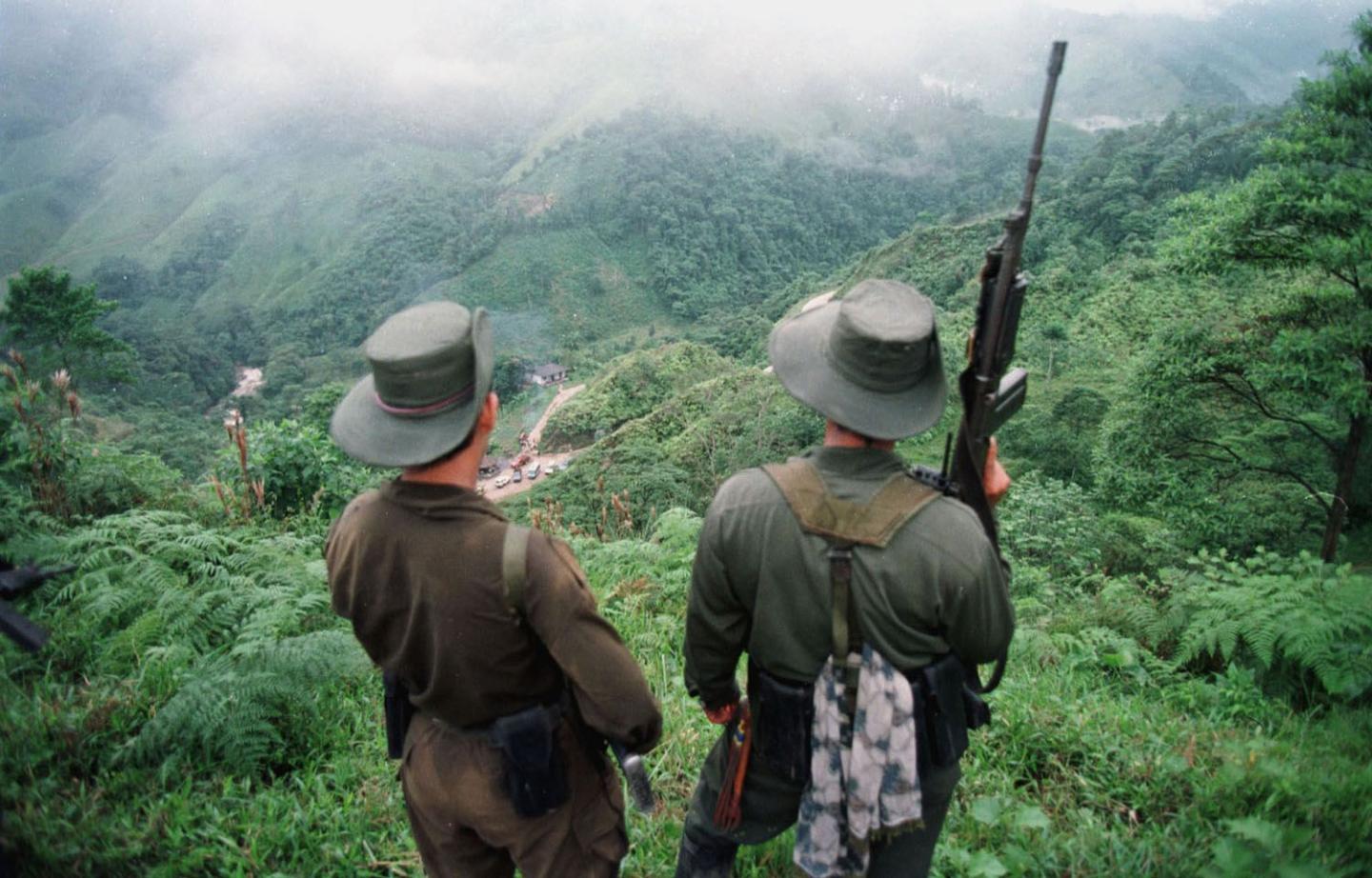
Colombia, a country that has battled powerful drug lords and guerilla fighters, has become more stable recently, thanks in large part to an improved political situation and increased safety. But according to some Colombians, that may all soon change, depending on the result on this weekend’s presidential election.
This election is the country’s first since a historic peace deal that ended 50 years of war between the Colombian government and the insurgent group FARC, known for its violence and kidnappings. As part of the agreement, FARC was guaranteed 10 seats out of the 268 within Colombia’s Congress until 2026 instead of the jail time many hoped the group’s leaders would receive.
In essence, the agreement turned FARC into a political party. A Gallup poll in August 2017 found that 12% of Colombians now have a favorable opinion of the FARC—slightly higher than the 10% for the country’s traditional political parties. The agreement was an incredibly polarizing topic, and the country is still split over the peace agreement.
That said, homicide rates are the lowest they’ve been in years, but coca farming remains a problem. Additionally, small groups have broken away from FARC and are now operating independently, essentially keep FARC alive on a smaller scale.
In his election campaign, frontrunner candidate Ivan Duque, who opposes the peace agreement, takes a tough stance against corruption and FARC, including advocating that drug trafficking be a crime that is ineligible for amnesty. The other leading candidate Gustavo Petro, on the other hand, supports the deal and goes so far as to blame former Colombian President Alvaro Uribe for the expansion of paramilitarism, or the war-like state in the country.
The recurring fear for many Colombians is that their country will become the next Venezuela, which is wrought with inflation and political turmoil, should Petro be elected. Petro is a strong supporter of embattled Venezuelan President Nicolas Maduro.
In recent years, American tourists have flocked to Colombia, the third most populous in South America. Americans represent the largest group of tourists, followed by Europeans. In 2006, only 1 million people visited Colombia, but that increased to 5.8 million in 2017.
In 2015, Colombia was cited in a MasterCard study as being among the 10 countries that were expected to have the fastest-growing tourist markets. Its tourism growth rate was expected to exceed the overall growth of South America.
Bogota, the capital and largest city, accounts for almost 50% of Colombia’s tourism, followed by the coastal city of Cartagena, with its tropical beaches and picturesque historic district. Medellin, a city that gained notoriety from hometown cocaine drug lord Pablo Escobar, and Cali, also of drug trafficking fame, are also popular destinations.
Americans are attracted by the country’s increased safety (largely thanks to the peace deal) and the decline in value of the peso, which makes for a favorable exchange rate. Top that off with generally cheap prices for American travelers, and you’ve hit gold. But, should Colombia become like a Venezuela as some Colombians fear, no one will want to visit.
Petro, a former mayor of the capital city of Bogota, is also a former M-19 gang member who served a leader of its political arm. He is campaigning on building a socialist economy and claims to be the champion of the common folk, similar to now deceased Venezuelan President Hugo Chavez. While in M-19, a gang separate from FARC which he joined as a teenager, Petro played a crucial role in promoting peace talks with the Colombian government, ushering in amnesty for his fellow gang members.
Petro, who has called Colombia one of the world’s most unequal countries, wants to close the inequality gap. He hopes to address the problem by taxing owners of unproductive land (much of which has been used to farm coca and has not been transitioned), overhaul the tax code, and move away from the export of oil and coal and be more dependent on clean energy instead. According to Reuters, “to contain the fiscal deficit, he would promote another tax reform to raise duties on corporate dividends and foreign profits and eliminate tax exemptions for large investors.”
As mayor, Petro had trouble keeping leadership positions filled, with over two dozen administration members resigning during his tenure (sound familiar?). His advisor positions were filled with former guerilleros, like himself.
In late 2013, Petro was removed from his mayoral position, the most powerful in the country after the presidency, for mismanagement of garbage collection and was subsequently banned from holding office for 15 years. The ruling was later overturned.
Because of his past and his leftist ideologies, dissidents tried to assassinate Petro while on the campaign trail and he has received numerous death threats. If he wins, he would likely get little support in the Colombian Congress, making it an uphill battle to enact his ideas.
Critics say Petro’s policies would cause inflation and a devaluation of the peso. They also say it could lead to restrictions on the sale of U.S. dollars, hurt pension plans, and increase unemployment and insecurity.
Petro supporters like Simon Rivera, a 26-year-old architect from Medellin, say he is the change the country needs. “He is different from the ones who have historically governed the country. He is not from the traditional families,” says Rivera.
Rivera hopes that he will help bring more equality to Colombia and continue to do the work he did as mayor of Bogota—create jobs, reduce the cost of living, and build schools.
When it comes to Petro’s past gang affiliation, it doesn’t bother Rivera. “In a country with a history where the elites decided to split up the power and made other people feel left out, some decide to pick up arms to fight for political power.” That’s just what Petro did.
Rivera also believes that “the history of a candidate is a reflection of the many factors around them in the different parts of their lives.”
But others see Petro as a socialist who will bring only bad things to Colombia. Duque, on the other hand, is a business-friendly politician who wants to encourage more international investment in the country.
“The specter of a socialist candidate is certainly alarming,” Charle Gamba, chief executive of Canadian energy company Canacol, which has most of its operations in Colombia, said in an interview with Bloomberg last month. Mario Castro, a strategist at Nomura Holdings, foresees a “very negative” market reaction if there’s strong public backing for Petro, says Bloomberg.
Other candidates who appear to be trailing the frontrunners are Sergio Farjado, a former governor in Colombia focused on education; German Vargas, current vice president for Juan Manuel Santos; Humberto de la Calle, who was instrumental in the FARC peace deal; and Jorge Antonio Trujillo, who trails in the polls.
According to Mario Esteban Madrid, a Colombian in his late 20s who lives in Medellin and recently opened his own company, Duque represents “a continuity of institutionalism,” while Petro represents a “social and economic left turn.”
Madrid says, “Colombia is about to define its future, deciding between keeping its relatively stable path or beginning a total change.” It seems eerily similar to the American choice between Donald Trump and Hilary Clinton for president.
According to one poll, two-thirds of Colombians are unhappy with the way the country is going, so the anti-establishment rhetoric is certainly hitting a nerve.
Petro, eerily similar to Trump, has railed against voter fraud and has called on his supporters to act as voting witnesses, watching over the polls.
Colombia has been known as a reliable right-wing South American country, despite FARC’s influences in the past, and has never elected a leftist president. It is the only South American nation not to have done so.
Alvaro Arango, who also lives in Medellin and is a former president of food conglomerate Nutresa, says, “If Petro wins, we run the risk of not generating a dynamic economy in respect to the industries that bring wealth the country [coffee, oil, flowers, etc.].”
Arango also says, “In the case that Ivan Duque wins, he would give priority to instigate the economic development favored by formal business and the knowledge to generate wealth and eliminate social inequalities.” Arango does, however, believe that no matter who wins, the institutional and democratic Colombian tradition will prevail.
According to Colombian polls, which should be taken with a grain of salt, Duque’s support has grown, and is especially strong in the 45-54 age group, He remains in the lead, but Petro has also found his niche demographic and continues to build his support.
In the hypothetical event of a runoff, Duque is expected to win. Currently, over 30% of those polled said they would “never vote for Petro,” and when narrowed down to businesspeople, only 1.5% would vote for him.

A first-round ballot in the presidential election will be held on May 27, but if no candidate gets more than half the votes, a second round will be held in June. The new president will take office in August.