• Home
  • Latest
  • Fortune 500
  • Finance
  • Tech
  • Leadership
  • Lifestyle
  • Rankings
  • Multimedia
CommentarySyria

Commentary: How Trump Can Neutralize Assad in Syria

By
Behnam Ben Taleblu
Behnam Ben Taleblu
and
Bethany Cianciolo
Bethany Cianciolo
Down Arrow Button Icon
By
Behnam Ben Taleblu
Behnam Ben Taleblu
and
Bethany Cianciolo
Bethany Cianciolo
Down Arrow Button Icon
April 13, 2018, 6:16 PM ET
SYRIA-CONFLICT-YARMUK
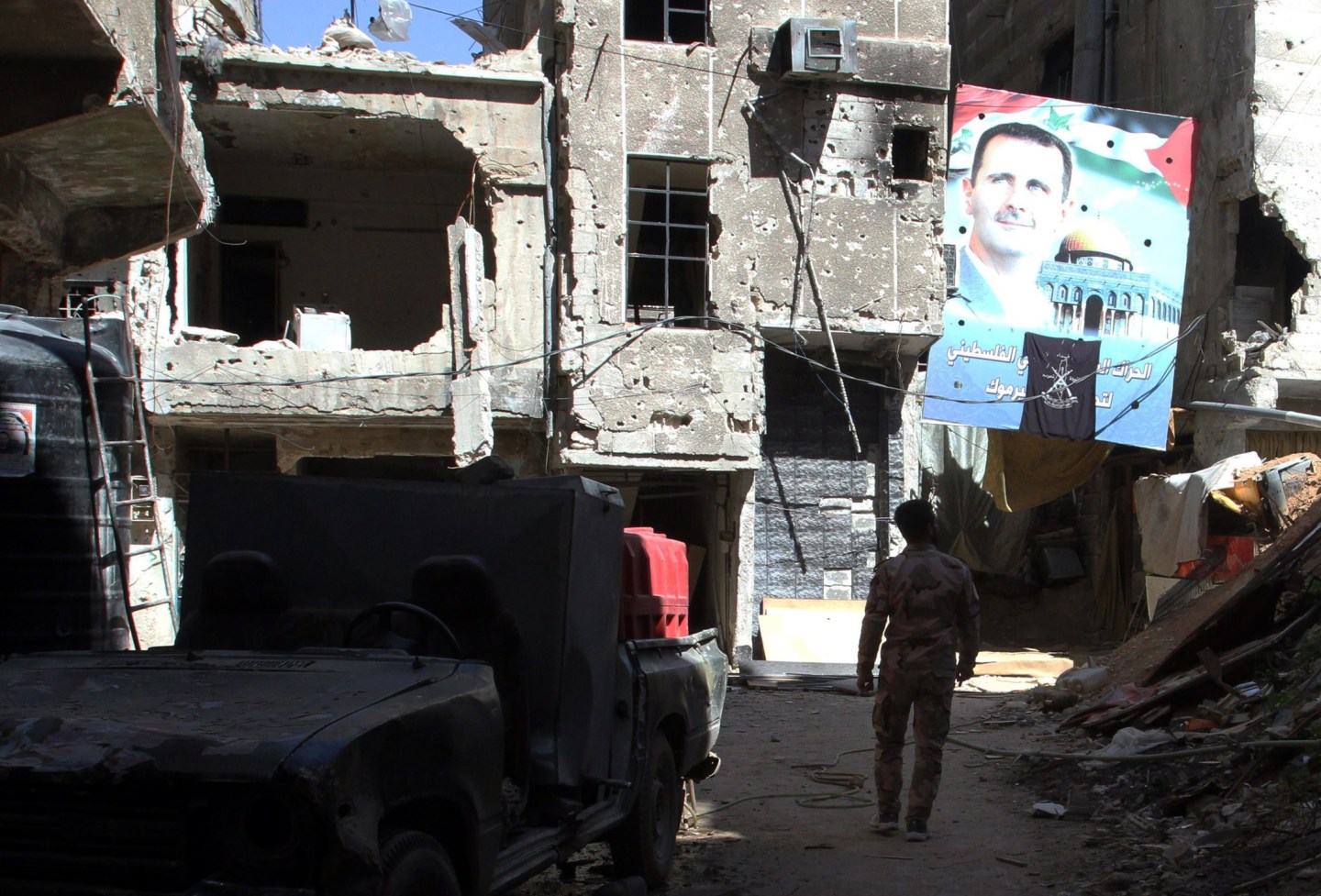
A man walks under a portrait of Syrian President Bashar al-Assad in a street inside the Yarmuk Palestinian refugee camp in the Syrian capital Damascus on April 6, 2015. A group of 14 Palestinian factions said on April 9, that they backed a joint military operation with the Syrian government to expel Islamic State group jihadists from the Yarmuk camp in southern Damascus. AFP PHOTO / YOUSSEF KARWASHAN (Photo credit should read YOUSSEF KARWASHAN/AFP/Getty Images)Youssef Karwashan—AFP/Getty Images

Ali-Akbar Velayati, a foreign affairs advisor to Iran’s Supreme Leader, met with Syrian dictator Bashar al-Assad on Thursday, just one day after U.S. President Donald Trump threatened military action against Damascus for its latest chemical attacks. The timing of the meeting attests to the resoluteness of Iranian support to Assad, which has only intensified over the past seven years of the Syrian Civil War. As the U.S. contemplates an appropriate military response, it must not miss an opportunity to contest Iran in the most important theater to it in the Middle East.

Iranian officials have routinely stressed the importance of Syria in Iran’s regional designs. Some have called on Iran to “possess” Syria, while others have framed Iran’s intervention there as necessary “to protect the accomplishments of the Islamic Revolution.” A chief accomplishment of this revolution was the creation of Lebanese Hezbollah.

Syria remains Tehran’s preferred Iranian land conduit to arm Lebanese Hezbollah with rockets and missiles. These weapons are more than just an impediment to Israeli security. They are what Iranian officials are counting on when they routinely threaten to destroy Tel-Aviv and Haifa. Iran has also tasked Lebanese Hezbollah with turning the tide in Tehran’s favor in multiple conflict zones. In Iraq, the group refined the terrorist tradecraft of anti-American Shiite insurgents. In Syria, they fought alongside Assad’s army in countless battles. In Yemen, they are reportedly training the country’s Houthi rebels. The success Iran had with Hezbollah can only be matched by the recent proliferation of pro-Iran Shiite militias throughout the region.

To shore up Assad, Iran has created scores of these mini-Hezbollahs all under the guise of combatting the so-called Islamic State. In the battle to save Assad, they are complimented by members of Iran’s own Islamic Revolutionary Guard Corps (IRGC), as well as thousands of Afghan and Pakistani Shiites. Despite suffering casualties in Syria, all of these forces remain active. But the regime has not stopped at troops. As early as 2012, the Islamic Republic provided the Assad regime with powerful conventional munitions, like the Fateh-110 short-range ballistic missile. Since then, Iran has hedged against interdiction strikes—which the Israelis have executed multiple times—and has reportedly taken to building missile bases and factories on Syrian soil.

All of this should focus the mind of President Trump and his advisors on Iran’s activities in Syria. The threat posed by the Assad regime to the Syrian people, to Israel, and to broader Middle East stability (as well as to Europe through the prism of the refugee issue) remains a function of the larger threat posed by an ascendant Iran. The lack of a coherent response to Iran in the Syrian theater makes this task all the more urgent, and admittedly, difficult, for U.S. national security planners.

Last April, in response to the Assad regime’s use of sarin, President Trump attempted to restore American credibility in Syria through limited cruise missile strikes. Iranian officials were quick to condemn the action, but did not fundamentally alter their activity in Syria. Although the strike could be interpreted as a signal of resolve against Assad and Iran, there was no follow-up to solidify that impression. To date, Washington has not developed a strategy in Syria to contest Tehran’s gains.

Any prospective U.S. military action in Syria must see last April’s strike as an indicator of what not to do again. First, to stem Assad’s use of chemical weapons, Washington must destroy the bulk of his regime’s delivery systems that include military jets and helicopters. Then, Washington should move to deny Assad use of his conventional weapons, some of which, like artillery, were also used to deliver chemical weapons. Should Washington decide to escalate further, it can target Shiite militiamen, as well as Lebanese Hezbollah. These forces function as auxiliaries to Syrian military power, having participated in both battles and sieges on behalf of Assad and Iran.

To compliment such actions, Washington must also bring to bear an arsenal of non-military tools such as economic sanctions against the Assad regime’s murky domestic assets and foreign financiers. This requires more than designating those who buy and sell oil on behalf of the Syrian regime. It means further penalizing Iranian financial institutions that enable Assad’s war machine and fund Iran’s logistics in Syria.


Another tool is diplomatic messaging. The recent wave of protests in Iran scolded the Islamic Republic for putting the regime’s foreign clients ahead to its own people. Consistently highlighting the cost of Iran’s intervention in Syria, be it in terms of blood, treasure, or national reputation, might invigorate the population to return en-masse to the streets. It would also signal solidarity with the countless Iranians whose cries of “Abandon Syria, think about us” during the 2017/2018 protests were derided by pro-IRGC outlets.

To be clear, the U.S. recognizes the need to push back on Iran’s regional ambitions, but seems unwilling to apply this idea to Syria. In October 2017, President Trump unveiled a long-awaited and admirable integrated Iran strategy that framed the Iranian challenge as being much broader than just the nuclear issue. That strategy plainly stated: “The Iranian regime has taken advantage of regional conflicts and instability to aggressively expand its regional influence and threaten its neighbors with little domestic or international cost for its actions.”

The Trump administration must impose a significant cost on Iran for its regional destabilization and support to the Assad regime. As long as Washington circumscribes its involvement in Syria, it will fail to meaningfully impede Iran. “We are waiting for you in Syria,” taunted the head of a pro-Iran Shiite militia. Decisive action in Syria against Iranian interests would ensure these militias do not have to wait much longer.

Behnam Ben Taleblu is a research fellow at Foundation for Defense of Democracies (FDD), a Washington-based, nonpartisan research institute focusing on national security and foreign policy.


About the Authors
By Behnam Ben Taleblu
See full bioRight Arrow Button Icon
By Bethany Cianciolo
See full bioRight Arrow Button Icon

Latest in Commentary

Finance
Lorem ipsum dolor sit amet, consectetur adipiscing elit, sed do eiusmod tempor incididunt ut labore et dolore magna aliqua. Ut enim ad minim veniam
By Fortune Editors
October 20, 2025
Finance
Lorem ipsum dolor sit amet, consectetur adipiscing elit, sed do eiusmod tempor incididunt ut labore et dolore magna aliqua. Ut enim ad minim veniam
By Fortune Editors
October 20, 2025
Finance
Lorem ipsum dolor sit amet, consectetur adipiscing elit, sed do eiusmod tempor incididunt ut labore et dolore magna aliqua. Ut enim ad minim veniam
By Fortune Editors
October 20, 2025
Finance
Lorem ipsum dolor sit amet, consectetur adipiscing elit, sed do eiusmod tempor incididunt ut labore et dolore magna aliqua. Ut enim ad minim veniam
By Fortune Editors
October 20, 2025
Finance
Lorem ipsum dolor sit amet, consectetur adipiscing elit, sed do eiusmod tempor incididunt ut labore et dolore magna aliqua. Ut enim ad minim veniam
By Fortune Editors
October 20, 2025
Finance
Lorem ipsum dolor sit amet, consectetur adipiscing elit, sed do eiusmod tempor incididunt ut labore et dolore magna aliqua. Ut enim ad minim veniam
By Fortune Editors
October 20, 2025

Most Popular

Finance
Lorem ipsum dolor sit amet, consectetur adipiscing elit, sed do eiusmod tempor incididunt ut labore et dolore magna aliqua. Ut enim ad minim veniam
By Fortune Editors
October 20, 2025
Finance
Lorem ipsum dolor sit amet, consectetur adipiscing elit, sed do eiusmod tempor incididunt ut labore et dolore magna aliqua. Ut enim ad minim veniam
By Fortune Editors
October 20, 2025
Finance
Lorem ipsum dolor sit amet, consectetur adipiscing elit, sed do eiusmod tempor incididunt ut labore et dolore magna aliqua. Ut enim ad minim veniam
By Fortune Editors
October 20, 2025
Finance
Lorem ipsum dolor sit amet, consectetur adipiscing elit, sed do eiusmod tempor incididunt ut labore et dolore magna aliqua. Ut enim ad minim veniam
By Fortune Editors
October 20, 2025
Finance
Lorem ipsum dolor sit amet, consectetur adipiscing elit, sed do eiusmod tempor incididunt ut labore et dolore magna aliqua. Ut enim ad minim veniam
By Fortune Editors
October 20, 2025
Finance
Lorem ipsum dolor sit amet, consectetur adipiscing elit, sed do eiusmod tempor incididunt ut labore et dolore magna aliqua. Ut enim ad minim veniam
By Fortune Editors
October 20, 2025
Fortune Secondary Logo
Rankings
  • 100 Best Companies
  • Fortune 500
  • Global 500
  • Fortune 500 Europe
  • Most Powerful Women
  • Future 50
  • World’s Most Admired Companies
  • See All Rankings
Sections
  • Finance
  • Fortune Crypto
  • Features
  • Leadership
  • Health
  • Commentary
  • Success
  • Retail
  • Mpw
  • Tech
  • Lifestyle
  • CEO Initiative
  • Asia
  • Politics
  • Conferences
  • Europe
  • Newsletters
  • Personal Finance
  • Environment
  • Magazine
  • Education
Customer Support
  • Frequently Asked Questions
  • Customer Service Portal
  • Privacy Policy
  • Terms Of Use
  • Single Issues For Purchase
  • International Print
Commercial Services
  • Advertising
  • Fortune Brand Studio
  • Fortune Analytics
  • Fortune Conferences
  • Business Development
  • Group Subscriptions
About Us
  • About Us
  • Editorial Calendar
  • Press Center
  • Work At Fortune
  • Diversity And Inclusion
  • Terms And Conditions
  • Site Map
  • About Us
  • Editorial Calendar
  • Press Center
  • Work At Fortune
  • Diversity And Inclusion
  • Terms And Conditions
  • Site Map
  • Facebook icon
  • Twitter icon
  • LinkedIn icon
  • Instagram icon
  • Pinterest icon

Latest in Commentary

benioff
CommentarySalesforce
AI’s next act: how Salesforce is turning efficiency gains into revenue
By Keith Ferrazzi and Wendy SmithApril 18, 2026
20 hours ago
trump
CommentaryWhite House
Trump has already endorsed the Monroe Doctrine. Now he needs to endorse the Truman Doctrine
By Robert HormatsApril 18, 2026
23 hours ago
trump
CommentaryManufacturing
Tariffs alone won’t save American manufacturing — here’s what actually will
By Johan "Kip" EidebergApril 18, 2026
23 hours ago
hormuz
CommentaryIran
With Hormuz under strain, a trade corridor built for resilience faces a real-world test
By Angela Chitkara and Samantha SuttonApril 17, 2026
2 days ago
broker
CommentarySoftware
The 3 forces quietly dismantling the business model that made enterprise software fabulously profitable
By Michael Jacobides and Stefano PuntoniApril 17, 2026
2 days ago
welti
CommentaryIran
Switzerland’s former ambassador to Iran: here’s how to end this war — and why Pakistan isn’t enough
By Philippe WeltiApril 17, 2026
2 days ago

Most Popular

'We should absolutely be concerned about non-college-educated men today': higher rents, living at home, falling out of the labor market
Economy
'We should absolutely be concerned about non-college-educated men today': higher rents, living at home, falling out of the labor market
By Catherina GioinoApril 18, 2026
1 day ago
Older millennials are starting to act like boomers in the housing market—and pulling away from the pack
Real Estate
Older millennials are starting to act like boomers in the housing market—and pulling away from the pack
By Nick LichtenbergApril 17, 2026
2 days ago
The power has swung back to employers—and workers are paying for it in benefits, flexibility, and leverage
Workplace Culture
The power has swung back to employers—and workers are paying for it in benefits, flexibility, and leverage
By Marco Quiroz-GutierrezApril 17, 2026
2 days ago
MacKenzie Scott has donated more than $26 billion—but it's barely made a dent in her net worth because of the power of Amazon shares
Success
MacKenzie Scott has donated more than $26 billion—but it's barely made a dent in her net worth because of the power of Amazon shares
By Sydney LakeApril 18, 2026
16 hours ago
Putin finally admits Russia's economy is in trouble and grasps for answers, after warnings about a financial crisis have been piling up
Economy
Putin finally admits Russia's economy is in trouble and grasps for answers, after warnings about a financial crisis have been piling up
By Jason MaApril 18, 2026
10 hours ago
Current price of oil as of April 17, 2026
Personal Finance
Current price of oil as of April 17, 2026
By Joseph HostetlerApril 17, 2026
2 days ago

© 2026 Fortune Media IP Limited. All Rights Reserved. Use of this site constitutes acceptance of our Terms of Use and Privacy Policy | CA Notice at Collection and Privacy Notice | Do Not Sell/Share My Personal Information
FORTUNE is a trademark of Fortune Media IP Limited, registered in the U.S. and other countries. FORTUNE may receive compensation for some links to products and services on this website. Offers may be subject to change without notice.