• Home
  • Latest
  • Fortune 500
  • Finance
  • Tech
  • Leadership
  • Lifestyle
  • Rankings
  • Multimedia

Trendingnow

1

Gen Z fled San Francisco for Texas and Florida. Now they’re turning ‘welcomer cities’ into the next big tech towns

2

Melinda French Gates' advice to new IPO millionaires: 'Give half your money away'

3

Trump expects to sign a deal with Iran on Sunday, but Tehran may want to avoid giving him a gift on his birthday

1

Gen Z fled San Francisco for Texas and Florida. Now they’re turning ‘welcomer cities’ into the next big tech towns

2

Melinda French Gates' advice to new IPO millionaires: 'Give half your money away'

3

Trump expects to sign a deal with Iran on Sunday, but Tehran may want to avoid giving him a gift on his birthday
Commentary

The Technology Behind Bitcoin Could Come in Handy at the SEC

By
Andrew Poelstra
Andrew Poelstra
and
Bethany Cianciolo
Bethany Cianciolo
Down Arrow Button Icon
By
Andrew Poelstra
Andrew Poelstra
and
Bethany Cianciolo
Bethany Cianciolo
Down Arrow Button Icon
September 28, 2017, 9:38 AM ET
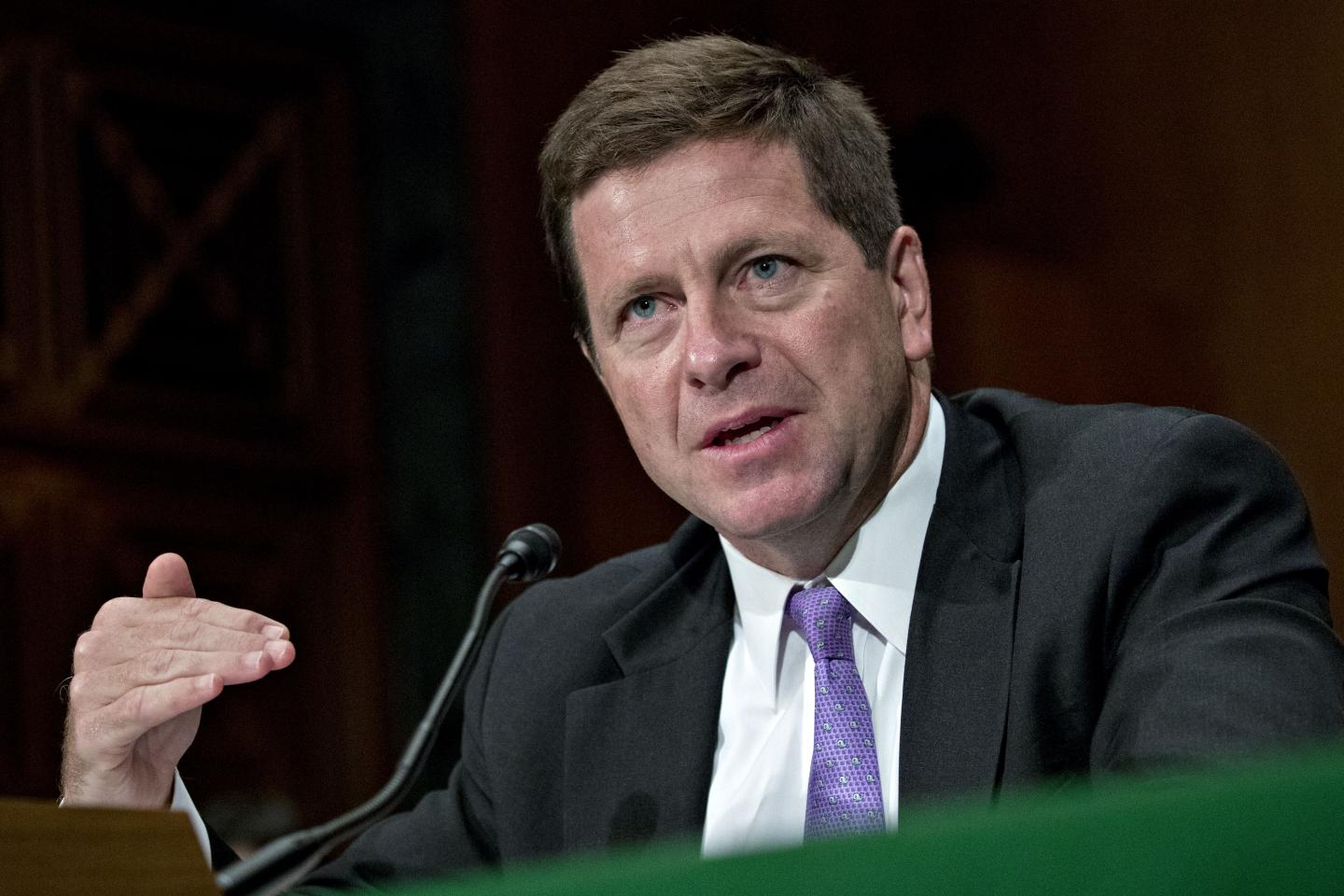
SEC Chairman Jay Clayton Testifies Before The Senate Banking Committee Hearing
Jay Clayton, chairman of the U.S. Securities and Exchange Commission (SEC), speaks during a Senate Banking Committee hearing in Washington, D.C., U.S., on Tuesday, Sept. 26, 2017. The SEC told government cybersecurity officials about a hack into its database of corporate filings soon after it happened last year, months before the agency's new chairman made the breach public. Photographer: Andrew Harrer/Bloomberg via Getty ImagesAndrew Harrer/Bloomberg via Getty Images

Last year, as was recently revealed, the SEC’s network was hacked, giving criminals access to non-public information before it became public, and potential access to lucrative and illegal trading opportunities. But if the SEC adopted technology similar to blockchains, where data must be secured while being stored on public networks, it could have prevented hackers from learning anything from the sensitive data they may have gotten their hands on.

The specific network, Electronic Data Gathering, Analysis and Retrieval (Edgar), is dedicated to the online collection of such information, which the SEC uses to watch actors on the financial stage and detect bad behavior. Financial regulations are full of reporting requirements related to data such as that collected by Edgar, and it is an implicit assumption in the financial world that the SEC, and all regulatory bodies, can be trusted to keep non-public data secret and secure. This trust is based on the SEC’s ability to monitor its network and stay ahead of any would-be attackers. While on the whole, the SEC does a commendable job at this, it is an ongoing battle in which both sides are continually improving their techniques.

In contrast to the carefully controlled information flows of traditional finance, on the Bitcoin blockchain, everything is public. It’s public because it is a decentralized and permission-less system: There are no central authorities to decide the validity of transactions, so everything must be publicly verifiable by the system’s users. Bitcoin has been criticized for its transparency, which leaves no room for confidentiality, or even personal privacy. Despite its reputation as an anonymous currency, Bitcoin is anything but, and researchers in the space are actively working to bring to Bitcoin the basic privacy technology it needs to work as a serious financial system.

Unlike the SEC, Bitcoin has no network boundary that can be secured. Anybody can join the system, every transaction is public, and its entire history is stored on the thousands of computers which comprise its peer-to-peer network. How, then, can security researchers prevent these sorts of unwanted disclosures?

Enter applied cryptography. This little-known field of mathematics deals with secure transmission of data across unsecured networks. It is the reason you can check your bank balance at a coffee-shop hotspot, or log into Facebook (FB) from a cell phone whose only communication medium—the air—can be tapped by anyone in a miles-wide radius. The data is still secure—what a hacker reads out of the air is random gibberish with no correlation to your Facebook data. In recent years, applied cryptographers have turned their attention to blockchains like Bitcoin, whose public nature makes them the ultimate unsecured network.

A lesson from their research, which the SEC may do well to take to heart, is that the easiest way to keep information private is to create systems in which there is no need for it to exist in the first place. As an example, consider one of the most basic rules written into the Bitcoin system: Transactions have to balance. The money that comes out of a transaction had better be matched by money that went into it. Today, Bitcoin solves this by publishing the exact amounts involved in every transaction, which verifiers download and check for equality. It’s easy to see that this works, but just as easy to see that it’s a privacy nightmare.

An alternate option, dubbed ”confidential assets” by its inventors at Blockstream, hides the amounts behind “homomorphic commitments,” a special way of scrambling numbers such that they can still be added together, even by someone who has no idea what those numbers were. Checking that a transaction balances is as simple as making sure that the input commitments add up to the same thing as the output commitments. In other words, the fact that a transaction balances is made public, but no other information about its amounts ever reaches the public eye.

Building on confidential assets, “Mimblewimble,” a form of applied cryptography (and alternate blockchain design to Bitcoin), goes one giant step further by breaking even the linkage between transactions’ inputs and outputs. It was invented by an anonymous cryptographer using the moniker Tom Elvis Jedusor, the birth name of Voldemort in the French Harry Potter books. While the identity of its creator may never be revealed, researchers have taken the idea seriously and are continuing to build on it.


Of course, the individuals who produce these transactions know the amounts, and they’re still able to provide that information to the SEC, which can later check mathematically that the reported data corresponds to the commitments on the blockchain. The difference is that these reporting requirements are no longer required in real time, since the rule they’re needed to enforce (that transactions must balance) can be checked using only the public blockchain. The need to report on sensitive data can therefore be satisfied by higher-latency, higher-security communication systems (such as hard drives transported to the SEC).

In a world where network boundaries are increasingly under attack, and information is harder to keep secret, it is worth looking at public blockchains, which have no network boundaries and therefore no secrets. In particular, techniques blockchains use to achieve confidentiality without the assumption of a secure border may prove to be useful in a world where this assumption too often turns out to be untrue.

Andrew Poelstra is a cryptographer at Blockstream.

About the Authors
By Andrew Poelstra
See full bioRight Arrow Button Icon
By Bethany Cianciolo
See full bioRight Arrow Button Icon

Latest in Commentary

Finance
Lorem ipsum dolor sit amet, consectetur adipiscing elit, sed do eiusmod tempor incididunt ut labore et dolore magna aliqua. Ut enim ad minim veniam
By Fortune Editors
October 20, 2025
Finance
Lorem ipsum dolor sit amet, consectetur adipiscing elit, sed do eiusmod tempor incididunt ut labore et dolore magna aliqua. Ut enim ad minim veniam
By Fortune Editors
October 20, 2025
Finance
Lorem ipsum dolor sit amet, consectetur adipiscing elit, sed do eiusmod tempor incididunt ut labore et dolore magna aliqua. Ut enim ad minim veniam
By Fortune Editors
October 20, 2025
Finance
Lorem ipsum dolor sit amet, consectetur adipiscing elit, sed do eiusmod tempor incididunt ut labore et dolore magna aliqua. Ut enim ad minim veniam
By Fortune Editors
October 20, 2025
Finance
Lorem ipsum dolor sit amet, consectetur adipiscing elit, sed do eiusmod tempor incididunt ut labore et dolore magna aliqua. Ut enim ad minim veniam
By Fortune Editors
October 20, 2025
Finance
Lorem ipsum dolor sit amet, consectetur adipiscing elit, sed do eiusmod tempor incididunt ut labore et dolore magna aliqua. Ut enim ad minim veniam
By Fortune Editors
October 20, 2025

Most Popular

Finance
Lorem ipsum dolor sit amet, consectetur adipiscing elit, sed do eiusmod tempor incididunt ut labore et dolore magna aliqua. Ut enim ad minim veniam
By Fortune Editors
October 20, 2025
Finance
Lorem ipsum dolor sit amet, consectetur adipiscing elit, sed do eiusmod tempor incididunt ut labore et dolore magna aliqua. Ut enim ad minim veniam
By Fortune Editors
October 20, 2025
Finance
Lorem ipsum dolor sit amet, consectetur adipiscing elit, sed do eiusmod tempor incididunt ut labore et dolore magna aliqua. Ut enim ad minim veniam
By Fortune Editors
October 20, 2025
Finance
Lorem ipsum dolor sit amet, consectetur adipiscing elit, sed do eiusmod tempor incididunt ut labore et dolore magna aliqua. Ut enim ad minim veniam
By Fortune Editors
October 20, 2025
Finance
Lorem ipsum dolor sit amet, consectetur adipiscing elit, sed do eiusmod tempor incididunt ut labore et dolore magna aliqua. Ut enim ad minim veniam
By Fortune Editors
October 20, 2025
Finance
Lorem ipsum dolor sit amet, consectetur adipiscing elit, sed do eiusmod tempor incididunt ut labore et dolore magna aliqua. Ut enim ad minim veniam
By Fortune Editors
October 20, 2025
Fortune Secondary Logo
Rankings
  • 100 Best Companies
  • Fortune 500
  • Global 500
  • Fortune 500 Europe
  • Most Powerful Women
  • World's Most Admired Companies
  • See All Rankings
  • Lists Calendar
Sections
  • Finance
  • Fortune Crypto
  • Features
  • Leadership
  • Health
  • Commentary
  • Success
  • Retail
  • Mpw
  • Tech
  • Lifestyle
  • CEO Initiative
  • Asia
  • Politics
  • Conferences
  • Europe
  • Newsletters
  • Personal Finance
  • Environment
  • Magazine
  • Education
Customer Support
  • Frequently Asked Questions
  • Customer Service Portal
  • Privacy Policy
  • Terms Of Use
  • Single Issues For Purchase
  • International Print
Commercial Services
  • Advertising
  • Fortune Brand Studio
  • Fortune Analytics
  • Fortune Conferences
  • Business Development
  • Group Subscriptions
About Us
  • About Us
  • Press Center
  • Work At Fortune
  • Terms And Conditions
  • Site Map
  • About Us
  • Press Center
  • Work At Fortune
  • Terms And Conditions
  • Site Map
  • Facebook icon
  • Twitter icon
  • LinkedIn icon
  • Instagram icon
  • Pinterest icon

Latest in Commentary

t
CommentaryTariffs
A quartz countertop tariff could double your kitchen renovation cost — and kill 13 jobs for every one it creates
By Steve SwedbergJune 14, 2026
8 hours ago
nexstar
CommentaryAntitrust
Nexstar CEO: big tech swallowed local newspapers. Local TV could be next
By Perry A. SookJune 14, 2026
8 hours ago
ravi
CommentaryWeather and forecasting
I spent 8 years flood-proofing a city. Capital markets are running out of time to take El Niño seriously
By Ravi S. BhallaJune 13, 2026
1 day ago
herrin
CommentaryInfrastructure
America just committed $1.2 trillion to fix its infrastructure. We’re still flying blind
By Gregg HerrinJune 13, 2026
1 day ago
cyber
Commentarycyber
Accenture cyber leads: why hiring more people won’t solve the cybersecurity talent gap
By Harpreet Sidhu and Vikram DesaiJune 13, 2026
1 day ago
t
CommentaryHospitality
AI is making promises your brand never made. Hotels are paying the price
By Teresa MackintoshJune 13, 2026
1 day ago

Most Popular

Gen Z fled San Francisco for Texas and Florida. Now they’re turning ‘welcomer cities’ into the next big tech towns
Real Estate
Gen Z fled San Francisco for Texas and Florida. Now they’re turning ‘welcomer cities’ into the next big tech towns
By Sydney LakeJune 13, 2026
1 day ago
Melinda French Gates' advice to new IPO millionaires: 'Give half your money away'
Startups & Venture
Melinda French Gates' advice to new IPO millionaires: 'Give half your money away'
By Emma HinchliffeJune 13, 2026
1 day ago
Trump expects to sign a deal with Iran on Sunday, but Tehran may want to avoid giving him a gift on his birthday
Middle East
Trump expects to sign a deal with Iran on Sunday, but Tehran may want to avoid giving him a gift on his birthday
By Jason MaJune 13, 2026
21 hours ago
'It's not a jailbreak' — Research leading to U.S. export restrictions on top Anthropic models was for defense, cybersecurity CEO says
AI
'It's not a jailbreak' — Research leading to U.S. export restrictions on top Anthropic models was for defense, cybersecurity CEO says
By Jason MaJune 13, 2026
24 hours ago
SpaceX CFO Bret Johnsen quietly engineered its historic IPO and became an overnight billionaire
C-Suite
SpaceX CFO Bret Johnsen quietly engineered its historic IPO and became an overnight billionaire
By Sasha RogelbergJune 13, 2026
1 day ago
Anthropic disables Fable and Mythos AI models after U.S. government bars it from giving foreigners access
AI
Anthropic disables Fable and Mythos AI models after U.S. government bars it from giving foreigners access
By Jeremy KahnJune 13, 2026
2 days ago

© 2026 Fortune Media IP Limited. All Rights Reserved. Use of this site constitutes acceptance of our Terms of Use and Privacy Policy | CA Notice at Collection and Privacy Notice | Do Not Sell/Share My Personal Information
FORTUNE is a trademark of Fortune Media IP Limited, registered in the U.S. and other countries. FORTUNE may receive compensation for some links to products and services on this website. Offers may be subject to change without notice.