• Home
  • Latest
  • Fortune 500
  • Finance
  • Tech
  • Leadership
  • Lifestyle
  • Rankings
  • Multimedia

Trendingnow

1

'I literally was crying last night because I’m nervous about what I’m going to find out': a record 51% of Americans aren't 'cost secure' on health

2

Jeff Bezos pledged $10 billion for climate change. With the 2030 clock ticking, his wife, Lauren Sánchez Bezos, is leading the charge to spend it

3

The Great Recession’s missing children are finally bringing college’s financial crisis into sight. Welcome to the ‘enrollment volatility’ era

1

'I literally was crying last night because I’m nervous about what I’m going to find out': a record 51% of Americans aren't 'cost secure' on health

2

Jeff Bezos pledged $10 billion for climate change. With the 2030 clock ticking, his wife, Lauren Sánchez Bezos, is leading the charge to spend it

3

The Great Recession’s missing children are finally bringing college’s financial crisis into sight. Welcome to the ‘enrollment volatility’ era
Commentary

Women Can Drive Now in Saudi Arabia. Here’s What They Still Can’t Do.

By
Rachel Vogelstein
Rachel Vogelstein
and
Bethany Cianciolo
Bethany Cianciolo
Down Arrow Button Icon
By
Rachel Vogelstein
Rachel Vogelstein
and
Bethany Cianciolo
Bethany Cianciolo
Down Arrow Button Icon
September 28, 2017, 5:05 PM ET
SAUDI-WOMEN-RIGHTS-DRIVE
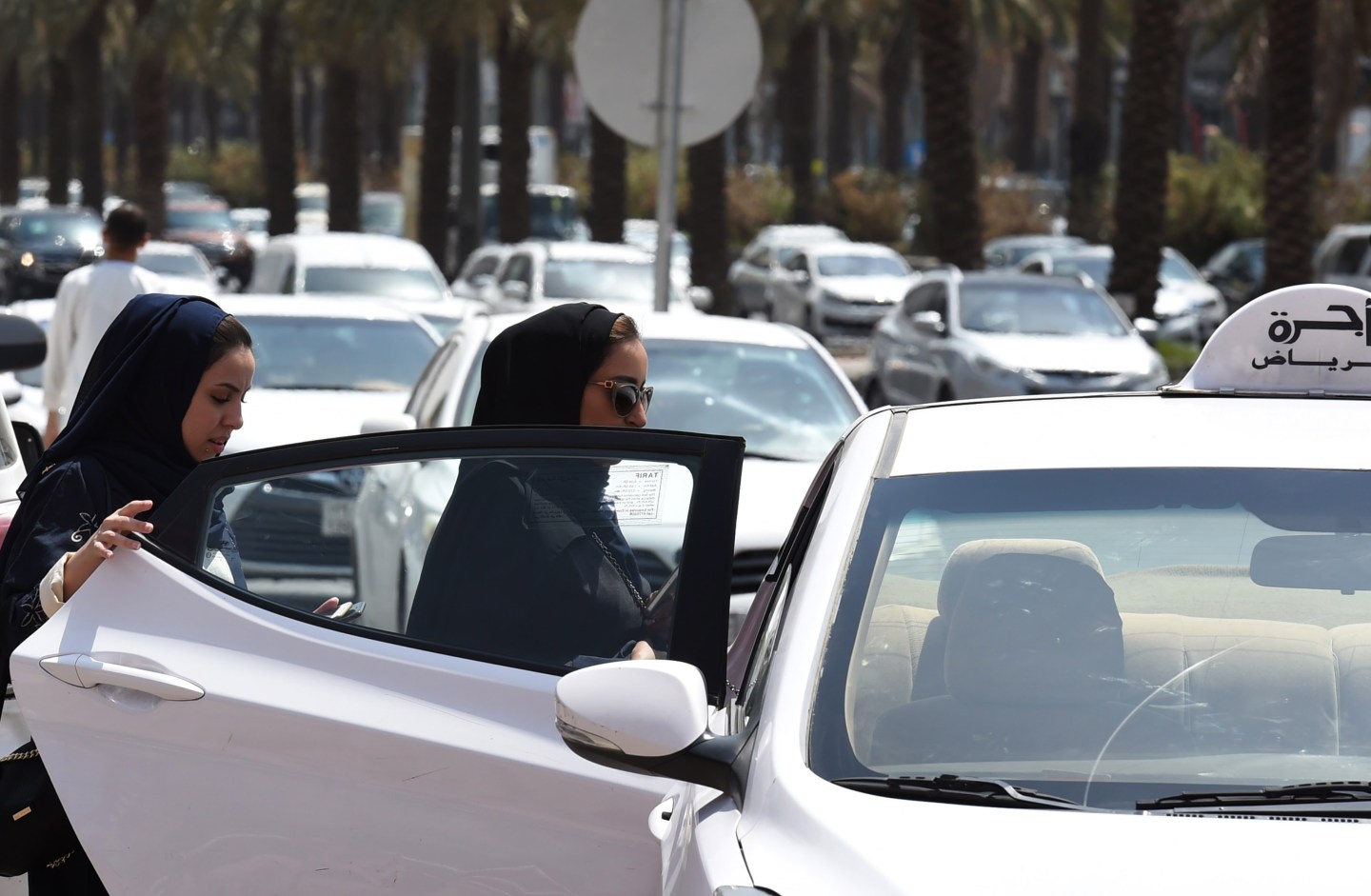
Saudi women get into a taxi at a street in the Saudi capital Riyadh on September 28, 2017. Saudi Arabia will allow women to drive from June 2018, state media said on September 26, 2017 in a historic decision that makes the Gulf kingdom the last country in the world to permit women behind the wheel. The shock announcement comes after a years-long resistance from women's rights activists, some of whom were jailed for defying the ban on female driving. / AFP PHOTO / FAYEZ NURELDINE (Photo credit should read FAYEZ NURELDINE/AFP/Getty Images)FAYEZ NURELDINE AFP/Getty Images
Add Fortune on Google for similar content.

Women in Saudi Arabia are rightfully celebrating the issuance of a royal decree lifting the female driving ban that has long symbolized their oppression in the kingdom. This hard-won breakthrough followed more than two decades of activism in the country, from the driving demonstration led by 40 courageous women in the 1990s, to more recent protests in the streets in 2011 and 2013.

This policy shift is animated less by a growing commitment to women’s rights and more by rank economic considerations: As oil prices go down, Saudi leaders have sought to implement a new economic program to shift from an oil-based economy into a modern one, and officials in Riyadh, Saudi Arabia have calculated that growing women’s participation in the labor force will fuel such a transformation.

This is an economic bet that is sure to pay off: In a country where women earn more than half of college and graduate degrees, but only comprise 20% of the workforce, Saudi Arabia has left the economic potential of nearly half of its population on the table.

Yet to improve women’s economic participation in Saudi Arabia, perhaps even more significant than the right to drive is ending the system of male guardianship that remains on the books. Under this legal regime, women are functionally equivalent to minors, unable to open a bank account, start certain businesses, apply for a passport, or travel abroad without the permission of a male relative—all rights that are fundamental to conducting business.

And while Saudi Arabia’s former ban on women drivers long rendered it a global outlier, other legal barriers to women’s economic participation in the kingdom are far more widespread than most recognize. According to the World Bank, women face gender-based job restrictions in 100 economies around the world, from spousal consent requirements for employment, to restrictions on property ownership, to the inability to sign a contract. In some countries (including France, Japan, Madagascar, Argentina, and Pakistan, among others), women are prohibited from performing traditionally “male” jobs or limited to certain hours, reducing their productivity and earnings; in others, women face discrimination in obtaining access to credit, thereby limiting their ability to start and grow businesses. These legal barriers exist in every region of the world, including in developed economies: Russia, for example, forbids women from employment in 456 specific occupations, from driving a subway to woodworking, and gender-based job restrictions remain in legal codes from France to Japan.

Thus, while Saudi Arabia’s driving ban has long captured the world’s attention as a marker of women’s subjugation, thousands of other laws limiting women’s ability to participate in the economy remain in place in nations around the world. As the Saudi government is beginning to recognize, these legal barriers impose a significant economic cost: Analyses from the International Monetary Fund and the Organization for Economic Cooperation and Development have long established a link between women’s labor force participation and economic growth. The private sector has documented this connection as well: One study from the McKinsey Global Institute concluded that closing gender gaps between women and men in the economy—including by eliminating legal barriers to women’s work—could add an estimated $12 trillion in global gross domestic product by 2025.


Some may argue that legal reform for women is inevitable, pointing to liberalization of laws in Saudi Arabia and elsewhere as signs of progress driven by economic realities that are impossible to ignore. But in light of the economic payoff at stake, the pace of change remains far too slow: After all, it took almost three decades of activism before the kingdom’s driving ban was removed, and legal restrictions in other countries have been on the books far longer than that. Others may caution that legal reform will go unheeded in countries where strong cultural norms undermine women’s ability to work in certain professions, or at all. However, even where implementation of gender equality laws remains an ongoing challenge, research shows a substantial link between stronger legal rights for women and economic development.

At a time when the global economy is struggling to emerge from an economic downturn that has roiled markets and capitals around the world, we can no longer afford to limit the economic potential of half the population—in Saudi Arabia, or anywhere else. All nations should recognize what the Saudis finally have: Women drive economic growth—and it is long past time for every nation to level the legal playing field and put them behind the wheel.

Rachel Vogelstein is the Douglas Dillon Senior Fellow at the Council on Foreign Relations.

About the Authors
By Rachel Vogelstein
See full bioRight Arrow Button Icon
By Bethany Cianciolo
See full bioRight Arrow Button Icon
Add Fortune on Google for similar content.

Latest in Commentary

Finance
Lorem ipsum dolor sit amet, consectetur adipiscing elit, sed do eiusmod tempor incididunt ut labore et dolore magna aliqua. Ut enim ad minim veniam
By Fortune Editors
October 20, 2025
Finance
Lorem ipsum dolor sit amet, consectetur adipiscing elit, sed do eiusmod tempor incididunt ut labore et dolore magna aliqua. Ut enim ad minim veniam
By Fortune Editors
October 20, 2025
Finance
Lorem ipsum dolor sit amet, consectetur adipiscing elit, sed do eiusmod tempor incididunt ut labore et dolore magna aliqua. Ut enim ad minim veniam
By Fortune Editors
October 20, 2025
Finance
Lorem ipsum dolor sit amet, consectetur adipiscing elit, sed do eiusmod tempor incididunt ut labore et dolore magna aliqua. Ut enim ad minim veniam
By Fortune Editors
October 20, 2025
Finance
Lorem ipsum dolor sit amet, consectetur adipiscing elit, sed do eiusmod tempor incididunt ut labore et dolore magna aliqua. Ut enim ad minim veniam
By Fortune Editors
October 20, 2025
Finance
Lorem ipsum dolor sit amet, consectetur adipiscing elit, sed do eiusmod tempor incididunt ut labore et dolore magna aliqua. Ut enim ad minim veniam
By Fortune Editors
October 20, 2025

Most Popular

Finance
Lorem ipsum dolor sit amet, consectetur adipiscing elit, sed do eiusmod tempor incididunt ut labore et dolore magna aliqua. Ut enim ad minim veniam
By Fortune Editors
October 20, 2025
Finance
Lorem ipsum dolor sit amet, consectetur adipiscing elit, sed do eiusmod tempor incididunt ut labore et dolore magna aliqua. Ut enim ad minim veniam
By Fortune Editors
October 20, 2025
Finance
Lorem ipsum dolor sit amet, consectetur adipiscing elit, sed do eiusmod tempor incididunt ut labore et dolore magna aliqua. Ut enim ad minim veniam
By Fortune Editors
October 20, 2025
Finance
Lorem ipsum dolor sit amet, consectetur adipiscing elit, sed do eiusmod tempor incididunt ut labore et dolore magna aliqua. Ut enim ad minim veniam
By Fortune Editors
October 20, 2025
Finance
Lorem ipsum dolor sit amet, consectetur adipiscing elit, sed do eiusmod tempor incididunt ut labore et dolore magna aliqua. Ut enim ad minim veniam
By Fortune Editors
October 20, 2025
Finance
Lorem ipsum dolor sit amet, consectetur adipiscing elit, sed do eiusmod tempor incididunt ut labore et dolore magna aliqua. Ut enim ad minim veniam
By Fortune Editors
October 20, 2025
Fortune Secondary Logo
Rankings
  • 100 Best Companies
  • Fortune 500
  • Global 500
  • Fortune 500 Europe
  • Most Powerful Women
  • World's Most Admired Companies
  • See All Rankings
  • Lists Calendar
Sections
  • Finance
  • Fortune Crypto
  • Features
  • Leadership
  • Health
  • Commentary
  • Success
  • Retail
  • Mpw
  • Tech
  • Lifestyle
  • CEO Initiative
  • Asia
  • Politics
  • Conferences
  • Europe
  • Newsletters
  • Personal Finance
  • Environment
  • Magazine
  • Education
Customer Support
  • Frequently Asked Questions
  • Customer Service Portal
  • Privacy Policy
  • Terms Of Use
  • Single Issues For Purchase
  • International Print
Commercial Services
  • Advertising
  • Fortune Brand Studio
  • Fortune Analytics
  • Fortune Conferences
  • Business Development
  • Group Subscriptions
About Us
  • About Us
  • Press Center
  • Work At Fortune
  • Terms And Conditions
  • Site Map
  • About Us
  • Press Center
  • Work At Fortune
  • Terms And Conditions
  • Site Map
  • Facebook icon
  • Twitter icon
  • LinkedIn icon
  • Instagram icon
  • Pinterest icon

Latest in Commentary

Patricia Camden is EY Studio+ Customer Experience and Loyalty Leader
CommentaryConsulting
EY: we found your biggest AI blind spot. It’s called the ‘tempo gap’
By Patricia Camden and John DuboisJune 20, 2026
23 hours ago
p
CommentaryInternet
GoDaddy Corporate Domains chief: The next Internet land rush is happening right now
By Phil LodicoJune 20, 2026
23 hours ago
g
CommentaryVenture Capital
I watched enterprises buy AI that solved the wrong problem. So I left Dell and built a startup to fix it
By Ganesh PadmanabhanJune 19, 2026
2 days ago
Samantha Gloede
CommentaryLeadership
Boards must avoid sleepwalking into the AI era. KPMG’s Global AI risk chief has a survival guide
By Samantha GloedeJune 19, 2026
2 days ago
Piyush Patel
Commentaryshopping
Black Friday already sorted the winners from the losers. Your industry is next
By Piyush PatelJune 19, 2026
2 days ago
audrey
CommentaryInsurance
Aflac general counsel: Georgia lawmakers took a crucial step forward on sickle cell disease – but there’s more work to be done
By Audrey Boone TillmanJune 19, 2026
2 days ago

Most Popular

'I literally was crying last night because I’m nervous about what I’m going to find out': a record 51% of Americans aren't 'cost secure' on health
Health
'I literally was crying last night because I’m nervous about what I’m going to find out': a record 51% of Americans aren't 'cost secure' on health
By Ali Swenson, Amelia Thomson-Deveaux and The Associated PressJune 20, 2026
17 hours ago
Jeff Bezos pledged $10 billion for climate change. With the 2030 clock ticking, his wife, Lauren Sánchez Bezos, is leading the charge to spend it
Environment
Jeff Bezos pledged $10 billion for climate change. With the 2030 clock ticking, his wife, Lauren Sánchez Bezos, is leading the charge to spend it
By Sydney LakeJune 19, 2026
2 days ago
The Great Recession’s missing children are finally bringing college’s financial crisis into sight. Welcome to the ‘enrollment volatility’ era
Economy
The Great Recession’s missing children are finally bringing college’s financial crisis into sight. Welcome to the ‘enrollment volatility’ era
By Tristan BoveJune 20, 2026
1 day ago
Nvidia CEO Jensen Huang says electricians and plumbers will be needed by the hundreds of thousands in the new working world
Success
Nvidia CEO Jensen Huang says electricians and plumbers will be needed by the hundreds of thousands in the new working world
By Preston ForeJune 20, 2026
23 hours ago
A new trade war may be brewing. This time, Europe is taking a page from Trump's playbook — 'We no longer live in a world of pink ponies and rainbows'
Economy
A new trade war may be brewing. This time, Europe is taking a page from Trump's playbook — 'We no longer live in a world of pink ponies and rainbows'
By Jason MaJune 20, 2026
13 hours ago
Microsoft boss Steve Ballmer publicly dismissed Chrome as a 'rounding error'—but Google’s CEO says he used the jab as fuel to win the browser-wars
Success
Microsoft boss Steve Ballmer publicly dismissed Chrome as a 'rounding error'—but Google’s CEO says he used the jab as fuel to win the browser-wars
By Preston ForeJune 17, 2026
4 days ago

© 2026 Fortune Media IP Limited. All Rights Reserved. Use of this site constitutes acceptance of our Terms of Use and Privacy Policy | CA Notice at Collection and Privacy Notice | Do Not Sell/Share My Personal Information
FORTUNE is a trademark of Fortune Media IP Limited, registered in the U.S. and other countries. FORTUNE may receive compensation for some links to products and services on this website. Offers may be subject to change without notice.