• Home
  • Latest
  • Fortune 500
  • Finance
  • Tech
  • Leadership
  • Lifestyle
  • Rankings
  • Multimedia

Trendingnow

1

I wrote that Boomers were choking America’s economy. Their responses to me were revealing

2

If Elon Musk merges SpaceX with Tesla he'll create a $3.4 trillion behemoth—with zero profits

3

When loyalty is rewarded: Top earners who stay in their jobs get much larger pay increases than those who switch

1

I wrote that Boomers were choking America’s economy. Their responses to me were revealing

2

If Elon Musk merges SpaceX with Tesla he'll create a $3.4 trillion behemoth—with zero profits

3

When loyalty is rewarded: Top earners who stay in their jobs get much larger pay increases than those who switch
Commentary

Why Bernie Sanders’ Single-Payer Health Care Bill Would Be a Disaster

By
Robert E. Moffit
Robert E. Moffit
and
Bethany Cianciolo
Bethany Cianciolo
Down Arrow Button Icon
By
Robert E. Moffit
Robert E. Moffit
and
Bethany Cianciolo
Bethany Cianciolo
Down Arrow Button Icon
August 21, 2017, 11:00 AM ET
Senators Leave Capitol Hill For Summer Break
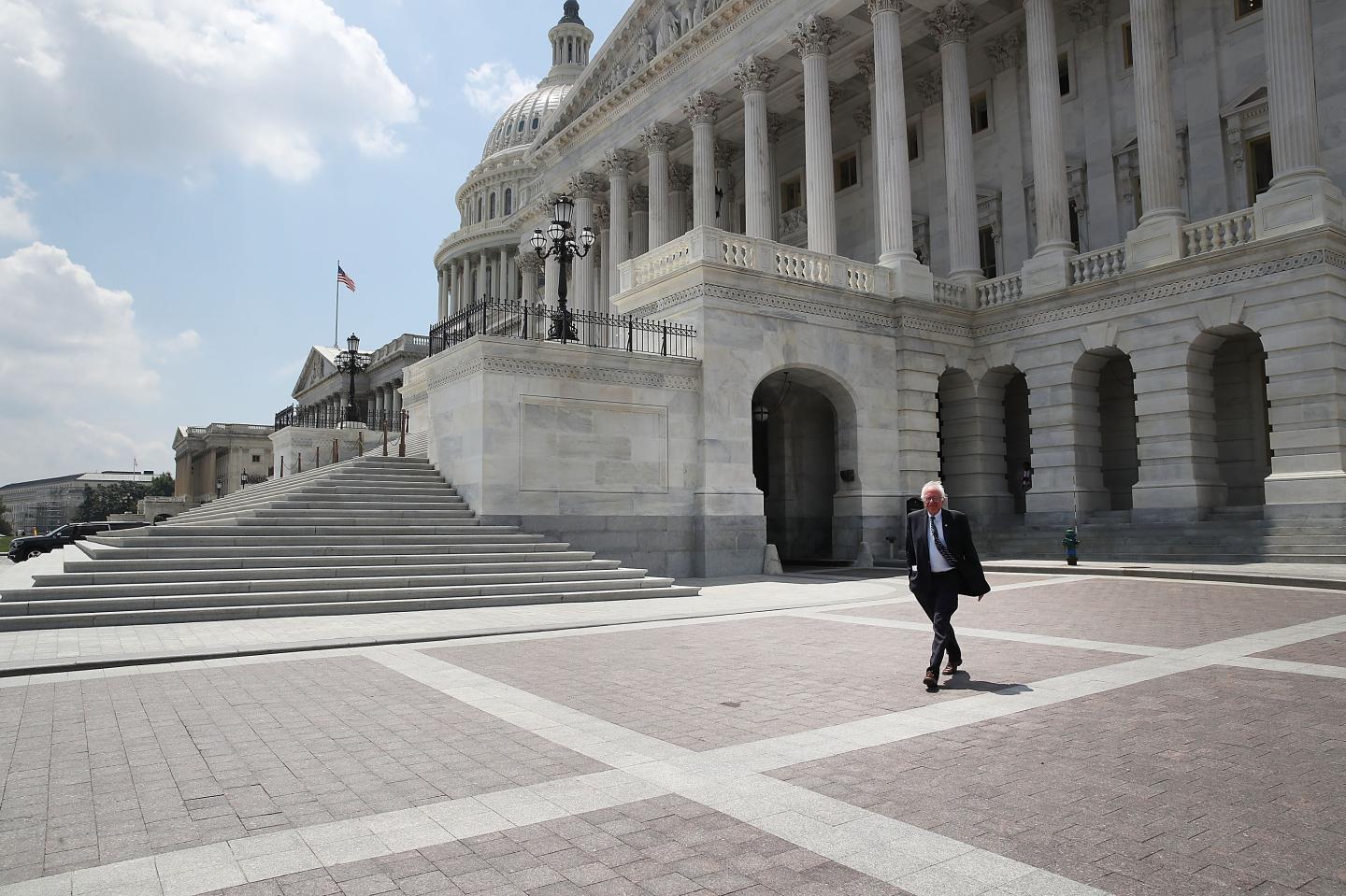
WASHINGTON, DC - AUGUST 03: Sen. Bernie Sanders (I-VT) walks away from the US Capitol after the last vote before the summer break, August 3, 2017 in Washington, DC. The US Senate is scheduled to return from summer break on September 5. (Photo by Mark Wilson/Getty Images)Mark Wilson Getty Images

Senate Republicans’ failure to enact a health reform bill has created a big policy vacuum, and liberals in Congress and elsewhere are eager to fill it.

Their solution: Move to a “single-payer system.” That anodyne term actually means a government monopoly over the financing and delivery of health care.

Rep. John Conyers (D-Mich.) has already introduced a single-payer bill. His “Medicare for All” proposal has 117 cosponsors, more than half of all House Democrats. Sen. Bernie Sanders, the Vermont Independent, says he will soon introduce a “Medicare for All” bill in the Senate. It will doubtless be based on a plan he posted on his website last year.

The “Medicare for All” moniker is politically attractive, due to the existing program’s popularity among seniors. But traditional Medicare is neither a purely single-payer system (e.g., most participants rely on private plans to fill crucial gaps in coverage), nor is it without problems. For example, it has generated reams of costly regulations, shifted administrative costs to doctors and other medical professionals, and burdened taxpayers with tens of trillions of dollars in long-term obligations. Some model.

The economic dynamics of a government health care monopoly—like Britain’s National Health Service—are tiresomely familiar: broad-based and heavy taxation and the imposition of government cost controls. Those controls may take the form of an overall spending limit or reductions in payments to health and medical providers. The result is usually trouble for patients getting access to care, mainly because of lengthening waiting lists and, in some cases, denial of service.

State attempts to implement single-payer health systems have thus far been met with failure. But California seems poised to give it a try.

The Healthy California Act, a “single payer” bill that would displace existing private and employer-based coverage, has already passed the state Senate. Coverage would extend to illegal immigrants and—if the state gets the necessary federal waivers—persons enrolled in Medicare and Medicaid, regardless of their preferences in the matter.

To control costs, the proposal would create a politically appointed board (the Healthy California board) to set payment rates for doctors and other medical professionals. Working against these cost-cutting measures, however, are provisions to prohibit co-payments and deductibles, which today are routine in both Medicare and private insurance. Abolishing these consumer “skin-in-the-game” features on the front end guarantees higher overall program costs on the back end.

And costs are a huge problem. Analysts estimate the California plan will cost anywhere from $330 to $400 billion dollars annually—an amount larger than California’s entire state budget. (Total state spending amounts to $183 billion for FY 2017-2018.)

A state legislative analysis estimated that the proposal would require a $200 billion tax increase, with the remaining $200 billion coming from the federal, state, and local funds now financing Medicare and Medi-Cal (the state’s Medicaid program). The analysis estimated that a new 15% payroll tax could secure the additional $200 billion in revenues needed to fund the program.

A tax hike of this magnitude, of course, would only intensify the out-migration of California’s middle class, exacerbating the state’s financial woes.

California lawmakers seem to think that they will somehow manage to do government health care “right.” But it hasn’t worked out so well elsewhere.

Consider what happened in Sanders’ home state. In 2014, former Vermont Gov. Peter Shumlin realized that a proposed 11.5% state payroll tax, plus the premiums needed to fund the state’s “single payer” initiative (“Green Mountain Care”) would cause serious “economic disruption” for families, businesses, and the state as a whole. The plan—which also included physician and hospital payments—quickly died.

Last year, a “single payer” initiative in Colorado faced similar problems. The “ColoradoCare,” with its estimated $25 billion annual price tag, called for a 10% payroll tax. But even that hike wouldn’t have been enough. The Colorado Health Institute estimated that, even with federal Medicaid matching funds kicked in, ColoradoCare would run a $253 million deficit in the first year of operation alone.

When the Colorado initiative was put up to a vote in a popular referendum, it failed spectacularly. Almost three out of four voters opposed to it.

Nonetheless, state experimentation, particularly in health policy, is a good thing. In America’s federal system, states should have broad authority to experiment in public policy, to try or test new and different solutions to public problems.

Effective this year, however, states have to get waivers from federal rules. Under Obamacare, liberal states find it easier to get waivers, since their applications are compatible with government-centric health programs, like “single-payer.” States pursuing conservative, market-based solutions to health care problems, however, find that a harder task under current law.


Congress should loosen up Obamacare’s regulatory restrictions, level the playing field, and encourage state officials to pursue a wide variety of policy prescriptions—approaches that best fit the needs of their people and their own political culture.

What if one of these experiments fails? Washington can limit the damage by making sure that federal taxpayers won’t have to bail out state failures. That way, if “Healthy California,” for example, crashes and burns, the fallout will at least be limited to that state’s taxpayers, doctors, and patients.

That’s one of the advantages of state experimentation. But if Sanders and Conyers succeed in imposing a federal monopoly on health care, no American would escape the damage.

Robert E. Moffit, PhD, is a senior fellow at the Heritage Foundation’s Center for health Policy. Mitchell Siegel, a Heritage Foundation intern from Duke University, contributed research for this article.

About the Authors
By Robert E. Moffit
See full bioRight Arrow Button Icon
By Bethany Cianciolo
See full bioRight Arrow Button Icon

Latest in Commentary

Finance
Lorem ipsum dolor sit amet, consectetur adipiscing elit, sed do eiusmod tempor incididunt ut labore et dolore magna aliqua. Ut enim ad minim veniam
By Fortune Editors
October 20, 2025
Finance
Lorem ipsum dolor sit amet, consectetur adipiscing elit, sed do eiusmod tempor incididunt ut labore et dolore magna aliqua. Ut enim ad minim veniam
By Fortune Editors
October 20, 2025
Finance
Lorem ipsum dolor sit amet, consectetur adipiscing elit, sed do eiusmod tempor incididunt ut labore et dolore magna aliqua. Ut enim ad minim veniam
By Fortune Editors
October 20, 2025
Finance
Lorem ipsum dolor sit amet, consectetur adipiscing elit, sed do eiusmod tempor incididunt ut labore et dolore magna aliqua. Ut enim ad minim veniam
By Fortune Editors
October 20, 2025
Finance
Lorem ipsum dolor sit amet, consectetur adipiscing elit, sed do eiusmod tempor incididunt ut labore et dolore magna aliqua. Ut enim ad minim veniam
By Fortune Editors
October 20, 2025
Finance
Lorem ipsum dolor sit amet, consectetur adipiscing elit, sed do eiusmod tempor incididunt ut labore et dolore magna aliqua. Ut enim ad minim veniam
By Fortune Editors
October 20, 2025

Most Popular

Finance
Lorem ipsum dolor sit amet, consectetur adipiscing elit, sed do eiusmod tempor incididunt ut labore et dolore magna aliqua. Ut enim ad minim veniam
By Fortune Editors
October 20, 2025
Finance
Lorem ipsum dolor sit amet, consectetur adipiscing elit, sed do eiusmod tempor incididunt ut labore et dolore magna aliqua. Ut enim ad minim veniam
By Fortune Editors
October 20, 2025
Finance
Lorem ipsum dolor sit amet, consectetur adipiscing elit, sed do eiusmod tempor incididunt ut labore et dolore magna aliqua. Ut enim ad minim veniam
By Fortune Editors
October 20, 2025
Finance
Lorem ipsum dolor sit amet, consectetur adipiscing elit, sed do eiusmod tempor incididunt ut labore et dolore magna aliqua. Ut enim ad minim veniam
By Fortune Editors
October 20, 2025
Finance
Lorem ipsum dolor sit amet, consectetur adipiscing elit, sed do eiusmod tempor incididunt ut labore et dolore magna aliqua. Ut enim ad minim veniam
By Fortune Editors
October 20, 2025
Finance
Lorem ipsum dolor sit amet, consectetur adipiscing elit, sed do eiusmod tempor incididunt ut labore et dolore magna aliqua. Ut enim ad minim veniam
By Fortune Editors
October 20, 2025
Fortune Secondary Logo
Rankings
  • 100 Best Companies
  • Fortune 500
  • Global 500
  • Fortune 500 Europe
  • Most Powerful Women
  • World's Most Admired Companies
  • See All Rankings
  • Lists Calendar
Sections
  • Finance
  • Fortune Crypto
  • Features
  • Leadership
  • Health
  • Commentary
  • Success
  • Retail
  • Mpw
  • Tech
  • Lifestyle
  • CEO Initiative
  • Asia
  • Politics
  • Conferences
  • Europe
  • Newsletters
  • Personal Finance
  • Environment
  • Magazine
  • Education
Customer Support
  • Frequently Asked Questions
  • Customer Service Portal
  • Privacy Policy
  • Terms Of Use
  • Single Issues For Purchase
  • International Print
Commercial Services
  • Advertising
  • Fortune Brand Studio
  • Fortune Analytics
  • Fortune Conferences
  • Business Development
  • Group Subscriptions
About Us
  • About Us
  • Press Center
  • Work At Fortune
  • Terms And Conditions
  • Site Map
  • About Us
  • Press Center
  • Work At Fortune
  • Terms And Conditions
  • Site Map
  • Facebook icon
  • Twitter icon
  • LinkedIn icon
  • Instagram icon
  • Pinterest icon

Latest in Commentary

Allison Danielsen is CEO, Tallo.
CommentaryCareers
My wrist injury derailed my college plans. It’s why I’m a CEO today
By Allison DanielsenMay 31, 2026
20 hours ago
treble
CommentaryElections
I built a startup from scratch and still nearly died because of a broken healthcare system. That’s why I’m running for Congress
By Jonathan TrebleMay 31, 2026
20 hours ago
bn
CommentaryEducation
Bill Nye: Companies say there’s a skills gap. They’re wrong — and students can prove it
By Bill NyeMay 31, 2026
21 hours ago
soccer moms
CommentarySports
Why soccer moms are shaping the future of football in the U.S.
By Ruslan BashirovMay 31, 2026
23 hours ago
Matt Rogers
Commentarystart-ups
I worked with Steve Jobs at Apple, where every OS update killed startups. AI founders are about to face the same thing
By Matt RogersMay 30, 2026
2 days ago
sam
CommentaryChips
The AI economy could crash on mounting chip costs — and those token costs won’t help
By Rakesh KumarMay 30, 2026
2 days ago

Most Popular

I wrote that Boomers were choking America’s economy. Their responses to me were revealing
Personal Finance
I wrote that Boomers were choking America’s economy. Their responses to me were revealing
By Nick LichtenbergMay 31, 2026
21 hours ago
If Elon Musk merges SpaceX with Tesla he'll create a $3.4 trillion behemoth—with zero profits
Investing
If Elon Musk merges SpaceX with Tesla he'll create a $3.4 trillion behemoth—with zero profits
By Shawn TullyMay 31, 2026
1 day ago
When loyalty is rewarded: Top earners who stay in their jobs get much larger pay increases than those who switch
Future of Work
When loyalty is rewarded: Top earners who stay in their jobs get much larger pay increases than those who switch
By Jacqueline MunisMay 30, 2026
2 days ago
Ex–Google CEO Eric Schmidt warns U.S. tech workers: Competing with China’s grueling 12-hour workdays means sacrificing work-life balance
Future of Work
Ex–Google CEO Eric Schmidt warns U.S. tech workers: Competing with China’s grueling 12-hour workdays means sacrificing work-life balance
By Marco Quiroz-GutierrezMay 30, 2026
2 days ago
Jamie Dimon tells Gen Z to 'learn how to think, learn how to earn respect' as he describes 'great meeting' with Zohran Mamdani
Success
Jamie Dimon tells Gen Z to 'learn how to think, learn how to earn respect' as he describes 'great meeting' with Zohran Mamdani
By Nick LichtenbergMay 29, 2026
3 days ago
U.S. says deals with Iran for safe Hormuz transit are prohibited
Politics
U.S. says deals with Iran for safe Hormuz transit are prohibited
By Jack Wittels and BloombergMay 30, 2026
2 days ago

© 2026 Fortune Media IP Limited. All Rights Reserved. Use of this site constitutes acceptance of our Terms of Use and Privacy Policy | CA Notice at Collection and Privacy Notice | Do Not Sell/Share My Personal Information
FORTUNE is a trademark of Fortune Media IP Limited, registered in the U.S. and other countries. FORTUNE may receive compensation for some links to products and services on this website. Offers may be subject to change without notice.