The Trump administration’s Department of Justice on Wednesday undercut the stance of the Obama administration’s DOJ and another autonomous federal agency, by arguing that an existing law, Title VII of the Civil Rights Act of 1964, does not bar an employer from firing a gay employee because he or she is gay.
The filing came the same day as President Trump’s announcement that he would bar transgender troops from serving in the military. Together, the two actions fueled outrage from lawmakers, activists and other leaders who argue that the administration is seeking to roll back the rights and protections won by the LGBT community in recent years.
As a candidate, Trump largely avoided talking about issues related to sexual orientation, but often implied that he wouldn’t interfere with recent progress, even going so far as to promise gays and lesbians, “I will fight for you.”
Thank you to the LGBT community! I will fight for you while Hillary brings in more people that will threaten your freedoms and beliefs.
— Donald J. Trump (@realDonaldTrump) June 14, 2016
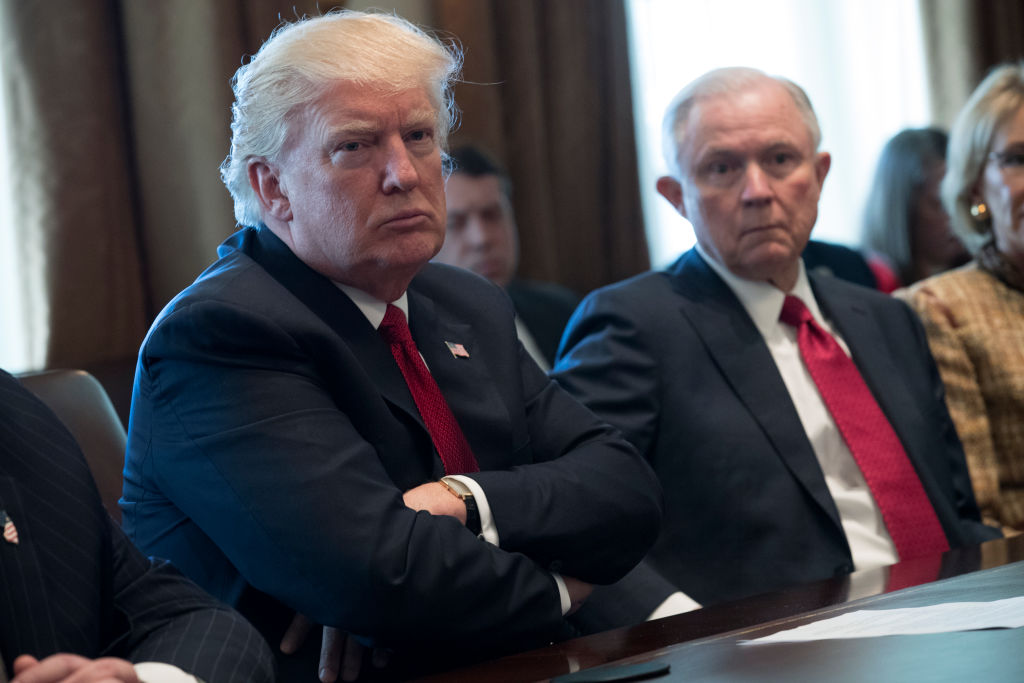
Since his inauguration, however, Trump has been largely silent on the issue. Social conservatives were key to his election victory, and, notably, his attorney general, Jeff Sessions, has been a longtime opponent of extending job protections based on sexual orientation.
Sexual orientation is not explicitly listed in Title VII, which protects individuals against employment discrimination on the basis of race and color, as well as national origin, sex, and religion. But the Equal Employment Opportunity Commission ruled in July 2015 that discrimination based on sexual orientation is, in essence, discrimination based on sex. Because sexual orientation can’t be defined or understood without reference to sex, the commission held, discrimination based on it is “premised on sex-based preferences, assumptions, expectations, stereotypes, or norms” and therefore barred by the law. The EEOC’s ruling was hailed as a victory for the LGBT community at the time, and under President Obama, it became the interpretation that the DOJ abided by.
Trump’s DOJ on Wednesday challenged that stance, arguing just the opposite: that Title VII does not protect against discrimination on the basis of sexual orientation. The DOJ’s opinion, filed in a brief in an ongoing legal case between a worker and his boss being heard by the Second Circuit Court of Appeals, says “the sole question here is whether, as a matter of law, Title VII reaches sexual orientation discrimination. It does not, as has been settled for decades. Any efforts to amend Title VII’s scope should be directed to Congress rather than the courts.”
The EEOC filed a motion in the same Second Circuit case just last month, reiterating its 2015 finding that Title VII bans bias based on sexual orientation.
In its filing, the DOJ acknowledged, rather frankly, that its stance on the matter contradicts that of its fellow government agency. “The EEOC is not speaking for the United States and its position about the scope of Title VII is entitled to no deference beyond its power to persuade,” the ruling says.
It’s true that courts are not bound by EEOC positions; they’re only required to honor legislation and the rulings of courts to which their cases can be appealed, including the Supreme Court. (It should be noted that the U.S. Court of Appeals for the Seventh Circuit made the same determination as the EEOC in a case in April.) But the EEOC’s decisions matter because the commission enforces Title VII, has the authority to bring lawsuits based on its rulings against private employers, and adjudicates cases brought by federal workers against federal agencies.
The DOJ meanwhile, is the defense attorney for the United States, so, in many ways, it’s just like any big employer that files an amicus brief in a case. But enforcing discrimination law in contexts outside of employment—housing, voting rights, disability—is part of the department’s mandate, meaning its stance on such issues carries more weight than other employers’, says Marcia McCormick, an employment law professor at St. Louis University School of Law.
Its filing in the Second Circuit case this week extends what has been a years-long debate over the scope of Title VII. The EEOC’s ruling on that matter in 2015 recognized that federal courts had concluded the opposite, but it said that those decisions were “dated.”
The EEOC’s stance on Title VII’s reach—spelled out in 2015—was considered a landmark decision because it gave gay workers extra cover in states that hadn’t passed their own laws barring discrimination based on sexual orientation. As of this April, 20 states have passed laws banning discrimination based on sexual orientation and gender identity; another two have passed legislation against bias based on sexual orientation only, according to the Human Rights Campaign, meaning there are 28 states where gay employees can be fired for being gay.
The DOJ’s new stance on the matter says that determining such workplace protections should be done through Congress, not through the courts. Lawmakers have pursued that route before. The federal Employment Non-Discrimination Act, which would have outlawed discrimination on the basis of sexual orientation (and, in more recent versions, gender identity) nationwide, was first introduced in 1994. Congress considered it at least 10 times in the following decade and a half, but it never became law. The current Congress, whose GOP leadership includes many social conservatives, seems highly unlikely to act on a similar bill.
The passage of such a federal measure could effectively clear up the murkiness of Title VII’s scope, but until then, the types of discrimination covered by the law will be a matter for the courts to hash out.