• Home
  • Latest
  • Fortune 500
  • Finance
  • Tech
  • Leadership
  • Lifestyle
  • Rankings
  • Multimedia
Commentary

This U.S. State’s Free College Plan Isn’t All It’s Cracked Up to Be

By
Douglas Webber
Douglas Webber
Down Arrow Button Icon
By
Douglas Webber
Douglas Webber
Down Arrow Button Icon
April 13, 2017, 2:06 PM ET
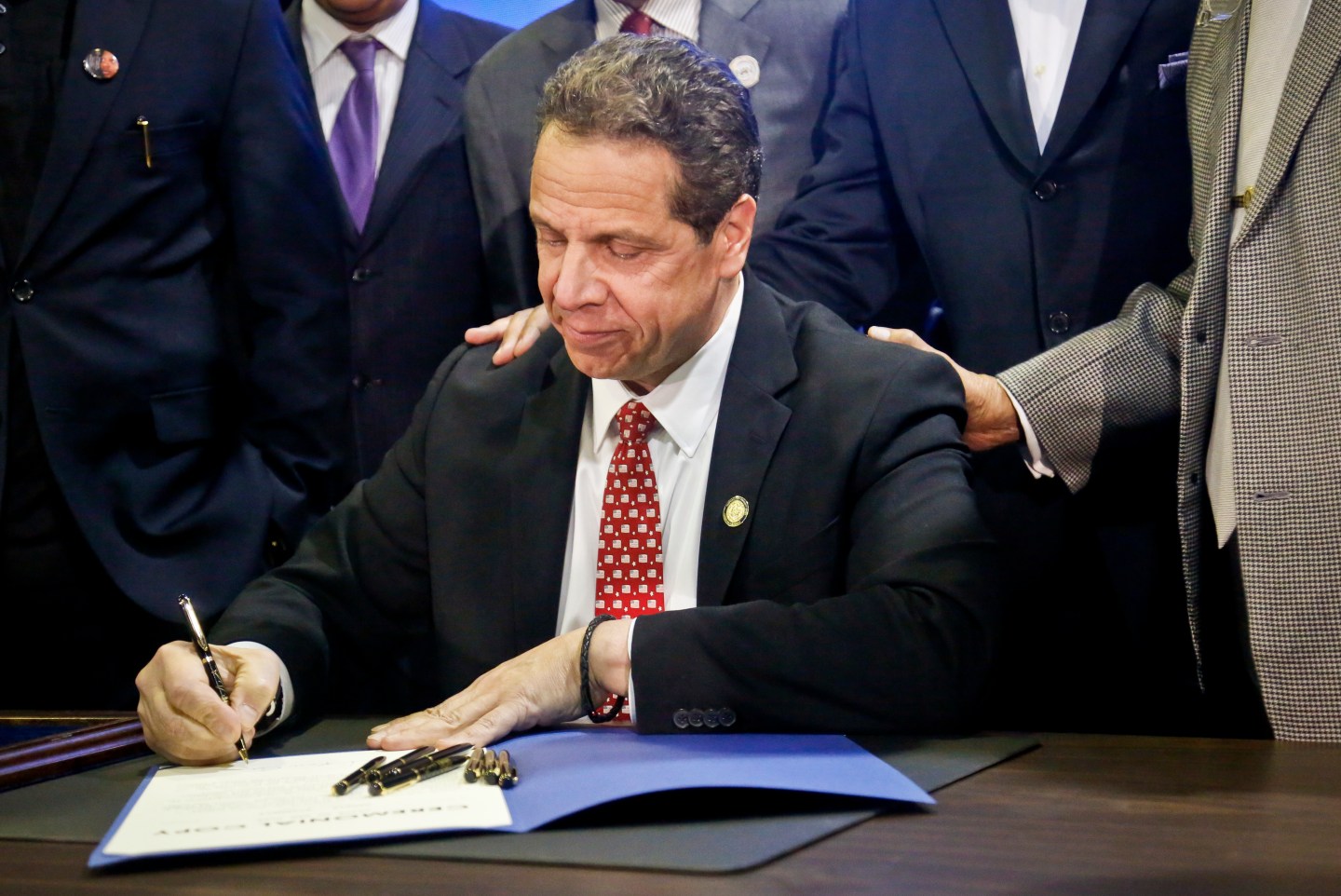
Bebeto Matthews—AP

A four-year degree has become a practical necessity in today’s labor market for those seeking a middle-class or better standard of living. At the same time, the cost of attending college has risen at a much faster rate than median income, putting even middle-class families in a tough spot when trying to figure out how to finance their children’s college education.

This is the impetus behind New York State’s Excelsior Scholarship plan, which was signed into law by Gov. Andrew Cuomo on Wednesday. The plan provides free tuition to students whose families earn less than $125,000 at all public two- and four-year colleges. While this will undoubtedly provide a needed boost to many middle-class families, there are some important flaws in its design that will cap its benefits for many and even make some worse off.

Regardless of the new free college plan’s flaws, the status quo of college education for lower- and middle-class Americans is not sustainable. Roughly three out of every five student loan borrowers are not making any progress paying down their principal loan balance three years after leaving school; that fraction only decreases to 57% seven years post-college. At best, these former students are barely keeping pace with interest payments. But most are likely seeing their debt continue to grow. In addition, there is a real psychological burden to navigating the (often needlessly) complex financial aid system, particularly for first-generation college students.

On top of that, graduating, particularly in a timely manner, is far from a sure thing. Arguably the worst position to be in is to have student loan debt (which typically cannot be discharged in bankruptcy), but have no degree. And even among those who complete a degree, it may not “pay off” until much later in life depending on the major, school attended, or other factors.

It’s not in dispute that there is no better and safer investment than a college degree. But just because on average it pays for itself many times over throughout a lifetime does not mean pursuing a degree is without risk.

We don’t have enough information yet to know whether the benefits of a national free college plan are worth the substantial monetary investment such a plan would require. But states can act as laboratories to figure out which financing models work best. New York will be the first major test case for middle-class families.

Gov. Cuomo’s plan, however, suffers from a potentially fatal flaw. At the last minute before the bill was signed, lawmakers included a clause that turns all tuition subsidies a student receives under the plan into a loan if they leave the state within four years of graduating (assuming they received four years worth of funding).


This is a big problem for several reasons. First, the ability to compete in the national labor market is a key reason that a college degree offers such a large financial return. This requirement puts a significant handicap on the job prospects of middle-class students at a critical point in their careers.

Second, it can encourage undesirable behavior, such as incentivizing an unemployed recent graduate to stay in New York and consume safety net services rather than taking an entry-level job in another state. A $30,000 tax is a powerful reason not to move. This could even lead to New York employers offering slightly lower salaries to in-state grads, since they’ll know this group has fewer out-of-state options.

Third, students who move out of state would actually be worse off for having participated in the free college program, because the loan they receive will not have the same benefits and protections that come with federal student loans (which they would have taken out in the absence of this plan). The most significant protection missing would be income-based repayment, which ties loan payments to how much someone makes.

Any effort to increase college access and reduce the burden on middle-class and low-income students should be lauded, as it is an investment that benefits both individuals and society as a whole. The New York free college program certainly has the potential to help many families struggling with the rising price of college. In this case, however, the law’s details reveal it to be far less generous than at first glance.

Douglas Webber is an assistant professor in the department of economics at Temple University.

About the Author
By Douglas Webber
See full bioRight Arrow Button Icon

Latest in Commentary

Finance
Lorem ipsum dolor sit amet, consectetur adipiscing elit, sed do eiusmod tempor incididunt ut labore et dolore magna aliqua. Ut enim ad minim veniam
By Fortune Editors
October 20, 2025
Finance
Lorem ipsum dolor sit amet, consectetur adipiscing elit, sed do eiusmod tempor incididunt ut labore et dolore magna aliqua. Ut enim ad minim veniam
By Fortune Editors
October 20, 2025
Finance
Lorem ipsum dolor sit amet, consectetur adipiscing elit, sed do eiusmod tempor incididunt ut labore et dolore magna aliqua. Ut enim ad minim veniam
By Fortune Editors
October 20, 2025
Finance
Lorem ipsum dolor sit amet, consectetur adipiscing elit, sed do eiusmod tempor incididunt ut labore et dolore magna aliqua. Ut enim ad minim veniam
By Fortune Editors
October 20, 2025
Finance
Lorem ipsum dolor sit amet, consectetur adipiscing elit, sed do eiusmod tempor incididunt ut labore et dolore magna aliqua. Ut enim ad minim veniam
By Fortune Editors
October 20, 2025
Finance
Lorem ipsum dolor sit amet, consectetur adipiscing elit, sed do eiusmod tempor incididunt ut labore et dolore magna aliqua. Ut enim ad minim veniam
By Fortune Editors
October 20, 2025

Most Popular

Finance
Lorem ipsum dolor sit amet, consectetur adipiscing elit, sed do eiusmod tempor incididunt ut labore et dolore magna aliqua. Ut enim ad minim veniam
By Fortune Editors
October 20, 2025
Finance
Lorem ipsum dolor sit amet, consectetur adipiscing elit, sed do eiusmod tempor incididunt ut labore et dolore magna aliqua. Ut enim ad minim veniam
By Fortune Editors
October 20, 2025
Finance
Lorem ipsum dolor sit amet, consectetur adipiscing elit, sed do eiusmod tempor incididunt ut labore et dolore magna aliqua. Ut enim ad minim veniam
By Fortune Editors
October 20, 2025
Finance
Lorem ipsum dolor sit amet, consectetur adipiscing elit, sed do eiusmod tempor incididunt ut labore et dolore magna aliqua. Ut enim ad minim veniam
By Fortune Editors
October 20, 2025
Finance
Lorem ipsum dolor sit amet, consectetur adipiscing elit, sed do eiusmod tempor incididunt ut labore et dolore magna aliqua. Ut enim ad minim veniam
By Fortune Editors
October 20, 2025
Finance
Lorem ipsum dolor sit amet, consectetur adipiscing elit, sed do eiusmod tempor incididunt ut labore et dolore magna aliqua. Ut enim ad minim veniam
By Fortune Editors
October 20, 2025
Rankings
  • 100 Best Companies
  • Fortune 500
  • Global 500
  • Fortune 500 Europe
  • Most Powerful Women
  • Future 50
  • World’s Most Admired Companies
  • See All Rankings
Sections
  • Finance
  • Leadership
  • Success
  • Tech
  • Asia
  • Europe
  • Environment
  • Fortune Crypto
  • Health
  • Retail
  • Lifestyle
  • Politics
  • Newsletters
  • Magazine
  • Features
  • Commentary
  • Mpw
  • CEO Initiative
  • Conferences
  • Personal Finance
  • Education
Customer Support
  • Frequently Asked Questions
  • Customer Service Portal
  • Privacy Policy
  • Terms Of Use
  • Single Issues For Purchase
  • International Print
Commercial Services
  • Advertising
  • Fortune Brand Studio
  • Fortune Analytics
  • Fortune Conferences
  • Business Development
About Us
  • About Us
  • Editorial Calendar
  • Press Center
  • Work At Fortune
  • Diversity And Inclusion
  • Terms And Conditions
  • Site Map

Latest in Commentary

Wesley Yin is a Professor of economics at UCLA in the Luskin School of Public Affairs and Anderson School of Management
CommentaryIPOs
Privatizing Fannie Mae and Freddie Mac the wrong way risks a second Great Recession
By Wesley YinDecember 30, 2025
17 hours ago
TV
CommentaryMedia
Television is a state of mind: why user experience will define the next era of media
By Lin CherryDecember 30, 2025
17 hours ago
Elon Musk
CommentaryCorporate Governance
Corporate board service isn’t charity. It’s risk capital
By Jane SadowskyDecember 30, 2025
17 hours ago
India
CommentaryIndia
AI adoption at scale is hard. Just look at India, which processes about 20 billion transactions every month 
By Shankar Maruwada and Angela ChitkaraDecember 30, 2025
20 hours ago
Sridhar Ramaswamy is CEO of Snowflake, the AI Data Cloud company.
CommentarySoftware
Snowflake CEO: Big Tech’s grip on AI will loosen in 2026 — plus 6 more predictions that will define the year
By Sridhar RamaswamyDecember 28, 2025
3 days ago
Federal Reserve Gov. Chris Waller engages 200 top CEOs at the Yale CEO Summit in December, 2025. (Photo courtesy of the Yale Chief Executive Leadership Institute/Photographer Donovan Marks)
CommentaryFederal Reserve
Why over 80% of America’s top CEOs think Trump would be wrong not to pick Chris Waller for Fed chair
By Jeffrey Sonnenfeld and Steven TianDecember 27, 2025
4 days ago

Most Popular

placeholder alt text
Success
Gen Z could wave goodbye to résumés because most companies have turned to skills-based recruitment—and find it more effective, research shows
By Orianna Rosa RoyleDecember 29, 2025
2 days ago
placeholder alt text
Europe
George Clooney moves to France and sends a strong message about the American Dream
By Nick LichtenbergDecember 30, 2025
13 hours ago
placeholder alt text
Arts & Entertainment
Gen Zers and millennials flock to so-called analog islands 'because so little of their life feels tangible'
By Michael Liedtke and The Associated PressDecember 28, 2025
3 days ago
placeholder alt text
Success
African millennials and Gen Z are quitting their big-city dreams to go make more money back on the farm
By Mark Banchereau and The Associated PressDecember 29, 2025
2 days ago
placeholder alt text
Law
YouTuber’s viral ‘Somali day care’ video spurs sweeping federal fraud probe in Minnesota as Walz defends oversight of $18 billion
By Nick LichtenbergDecember 30, 2025
17 hours ago
placeholder alt text
AI
'Godfather of AI' Geoffrey Hinton predicts 2026 will see the technology get even better and gain the ability to 'replace many other jobs'
By Jason MaDecember 28, 2025
2 days ago

© 2025 Fortune Media IP Limited. All Rights Reserved. Use of this site constitutes acceptance of our Terms of Use and Privacy Policy | CA Notice at Collection and Privacy Notice | Do Not Sell/Share My Personal Information
FORTUNE is a trademark of Fortune Media IP Limited, registered in the U.S. and other countries. FORTUNE may receive compensation for some links to products and services on this website. Offers may be subject to change without notice.