• Home
  • Latest
  • Fortune 500
  • Finance
  • Tech
  • Leadership
  • Lifestyle
  • Rankings
  • Multimedia
Commentary

Tillerson’s Moscow Meeting Is a Reminder of How Dangerous Russia Is

By
James F Jeffrey
James F Jeffrey
and
Bethany Cianciolo
Down Arrow Button Icon
April 12, 2017, 5:35 PM ET
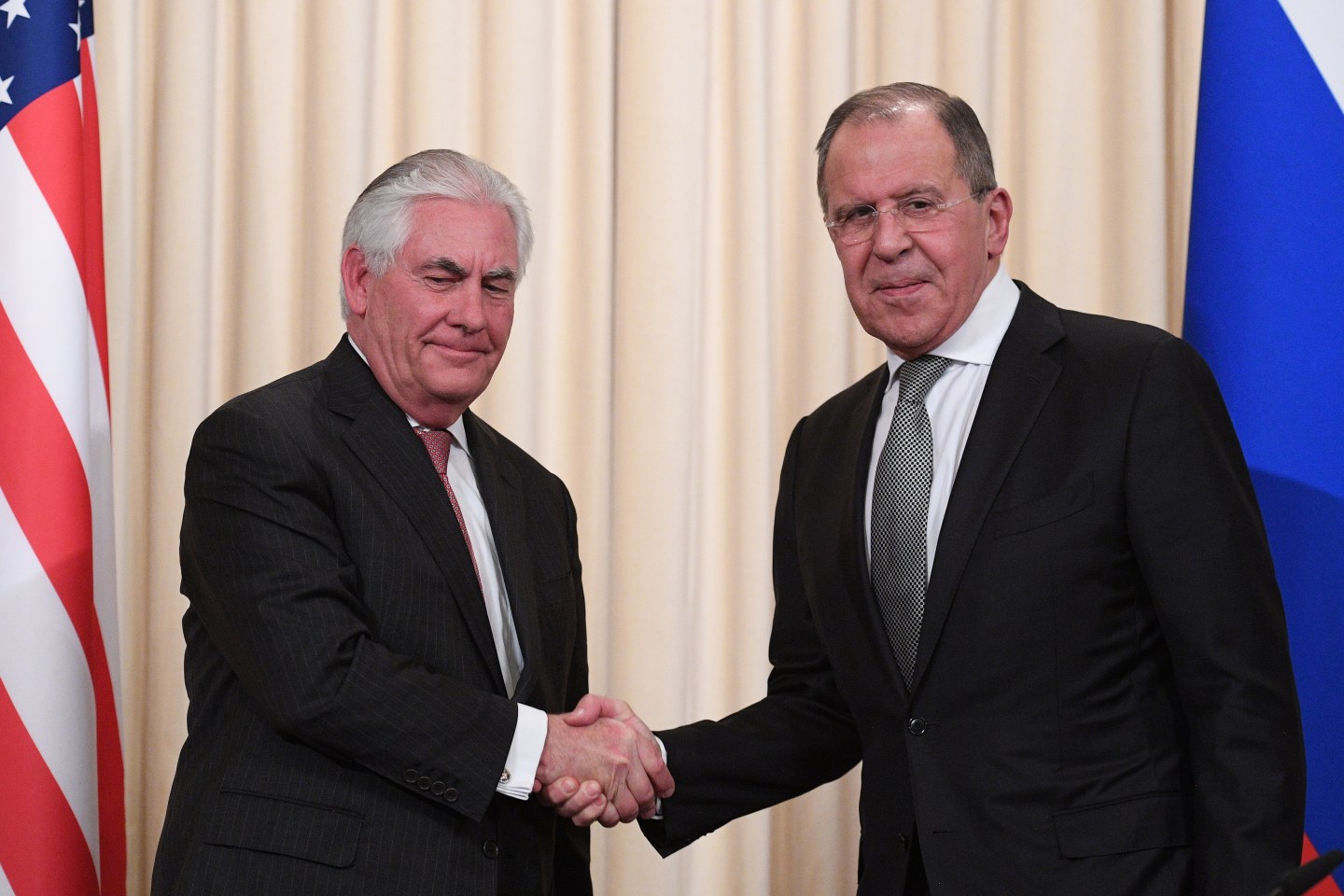
News conference by Russian Foreign Minister Sergei Lavrov and U.S. Secretary of State Rex Tillerson
3072160 04/12/2017 Russian Foreign Minister Sergei Lavrov, right, and U.S. Secretary of State Rex Tillerson during the joint news conference following their talks in Moscow. Ramil Sitdikov/Sputnik via APRamil Sitdikov—Sputnik via AP

After meeting with Russian Foreign Minister Sergey Lavrov on Wednesday, U.S. Secretary of State Rex Tillerson echoed what the world already knows: There’s a low level of trust between the two nations. Just last week, Russian President Vladimir Putin—who Tillerson also met with—criticized the U.S. for its missile strike on Syria and referred to the U.S. relationship as “degraded” since President Trump took office. It’s not surprising that there were no real breakthroughs during Tillerson’s Moscow visit, but if the two nations are to make any progress, the U.S. first needs to keep in mind how dangerous Russia really is.

Russia and the U.S. view the world in fundamentally different ways. Back in 2013, American historian Walter Russell Mead argued in The American Interest that near-peer competitors China and Russia were now deliberately challenging the U.S.-led global order. His argument still holds true. While China is the more serious challenge, Russia is more dangerous. It has challenged Western norms and global security with Crimean annexation, civil war in Eastern Ukraine, provocative behavior toward American and other NATO forces on NATO’s borders and in international airspace, intervention in Syria, carpet bombing of Aleppo’s civilian population, toleration of Syria’s use of chemical weapons, and, finally, attempted destabilization of national elections in NATO states, including the U.S.

To be sure, unlike China, Putin has few economic or cultural tools to deploy for national glory, nor is Russia, in contrast to China, a major beneficiary of the world economic system. Its export industries and investment opportunities beyond energy are simply too modest.

Yet Putin is determined to challenge the U.S.-led international order, signaling exactly that in 2007 by publicly bemoaning the end of the USSR as the greatest tragedy of the 20th century. Putin’s strategy sees the world in 19th-century terms. Great powers such as Russia vie for power amongst themselves, leaving other states as little more than pawns. Thus, a Crimea can be annexed, a Chechnya turned into rubble, and Assad backed to the hilt. International law, humanitarian values, and global order do not matter—only the amoral accretion of power.

This is worrisome, as such a worldview provoked both world wars, and could endanger a third, this time in a world with tens of thousands of nuclear warheads and potent cyber capabilities. Since 1940, the U.S. has been the leader and major beneficiary of a law-based international collective security order, and sees itself directly challenged by Putin’s “19th century” Russia more than by China, somewhat more committed to the global order.

Trump often questioned this order, arguing that, from an “America First” perspective, the U.S. wasn’t getting its money’s worth. This led to demands that our allies do more, and put the whole U.S. role in world affairs in doubt. But then Trump had an epiphany, seen in his affirmation of NATO, his growing ties to world leaders lobbying for American leadership, and his strong reaction to that order’s breakdown with Syria’s horrific Sarin gas attack, despite a UN prohibition “guaranteed” by Russia.

It is this larger background that shaped Tillerson’s Moscow talks. The U.S. must convince Russia that it seeks not war with or domination over Russia, but rather cessation of Russia’s relentless attacks on that international order.

The ‘stick’ Tillerson brings is readiness to contain Russia across the board, mobilizing America’s greater military and economic power, and its international support, as seen in the near-universal endorsement of the U.S. Syrian strike. Such a strategy would include strengthening sanctions on Moscow, which Tillerson said the U.S. was open to implementing, establishing safe zones in Syria, and arming rebels. His ‘carrot’ would be gradually lifting those sanctions, along with compromises on both Ukraine and Syria. And it appears reasonable: Russia is in dire economic straits, partly caused by its Syria and Ukraine actions, and such an offer would leave both Russia and the U.S. with ‘half a loaf.’ Here’s what that would look like.

Ukraine
On Ukraine, Russia would back a ceasefire, halt support for separatists, and allow armed international monitors to enforce the ceasefire along the Russian-Ukrainian border. In return, NATO states would commit to not accepting Ukraine into NATO, not stationing NATO forces on Ukrainian territory, and gradually lifting most economic sanctions, apart from some tied to Russia’s illegal annexation of Crimea.

Syria
On Syria, Russia would receive assurances that the U.S. would not push for regime change, and would consider Russia’s two bases there sacrosanct. In return, Russia would block Assad’s brutal effort to recapture much of Syria from a population that fears and detests him. Russia would also support negotiations brokered by the UN in Geneva toward a ceasefire, and then a compromise settlement endorsed by all neighbors and policed by international peacekeepers.


ISIS
Such a ceasefire-peacekeepers package would require advanced destruction of ISIS and al Qaeda in Syria. That is often touted as an area of joint U.S.-Russian cooperation, but there is less than meets the eye. Russia’s interest in destroying ISIS is subordinated to that of backing Syria and Iran. But an Iran-backed Assad is what created ISIS in the first place in 2013 when he used chemical weapons against his own people. He’ll do the same again if he gains control of all of Syria. Thus, destroying ISIS will have to remain a job largely for the U.S. coalition.

Such “controlled” competition between a Russia motivated by 19th-century power politics and a U.S.-led international community supporting a global security order has a precedent: Most of the Cold War was conducted that way, with each side carefully evaluating the other’s military capabilities and intentions before acting. The problem is that Putin’s judgment of U.S. intentions has been shaped by President Obama’s reluctance to defend that order militarily, and Trump’s earlier questioning of the global order itself.

But in Syria, Putin appears to be ‘going for broke,’ despite limited military capabilities, apparently because he assumed no effective U.S. response. There was a precedent for this as well in the Cold War—Soviet moves from Afghanistan to Central America to Europe 1978-1983 on the assumption the U.S. lacked the will to respond. That was a dangerous period, and we might be entering another one now.

James F Jeffrey is the Philip Solondz Visiting Fellow at The Washington Institute, and former ambassador to Turkey, Iraq, and Albania.

About the Authors
By James F Jeffrey
See full bioRight Arrow Button Icon
By Bethany Cianciolo
See full bioRight Arrow Button Icon

Latest in Commentary

Finance
Lorem ipsum dolor sit amet, consectetur adipiscing elit, sed do eiusmod tempor incididunt ut labore et dolore magna aliqua. Ut enim ad minim veniam
By Fortune Editors
October 20, 2025
Finance
Lorem ipsum dolor sit amet, consectetur adipiscing elit, sed do eiusmod tempor incididunt ut labore et dolore magna aliqua. Ut enim ad minim veniam
By Fortune Editors
October 20, 2025
Finance
Lorem ipsum dolor sit amet, consectetur adipiscing elit, sed do eiusmod tempor incididunt ut labore et dolore magna aliqua. Ut enim ad minim veniam
By Fortune Editors
October 20, 2025
Finance
Lorem ipsum dolor sit amet, consectetur adipiscing elit, sed do eiusmod tempor incididunt ut labore et dolore magna aliqua. Ut enim ad minim veniam
By Fortune Editors
October 20, 2025
Finance
Lorem ipsum dolor sit amet, consectetur adipiscing elit, sed do eiusmod tempor incididunt ut labore et dolore magna aliqua. Ut enim ad minim veniam
By Fortune Editors
October 20, 2025
Finance
Lorem ipsum dolor sit amet, consectetur adipiscing elit, sed do eiusmod tempor incididunt ut labore et dolore magna aliqua. Ut enim ad minim veniam
By Fortune Editors
October 20, 2025

Most Popular

Finance
Lorem ipsum dolor sit amet, consectetur adipiscing elit, sed do eiusmod tempor incididunt ut labore et dolore magna aliqua. Ut enim ad minim veniam
By Fortune Editors
October 20, 2025
Finance
Lorem ipsum dolor sit amet, consectetur adipiscing elit, sed do eiusmod tempor incididunt ut labore et dolore magna aliqua. Ut enim ad minim veniam
By Fortune Editors
October 20, 2025
Finance
Lorem ipsum dolor sit amet, consectetur adipiscing elit, sed do eiusmod tempor incididunt ut labore et dolore magna aliqua. Ut enim ad minim veniam
By Fortune Editors
October 20, 2025
Finance
Lorem ipsum dolor sit amet, consectetur adipiscing elit, sed do eiusmod tempor incididunt ut labore et dolore magna aliqua. Ut enim ad minim veniam
By Fortune Editors
October 20, 2025
Finance
Lorem ipsum dolor sit amet, consectetur adipiscing elit, sed do eiusmod tempor incididunt ut labore et dolore magna aliqua. Ut enim ad minim veniam
By Fortune Editors
October 20, 2025
Finance
Lorem ipsum dolor sit amet, consectetur adipiscing elit, sed do eiusmod tempor incididunt ut labore et dolore magna aliqua. Ut enim ad minim veniam
By Fortune Editors
October 20, 2025
Rankings
  • 100 Best Companies
  • Fortune 500
  • Global 500
  • Fortune 500 Europe
  • Most Powerful Women
  • Future 50
  • World’s Most Admired Companies
  • See All Rankings
Sections
  • Finance
  • Leadership
  • Success
  • Tech
  • Asia
  • Europe
  • Environment
  • Fortune Crypto
  • Health
  • Retail
  • Lifestyle
  • Politics
  • Newsletters
  • Magazine
  • Features
  • Commentary
  • Mpw
  • CEO Initiative
  • Conferences
  • Personal Finance
  • Education
Customer Support
  • Frequently Asked Questions
  • Customer Service Portal
  • Privacy Policy
  • Terms Of Use
  • Single Issues For Purchase
  • International Print
Commercial Services
  • Advertising
  • Fortune Brand Studio
  • Fortune Analytics
  • Fortune Conferences
  • Business Development
About Us
  • About Us
  • Editorial Calendar
  • Press Center
  • Work At Fortune
  • Diversity And Inclusion
  • Terms And Conditions
  • Site Map

© 2025 Fortune Media IP Limited. All Rights Reserved. Use of this site constitutes acceptance of our Terms of Use and Privacy Policy | CA Notice at Collection and Privacy Notice | Do Not Sell/Share My Personal Information
FORTUNE is a trademark of Fortune Media IP Limited, registered in the U.S. and other countries. FORTUNE may receive compensation for some links to products and services on this website. Offers may be subject to change without notice.


Latest in Commentary

Sridhar Ramaswamy is CEO of Snowflake, the AI Data Cloud company.
CommentarySoftware
Snowflake CEO: Big Tech’s grip on AI will loosen in 2026 — plus 6 more predictions that will define the year
By Sridhar RamaswamyDecember 28, 2025
22 hours ago
Federal Reserve Gov. Chris Waller engages 200 top CEOs at the Yale CEO Summit in December, 2025. (Photo courtesy of the Yale Chief Executive Leadership Institute/Photographer Donovan Marks)
CommentaryFederal Reserve
Why over 80% of America’s top CEOs think Trump would be wrong not to pick Chris Waller for Fed chair
By Jeffrey Sonnenfeld and Steven TianDecember 27, 2025
2 days ago
Kence Anderson is the founder and CEO of AMESA 
CommentarySoftware
I pioneered machine teaching at Microsoft. Building AI agents is like building a basketball team, not drafting a player 
By Kence AndersonDecember 27, 2025
2 days ago
Butch Meily
Commentaryempathy
The global empathy crisis that confronts us this Christmas
By Butch MeilyDecember 25, 2025
4 days ago
economy
CommentaryGDP
Why 4.3% GDP growth proves the ‘vibecession’ theory is historically wrong
By Brian HamiltonDecember 24, 2025
5 days ago
students
CommentaryEducation
Why restricting graduate loans will bankrupt America’s talent supply chain
By Katica RoyDecember 23, 2025
6 days ago

Most Popular

placeholder alt text
Future of Work
Malcolm Gladwell tells young people if they want a STEM degree, 'don’t go to Harvard.' You may end up at the bottom of your class and drop out
By Sasha RogelbergDecember 27, 2025
2 days ago
placeholder alt text
Arts & Entertainment
Gen Zers and millennials flock to so-called analog islands 'because so little of their life feels tangible'
By Michael Liedtke and The Associated PressDecember 28, 2025
20 hours ago
placeholder alt text
Success
MacKenzie Scott's close relationship with Toni Morrison long before Amazon put her on the path give more than $1 billion to HBCUs
By Sasha RogelbergDecember 28, 2025
22 hours ago
placeholder alt text
Banking
Russian official warns a banking crisis is possible amid nonpayments. 'I don’t want to think about a continuation of the war or an escalation'
By Jason MaDecember 27, 2025
2 days ago
placeholder alt text
Real Estate
Paris Hilton took out a mortgage on the $63 million mansion she bought from Mark Wahlberg. Here’s why that’s actually a smart financial decision
By Sydney LakeDecember 28, 2025
22 hours ago
placeholder alt text
Politics
Peter Thiel and Larry Page are preparing to flee California in case the state passes a billionaire wealth tax, report says
By Jason MaDecember 27, 2025
2 days ago