• Home
  • Latest
  • Fortune 500
  • Finance
  • Tech
  • Leadership
  • Lifestyle
  • Rankings
  • Multimedia
CommentaryDonald Trump

Trump’s Defense Spending Increase Could Actually Make the U.S. Less Safe

By
Lawrence J. Korb
Lawrence J. Korb
Down Arrow Button Icon
By
Lawrence J. Korb
Lawrence J. Korb
Down Arrow Button Icon
March 5, 2017, 10:00 AM ET
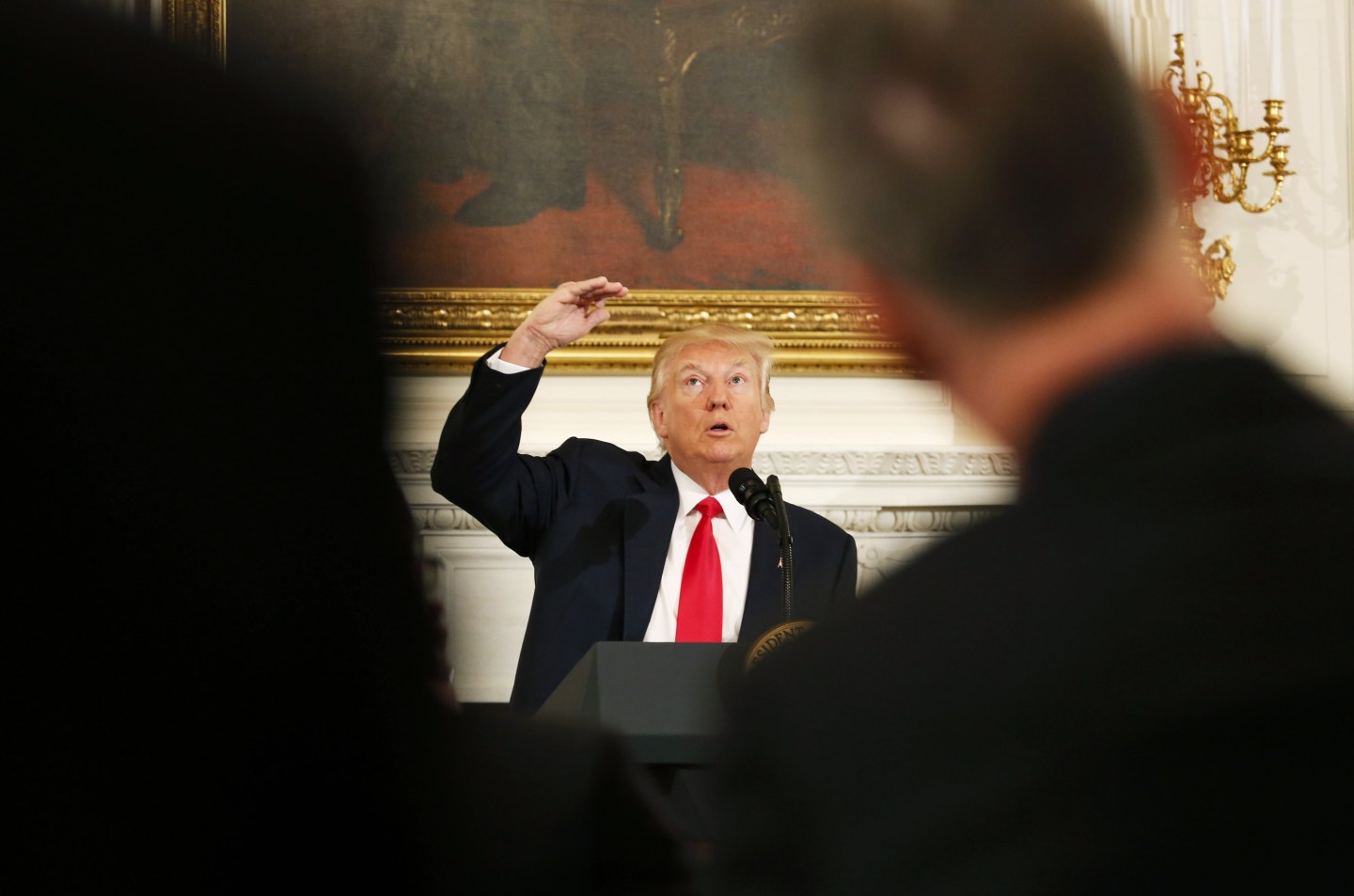
President Trump Speaks At National Governors Association Meeting
U.S. President Donald Trump speaks at the National Governors Association meeting in the State Dining Room of the White House in Washington, D.C., on Monday, Feb. 27, 2017. Trump will propose boosting defense spending by $54 billion in his first budget plan and offset that by an equal amount cut from the rest of the governments discretionary budget, according to administration officials. Photographer: Aude Guerrucci/Pool via BloombergPhotograph by Aude Guerrucci—Bloomberg via Getty Images

President Dwight Eisenhower said in 1960 that the U.S. should spend as much as necessary on defense, but not one penny more. Before Congress approves the massive 10% increase in defense spending proposed by President Donald Trump—which will be offset by slashing the budgets of the State Department and Environmental Protection Agency, as well as killing several domestic programs—the legislative body must be able to explain why current spending levels are insufficient.

Even a cursory look at our national security spending will show that they are not. The U.S. by itself spends more on defense than the next seven highest-spending nations in the world combined.

Regardless, no matter how much the U.S. or any nation spends on defense, it cannot buy perfect security. Whatever level of funding we provide for national security is not as important as having the appropriate strategy to deal with the current challenges facing the nation. Spending large sums of money to deal with threats from a bygone era like the Cold War, for instance, will not enhance national security. While Russia has rebuilt its military somewhat, it is nowhere near as capable as that of the former Soviet Union. In fact, Russia’s total defense budget is less than $50 billion. Just as the sequester is a non-strategic and unwise way to limit a budget, increased funding that is not connected to a sound defensive strategy for the demands we face today will be non-strategic, wasteful, and do more harm than good.

Proponents of increased Pentagon spending argue that our military is not prepared to deal with current threats and that the defense budget is not receiving a large enough share of the nation’s gross domestic product. While it is true that defense spending compared to GDP dropped over the Obama presidency, the economy has grown—a lot. A lower ratio of spending to GDP is not an accurate representation of the readiness of our military to respond to threats posed by terrorist groups like ISIS, as well as states like Russia, China, North Korea, and Iran. In a recent article in Foreign Affairs, Gen. David Petraeus and the Brookings Institution’s Michael O’Hanlon make clear that the current state of U.S. armed forces is “awesome,” they are not facing a readiness crisis, and the current level of defense spending on the readiness portions of the defense budget and procurement is more than adequate.

Read more: Why Trump’s Military Buildup Is Not As Big As He Promises

Even with the limits placed upon the Pentagon under the 2011 Budget Control Act (BCA), the amount of funding for defense in the National Defense Authorization Act (NDAA) recently signed by Obama amounts to more in real terms than the U.S. spent on average in the Cold War and also more than was spent at the height of the Reagan defense buildup. This amount is three times more than our nearest competitor, the Chinese, will spend this year, and accounts for more than one-third of the world’s total military expenditures. Even the BCA hasn’t hamstrung defense spending, as large amounts of the war budget, which is exempt from BCA rules, have been used for enduring programs not associated with any war.


While the defense budget is the most conspicuous dollar amount associated with national security, it is in no way the only federal agency working to keep America safe. The State Department and the U.S. Agency for International Development (USAID), for example, both play vital roles in protecting the country. State Department diplomats forge relationships and bonds of trust with U.S. allies and potential adversaries, while USAID provides humanitarian and development assistance that saves and improves the lives of millions of people around the globe. As Defense Secretary James Mattis has noted, not fully funding these areas makes new wars and conflicts more likely. Each of these face steep cuts in order to increase the defense budget. If the government provides so much of its limited resources to the Pentagon that it cannot fund these agencies adequately, U.S. national security will suffer.

Nor does America have to use military power as a first resort. Whether it is dealing with Russia, China, North Korea, Iran, or ISIS, the U.S. can and should work effectively with allies and partners. The U.S.-led 60-nation coalition fighting ISIS, the buildup of military forces by NATO allies to combat aggressive moves by Russia, and the economic sanctions the U.S. and European Union placed on Russia after its annexation of Ukraine are examples of leveraging all the instruments of American power and the contributions of allies to protect national security.

It is true that despite the many contributions of U.S. allies, both Republican and Democrat secretaries of defense like Robert Gates, Leon Panetta, and Chuck Hagel have all expressed dismay about inadequate defense spending by our partners. But that kind of behavior is enabled by profligate U.S. defense spending. America needs to spend wisely as it calls on friends to honor their side of the common security bargain.

Finally, the U.S. cannot be strong abroad if it is not strong at home. As Eisenhower realized, a strong domestic economy is the basis for military might abroad. Therefore, running up large deficits or not providing adequate funds for education, health, or infrastructure—as a result of providing too much of America’s limited resources for defense—will have a negative impact on national security.

Lawrence J. Korb is a senior fellow at the Center for American Progress. He served as assistant secretary of defense during the Reagan administration.


About the Author
By Lawrence J. Korb
See full bioRight Arrow Button Icon

Latest in Commentary

Finance
Lorem ipsum dolor sit amet, consectetur adipiscing elit, sed do eiusmod tempor incididunt ut labore et dolore magna aliqua. Ut enim ad minim veniam
By Fortune Editors
October 20, 2025
Finance
Lorem ipsum dolor sit amet, consectetur adipiscing elit, sed do eiusmod tempor incididunt ut labore et dolore magna aliqua. Ut enim ad minim veniam
By Fortune Editors
October 20, 2025
Finance
Lorem ipsum dolor sit amet, consectetur adipiscing elit, sed do eiusmod tempor incididunt ut labore et dolore magna aliqua. Ut enim ad minim veniam
By Fortune Editors
October 20, 2025
Finance
Lorem ipsum dolor sit amet, consectetur adipiscing elit, sed do eiusmod tempor incididunt ut labore et dolore magna aliqua. Ut enim ad minim veniam
By Fortune Editors
October 20, 2025
Finance
Lorem ipsum dolor sit amet, consectetur adipiscing elit, sed do eiusmod tempor incididunt ut labore et dolore magna aliqua. Ut enim ad minim veniam
By Fortune Editors
October 20, 2025
Finance
Lorem ipsum dolor sit amet, consectetur adipiscing elit, sed do eiusmod tempor incididunt ut labore et dolore magna aliqua. Ut enim ad minim veniam
By Fortune Editors
October 20, 2025

Most Popular

Finance
Lorem ipsum dolor sit amet, consectetur adipiscing elit, sed do eiusmod tempor incididunt ut labore et dolore magna aliqua. Ut enim ad minim veniam
By Fortune Editors
October 20, 2025
Finance
Lorem ipsum dolor sit amet, consectetur adipiscing elit, sed do eiusmod tempor incididunt ut labore et dolore magna aliqua. Ut enim ad minim veniam
By Fortune Editors
October 20, 2025
Finance
Lorem ipsum dolor sit amet, consectetur adipiscing elit, sed do eiusmod tempor incididunt ut labore et dolore magna aliqua. Ut enim ad minim veniam
By Fortune Editors
October 20, 2025
Finance
Lorem ipsum dolor sit amet, consectetur adipiscing elit, sed do eiusmod tempor incididunt ut labore et dolore magna aliqua. Ut enim ad minim veniam
By Fortune Editors
October 20, 2025
Finance
Lorem ipsum dolor sit amet, consectetur adipiscing elit, sed do eiusmod tempor incididunt ut labore et dolore magna aliqua. Ut enim ad minim veniam
By Fortune Editors
October 20, 2025
Finance
Lorem ipsum dolor sit amet, consectetur adipiscing elit, sed do eiusmod tempor incididunt ut labore et dolore magna aliqua. Ut enim ad minim veniam
By Fortune Editors
October 20, 2025
Rankings
  • 100 Best Companies
  • Fortune 500
  • Global 500
  • Fortune 500 Europe
  • Most Powerful Women
  • Future 50
  • World’s Most Admired Companies
  • See All Rankings
Sections
  • Finance
  • Leadership
  • Success
  • Tech
  • Asia
  • Europe
  • Environment
  • Fortune Crypto
  • Health
  • Retail
  • Lifestyle
  • Politics
  • Newsletters
  • Magazine
  • Features
  • Commentary
  • Mpw
  • CEO Initiative
  • Conferences
  • Personal Finance
  • Education
Customer Support
  • Frequently Asked Questions
  • Customer Service Portal
  • Privacy Policy
  • Terms Of Use
  • Single Issues For Purchase
  • International Print
Commercial Services
  • Advertising
  • Fortune Brand Studio
  • Fortune Analytics
  • Fortune Conferences
  • Business Development
About Us
  • About Us
  • Editorial Calendar
  • Press Center
  • Work At Fortune
  • Diversity And Inclusion
  • Terms And Conditions
  • Site Map
  • Facebook icon
  • Twitter icon
  • LinkedIn icon
  • Instagram icon
  • Pinterest icon

Latest in Commentary

journalists
CommentaryMedia
I’m a war gamer for the Navy and I know why you don’t trust the media anymore. It’s fighting yesterday’s battles
By Charles Edward Gehrke and The ConversationFebruary 9, 2026
13 hours ago
super bowl
CommentaryAdvertising
The Super Bowl reveals a dangerous gap in corporate strategy 
By Christopher VollmerFebruary 9, 2026
18 hours ago
tara comonte
CommentaryAdvertising
Weight Watchers CEO: what the GLP-1 Super Bowl ads are missing
By Tara ComonteFebruary 9, 2026
18 hours ago
ceo
CommentaryLeadership
The next 18 months of the agentic era will feel like a slow-motion stress test for CEOs. Most will make the same critical mistake
By Amy Eliza WongFebruary 9, 2026
20 hours ago
CommentaryHealth
Patient private capital is needed to help Asia plug its healthcare gaps
By Abrar MirFebruary 8, 2026
1 day ago
nfl
CommentaryTV
The Super Bowl was made for TV and instant replay was made for visual AI. Here’s how it could be better and what it would look like
By Jason CorsoFebruary 8, 2026
2 days ago

Most Popular

placeholder alt text
C-Suite
Meet Jody Allen, the billionaire owner of the Seattle Seahawks, who plans to sell the team and donate the proceeds to charity
By Jake AngeloFebruary 9, 2026
13 hours ago
placeholder alt text
AI
As billionaires bail, Mark Zuckerberg doubles down on California with $50 million donation
By Sydney LakeFebruary 9, 2026
16 hours ago
placeholder alt text
Economy
China might be beginning to back away from U.S. debt as investors get nervous about overexposure to American assets
By Eleanor PringleFebruary 9, 2026
21 hours ago
placeholder alt text
Economy
Elon Musk warns the U.S. is '1,000% going to go bankrupt' unless AI and robotics save the economy from crushing debt
By Jason MaFebruary 7, 2026
3 days ago
placeholder alt text
Commentary
America marks its 250th birthday with a fading dream—the first time that younger generations will make less than their parents
By Mark Robert Rank and The ConversationFebruary 8, 2026
2 days ago
placeholder alt text
Economy
Russian officials are warning Putin that a financial crisis could arrive this summer, report says, while his war on Ukraine becomes too big to fail
By Jason MaFebruary 8, 2026
1 day ago

© 2026 Fortune Media IP Limited. All Rights Reserved. Use of this site constitutes acceptance of our Terms of Use and Privacy Policy | CA Notice at Collection and Privacy Notice | Do Not Sell/Share My Personal Information
FORTUNE is a trademark of Fortune Media IP Limited, registered in the U.S. and other countries. FORTUNE may receive compensation for some links to products and services on this website. Offers may be subject to change without notice.