• Home
  • Latest
  • Fortune 500
  • Finance
  • Tech
  • Leadership
  • Lifestyle
  • Rankings
  • Multimedia
CommentaryLeadership

The Biggest Question Senators Should Ask Steven Mnuchin at His Confirmation Hearing

By
Douglas Cliggott
Douglas Cliggott
Down Arrow Button Icon
By
Douglas Cliggott
Douglas Cliggott
Down Arrow Button Icon
January 19, 2017, 9:20 AM ET
Political And Business Visitors At Trump Tower During President-Elect's Transition To The White House
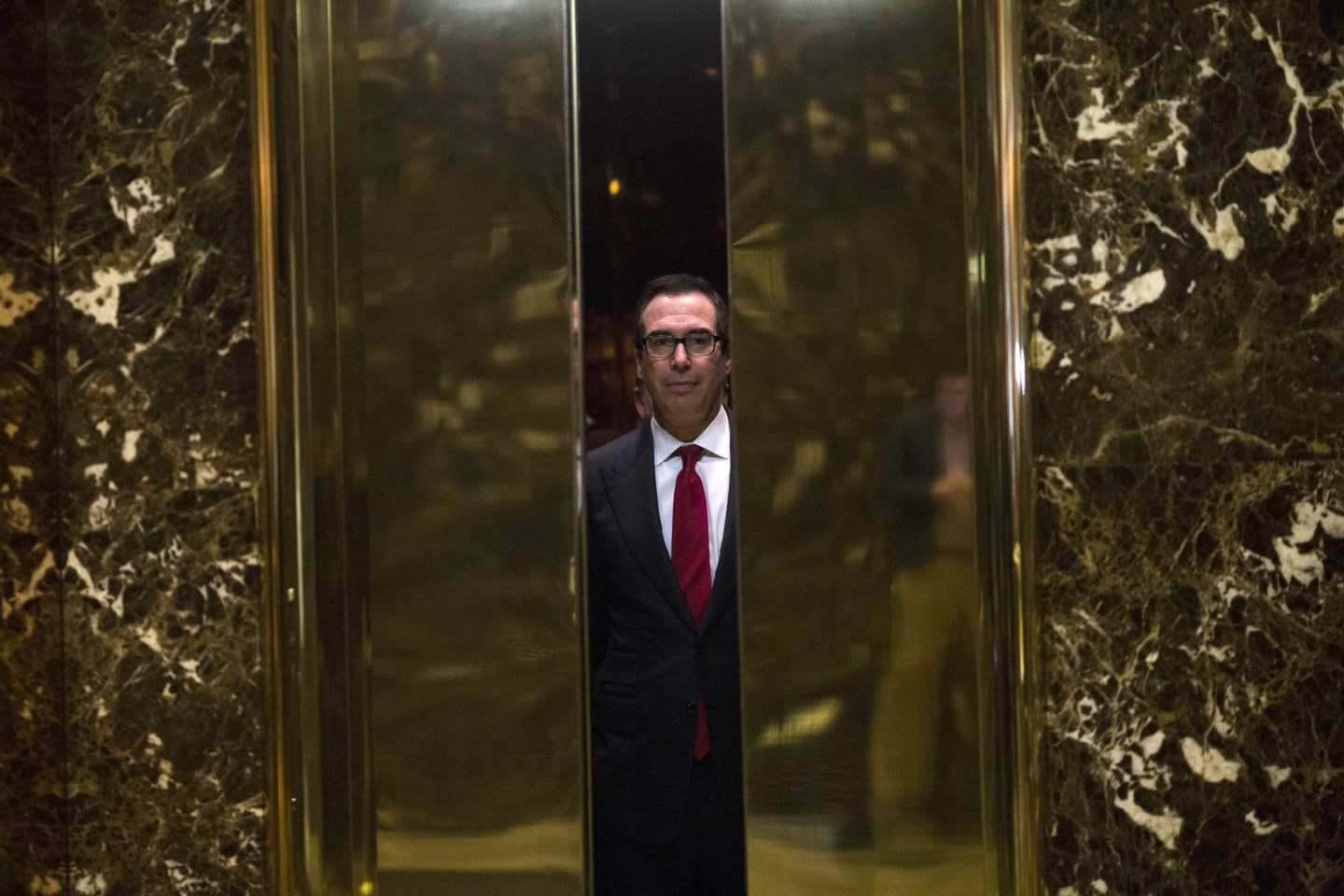
Steven Mnuchin, Treasury secretary nominee for president-elect Donald Trump, stands in the elevator at Trump Tower in New York, U.S., on Wednesday, Dec. 7, 2016. President-elect Donald Trump, whose victory last month was greeted with a surge in pharmaceutical stocks, declared himself an opponent of high drug prices in an interview with Time magazine. Photographer: John Taggart/Bloomberg via Getty ImagesJohn Taggart — Bloomberg via Getty Images

On Thursday, the Senate is expected to question Steven Mnuchin, Donald Trump’s nominee for treasury secretary, to determine whether he is qualified for the position.

The treasury secretary is uniquely positioned to enact policies that can improve economic growth and standards of living. In order to achieve this, the incoming secretary will need to take on two challenging tasks: reduce inequality and enhance labor productivity.

Unfortunately, we have no idea how Mnuchin prioritizes these goals, and if he does, how he plans to bring them about. We know that Mnuchin has accumulated significant personal wealth through his work as a senior manager at Goldman Sachs and hedge fund investor. But thus far, he has offered few indications of his views on central economic policy issues, other than repeated the tired conservative cliché to cut taxes and reduce regulations.

Since the 1980s, that has been the basic game plan of each and every Republican administration, and the cumulative result has been piles of government debt, crumbling infrastructure, financial chaos that brought the world economy to its knees, and a stunning increase in inequality that has produced declining standards of living for a growing number of Americans.

Given this uncertainty, if the Senate hopes to properly evaluate Mnuchin, it should focus on understanding how he’ll approach reducing income inequality and enhancing labor productivity.

“What are you going to do about inequality?” may sound at first like a strange question to ask the incoming secretary treasury, a position not known for a bleeding heart approach to income redistribution, from the days of Alexander Hamilton and Henry Morgenthau Jr. to Henry Paulson, Timothy Geithner, and Jack Lew.

But it’s the right question, because economic growth— the Treasury’s traditional bailiwick—is today inextricably tied to income equality. In the middle of the twentieth century, U.S. economic policy makers regularly increased the federal minimum wage to keep up with the cost of living and advocated strengthening the power and broadening the reach of labor unions. The result was a much more equal distribution of income than we see today. The Senate should ask Mnuchin if he supports such changes.

U.S. economic policymakers in the middle of the twentieth century also placed high marginal tax rates on families earning high incomes and a significant tax on the estates of wealthy families as a way of redistributing income to the less fortunate among us. This also led to a much more equal distribution of income. Will Mnuchin take a similar path? We deserve to know.

Mnuchin’s other priority should be to revive labor productivity. Stagnating productivity is a root cause of the stubbornly slow growth of our economy. In the long run, just two things account for an economy’s growth rate: how fast its population is growing and growth in the output of each person. In the 1950s through 1970s, when the U.S. economy was growing 3% to 4% per year, the output of each American was expanding by about 2.5% per year. That growth rate has now fallen to about 1% per year—the slowest rate we have witnessed since the Industrial Revolution.

One reason for this is that corporate America is pouring an increasing share of its profits into purchases of its own shares— so-called stock buybacks. These stock purchases now amount to several hundred billions of dollars a year. So rather than investing in research and development and new tools and technologies that would increase labor productivity, U.S. corporations are using their profits to manipulate their own stock prices. This needs to change. The Senate should try to determine how Mnuchin would impel businesses to reinvest in themselves.

The Senate should take their responsibility for questioning Steven Mnuchin seriously. On the cusp of handing him enormous economic power, we should be sure he knows how to wield it.

Douglas Cliggott is a lecturer in economics at the University of Massachusetts Amherst.

About the Author
By Douglas Cliggott
See full bioRight Arrow Button Icon

Latest in Commentary

Finance
Lorem ipsum dolor sit amet, consectetur adipiscing elit, sed do eiusmod tempor incididunt ut labore et dolore magna aliqua. Ut enim ad minim veniam
By Fortune Editors
October 20, 2025
Finance
Lorem ipsum dolor sit amet, consectetur adipiscing elit, sed do eiusmod tempor incididunt ut labore et dolore magna aliqua. Ut enim ad minim veniam
By Fortune Editors
October 20, 2025
Finance
Lorem ipsum dolor sit amet, consectetur adipiscing elit, sed do eiusmod tempor incididunt ut labore et dolore magna aliqua. Ut enim ad minim veniam
By Fortune Editors
October 20, 2025
Finance
Lorem ipsum dolor sit amet, consectetur adipiscing elit, sed do eiusmod tempor incididunt ut labore et dolore magna aliqua. Ut enim ad minim veniam
By Fortune Editors
October 20, 2025
Finance
Lorem ipsum dolor sit amet, consectetur adipiscing elit, sed do eiusmod tempor incididunt ut labore et dolore magna aliqua. Ut enim ad minim veniam
By Fortune Editors
October 20, 2025
Finance
Lorem ipsum dolor sit amet, consectetur adipiscing elit, sed do eiusmod tempor incididunt ut labore et dolore magna aliqua. Ut enim ad minim veniam
By Fortune Editors
October 20, 2025

Most Popular

Finance
Lorem ipsum dolor sit amet, consectetur adipiscing elit, sed do eiusmod tempor incididunt ut labore et dolore magna aliqua. Ut enim ad minim veniam
By Fortune Editors
October 20, 2025
Finance
Lorem ipsum dolor sit amet, consectetur adipiscing elit, sed do eiusmod tempor incididunt ut labore et dolore magna aliqua. Ut enim ad minim veniam
By Fortune Editors
October 20, 2025
Finance
Lorem ipsum dolor sit amet, consectetur adipiscing elit, sed do eiusmod tempor incididunt ut labore et dolore magna aliqua. Ut enim ad minim veniam
By Fortune Editors
October 20, 2025
Finance
Lorem ipsum dolor sit amet, consectetur adipiscing elit, sed do eiusmod tempor incididunt ut labore et dolore magna aliqua. Ut enim ad minim veniam
By Fortune Editors
October 20, 2025
Finance
Lorem ipsum dolor sit amet, consectetur adipiscing elit, sed do eiusmod tempor incididunt ut labore et dolore magna aliqua. Ut enim ad minim veniam
By Fortune Editors
October 20, 2025
Finance
Lorem ipsum dolor sit amet, consectetur adipiscing elit, sed do eiusmod tempor incididunt ut labore et dolore magna aliqua. Ut enim ad minim veniam
By Fortune Editors
October 20, 2025
Fortune Secondary Logo
Rankings
  • 100 Best Companies
  • Fortune 500
  • Global 500
  • Fortune 500 Europe
  • Most Powerful Women
  • Future 50
  • World’s Most Admired Companies
  • See All Rankings
Sections
  • Finance
  • Fortune Crypto
  • Features
  • Leadership
  • Health
  • Commentary
  • Success
  • Retail
  • Mpw
  • Tech
  • Lifestyle
  • CEO Initiative
  • Asia
  • Politics
  • Conferences
  • Europe
  • Newsletters
  • Personal Finance
  • Environment
  • Magazine
  • Education
Customer Support
  • Frequently Asked Questions
  • Customer Service Portal
  • Privacy Policy
  • Terms Of Use
  • Single Issues For Purchase
  • International Print
Commercial Services
  • Advertising
  • Fortune Brand Studio
  • Fortune Analytics
  • Fortune Conferences
  • Business Development
  • Group Subscriptions
About Us
  • About Us
  • Editorial Calendar
  • Press Center
  • Work At Fortune
  • Diversity And Inclusion
  • Terms And Conditions
  • Site Map
  • About Us
  • Editorial Calendar
  • Press Center
  • Work At Fortune
  • Diversity And Inclusion
  • Terms And Conditions
  • Site Map
  • Facebook icon
  • Twitter icon
  • LinkedIn icon
  • Instagram icon
  • Pinterest icon

Latest in Commentary

assis
CommentaryIBM
The digital sovereignty dilemma is a false choice — here’s how enterprises can have both
By Ana Paula AssisApril 9, 2026
20 hours ago
housing
CommentaryHousing
The housing market has been frozen for 3 years. Here’s why this spring could finally change that
By Jessica LautzApril 8, 2026
2 days ago
curtin
CommentaryInfrastructure
TE Connectivity CEO: the real promise of AI is long-term transformation, not short-term efficiency gains
By Terrence CurtinApril 7, 2026
3 days ago
philip
CommentaryEducation
I just became CEO of one of education’s Big 3. Here’s why AI will never replace a great teacher
By Philip MoyerApril 7, 2026
3 days ago
omar
Commentarydisruption
Pearson CEO: the AI job apocalypse is a Silicon Valley story. The data tells a different one
By Omar AbboshApril 6, 2026
4 days ago
no kings
CommentaryLeadership
America’s CEOs have become reluctant guardians of democracy
By Jeffrey Sonnenfeld and Stephen HenriquesApril 6, 2026
4 days ago

Most Popular

The U.S. government is spending $88 billion a month in interest on national debt—equal to spending on defense and education combined
Economy
The U.S. government is spending $88 billion a month in interest on national debt—equal to spending on defense and education combined
By Fortune EditorsApril 9, 2026
18 hours ago
A Meta employee created a dashboard so coworkers can compete to be the company's No. 1 AI token user—and Zuckerberg doesn't even rank in the top 250
AI
A Meta employee created a dashboard so coworkers can compete to be the company's No. 1 AI token user—and Zuckerberg doesn't even rank in the top 250
By Fortune EditorsApril 9, 2026
20 hours ago
Gen Z doesn't want your full-time job. They want several part-time roles, and it's reshaping the entire workforce
Success
Gen Z doesn't want your full-time job. They want several part-time roles, and it's reshaping the entire workforce
By Fortune EditorsApril 9, 2026
21 hours ago
2 years ago, Saudi Arabia quietly canceled the ‘petrodollar’ deal with America that wired the world economy for 50 years. Then war broke out in Iran
Energy
2 years ago, Saudi Arabia quietly canceled the ‘petrodollar’ deal with America that wired the world economy for 50 years. Then war broke out in Iran
By Fortune EditorsApril 7, 2026
2 days ago
White-collar workers are quietly rebelling against AI as 80% outright refuse adoption mandates
AI
White-collar workers are quietly rebelling against AI as 80% outright refuse adoption mandates
By Fortune EditorsApril 9, 2026
19 hours ago
Gen Z workers are so fearful AI will take their job they’re intentionally sabotaging their company’s AI rollout
AI
Gen Z workers are so fearful AI will take their job they’re intentionally sabotaging their company’s AI rollout
By Fortune EditorsApril 8, 2026
2 days ago

© 2026 Fortune Media IP Limited. All Rights Reserved. Use of this site constitutes acceptance of our Terms of Use and Privacy Policy | CA Notice at Collection and Privacy Notice | Do Not Sell/Share My Personal Information
FORTUNE is a trademark of Fortune Media IP Limited, registered in the U.S. and other countries. FORTUNE may receive compensation for some links to products and services on this website. Offers may be subject to change without notice.










