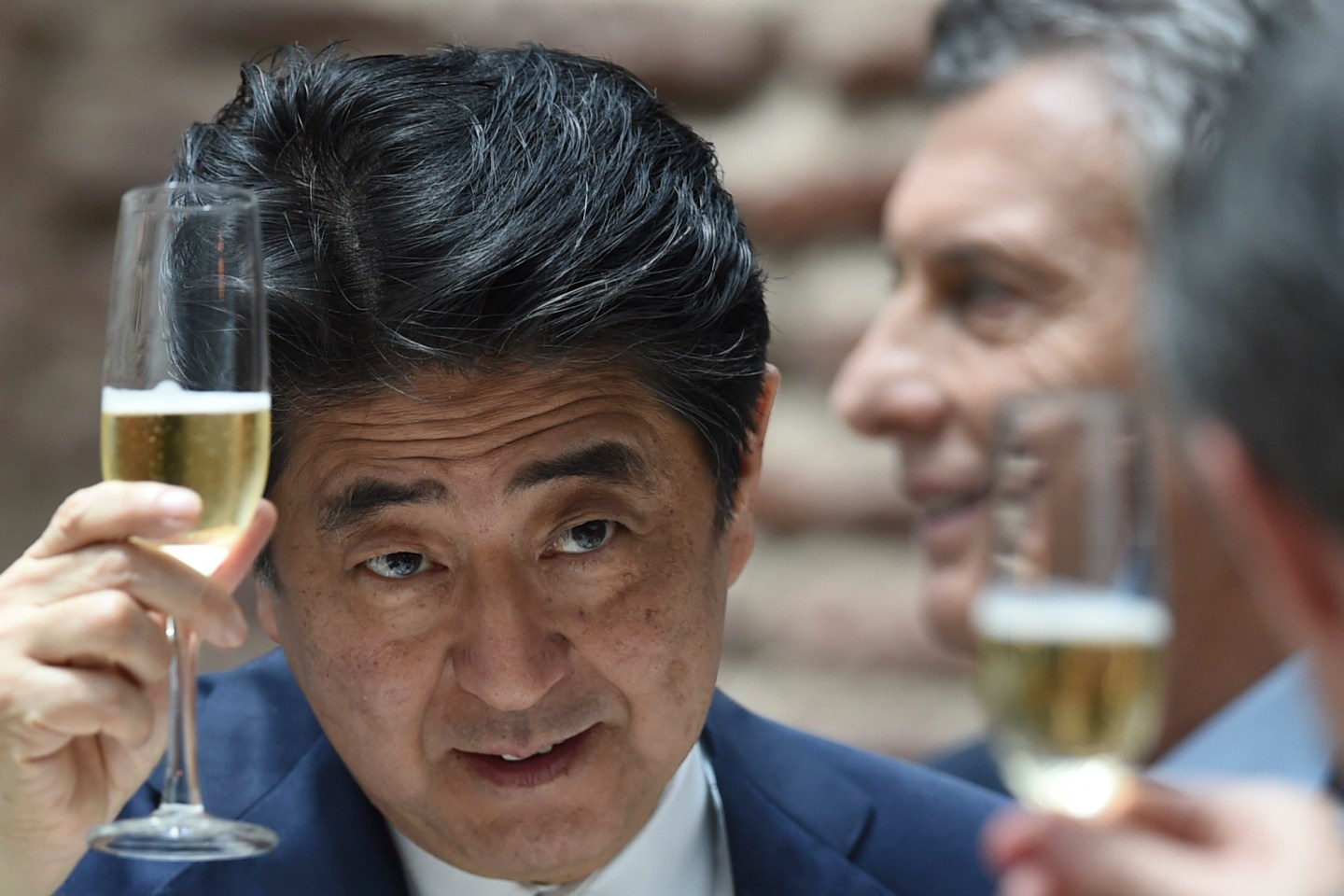
Last month, Japanese Prime Minister Shinzo Abe became the first head of government to visit the U.S. president-elect in his New York tower. It was a chance to establish a personal rapport, and to gauge more precisely where Donald Trump stands vis-a-vis Japan, China, North Korea, and issues surrounding the Trans-Pacific Partnership. In the months leading to the November election, Trump raised alarm in Japan by alluding that the country should arm itself with nuclear weapons in order to better protect itself against an unpredictable North Korea, and the regional bulling of a rising China. It may be premature to make any conclusions about the future from this unofficial meeting, but it is clear that the incoming Trump administration and Abe’s government will have much to negotiate on a variety of issues. Nonetheless, Japan could actually come out better under a Trump administration—if it plays its cards well.
National security
The change in Washington gives a chance for the relationship between the two nations to finally change its foundational pillars and step on an equal partnership. Currently, Japan’s national security capacity is severely crippled by its pacifist constitution, which forbids the country from having a standing army—only a “self-defense force.” For that reason, Japan must rely heavily on the U.S. for safety. Tokyo doesn’t have the equivalent of a CIA or MI6, nor does it have specialized agencies for comprehensive satellite monitoring, akin to the National Geospatial-Intelligence Agency in the U.S. It also doesn’t participate in the FVEY intelligence surveillance program, headed by the U.S., U.K., and Australia.
These are all crucial components for any well-developed missile defense network, and a comprehensive security system that has the ambition to protect an island nation against possible attack by air or sea. But Japan doesn’t have any offensive ballistic missile capabilities, and the three branches of its Self-Defense Forces are severely underfunded and under-integrated.
Keeping the current security blanket that Japan receives from the U.S. is no longer sustainable. What the Trump administration seems to expect from Japan is not an ultimatum, but a reasonable policy change. What’s more, this actually plays in tune with Prime Minister Abe’s strategy: Tackle the extremely sensitive question of constitutional change and return to what may be called “an international normalcy.”
With a price tag set close to 200 billion yen, or around $1.8 billion, for supporting U.S. troops in the country, an extra billion, or even two, is actually a very good deal for the world’s third-largest economy, in exchange for continued security from the U.S. In an alternative go-it-alone option, Japan will have to do quite a lot more, where a doubling or even tripling of its military budget, currently limited by its constitution to 1% of its GDP, will be just the first step. Military capabilities and agencies cannot be built overnight. But even the minimum scenario of just aiming to maintain the current level of cooperation with the U.S. and benefiting from its extensive security blanket will still require a substantial increase in the military budget, as well as greater integration between the Maritime SDF and the U.S. Navy, beyond just patrolling Japan’s territorial waters.
Like two good salesmen on the market, Trump and Abe engaged early on in the bargaining process. Regardless of the specific outcome from it, Abe will have to get constitutional changes approved and passed through the Japanese parliament in order to open up the path for re-militarization. But Trump’s election will undoubtedly facilitate Abe’s struggle to do so.
Economy
Immediately following the election, the anticipated unleashing of mega fiscal spending that would generate reflationary waves beyond the U.S. economy resulted in a sharp decline of the Japanese yen to 113 yen for a dollar, from 101 just before the election. This provided a momentary easing for the Japanese exporting industries at a crucial moment—when the domestic business investment spending cycle was just starting. Moreover, if Trump, along with the Republican-dominated House and Senate, pushes ahead with his tax cuts as promised and slashes corporate tax to 15%, this will benefit enormously the Japanese corporations with footing in the U.S. About 14% of their profits come from factories in the U.S., and a lower corporate tax will deliver an estimated additional 2% to 3% of profits. Japanese corporations are the largest holders of Japanese public debt, and the stability of the economy depends on their own standing. The boost in profit will go a long way.
Not to mention that the Trump administration may go ahead with bringing the Japanese Shinkansen train—maybe not the fastest, but certainly the safest, most reliable and punctual bullet-train option among the short list of such technologies on the market—to the U.S. This means not just that Japanese trains will travel in Texas, and allegedly in other states after that, but also that Japanese engineering companies, infrastructure construction companies, and other related business will benefit from major infrastructure investments in the U.S. Japanese companies may also be among the leading candidates for renovation and equipment required for the renovation of many American airports, in line with Trump’s campaign promises.
Global influence
With Trump as president-elect, U.S. participation in the TPP is now all but dead after his recent promise to quit the deal on his first day in office. What seems like a big setback for Prime Minister Abe, however, is really a chance for Japan to show its true global leadership potential. The importance of the moment doesn’t seem to have been lost to Abe’s government, either. In less than a week left before the U.S. elections, in anticipation of unfavorable prospects for future U.S. participation in the TPP, Abe’s Liberal Democratic Party rammed a TPP ratification bill through the key committees in the Japanese parliament despite the vociferous protests of the opposition lawmakers who blamed the government for acting too hastily. Obviously, Abe must have foreseen that without the U.S. at its helm, the TPP resistance from domestic interest groups and political factions may gain momentum, and sought to counter it.
The benefits the TPP provides Japan arguably outpace the U.S.’s withdrawal from it. With the remaining 35% of its former economic prowess, the TPP still amasses an impressive 15.5% of the global GDP, or around $11 trillion. This gives the members in the zone significant economic clout. More importantly, TPP’s strong impact can already be detected on the 11 remaining active members, and the consequences from it indirectly benefit the global trade by providing unification standards for production, clear rules of engagement and resolution of commercial disputes, greater protection of copyrights, liberalization of agricultural markets, and intensified industrial trade. TPP will remain beneficial for its members, even without the U.S., its most significant member.
As for Japan’s “lost” benefits regarding its anticipated access to the U.S. market, they are not actually all that significant, considering the fact one of the biggest items of contention—the import tariff on Japanese cars, currently set at 2.5%, will not even begin to fade away within the next 15 years, and after that will eventually disappear in steps only in about 25 years from now. In the meantime, other Japanese export products, such as electronics, already benefit from certain preferential treatment.
Liubomir K. Topaloff is an associate professor of political science at Meiji University in Tokyo, Japan.