• Home
  • Latest
  • Fortune 500
  • Finance
  • Tech
  • Leadership
  • Lifestyle
  • Rankings
  • Multimedia

Trendingnow

1

Jensen Huang made his $172 billion fortune on AI chips. His family's $75 million gift to Vanderbilt argues art decides what technology is for

2

'The demographic dividend of the last 40 years is ending': J.P. Morgan says the world is running out of the two things that kept interest rates down

3

The $39 trillion U.S. national debt isn’t as high as Japan’s and Singapore’s relative to economy size—and yet it's still worse somehow

1

Jensen Huang made his $172 billion fortune on AI chips. His family's $75 million gift to Vanderbilt argues art decides what technology is for

2

'The demographic dividend of the last 40 years is ending': J.P. Morgan says the world is running out of the two things that kept interest rates down

3

The $39 trillion U.S. national debt isn’t as high as Japan’s and Singapore’s relative to economy size—and yet it's still worse somehow
Commentary

What the Canada-EU Deal Means for the Future of Trade

By
Alan Wolff
Alan Wolff
Down Arrow Button Icon
By
Alan Wolff
Alan Wolff
Down Arrow Button Icon
November 2, 2016, 12:15 PM ET
BELGIUM-EU-CANADA-POLITICS-CETA-TRADE
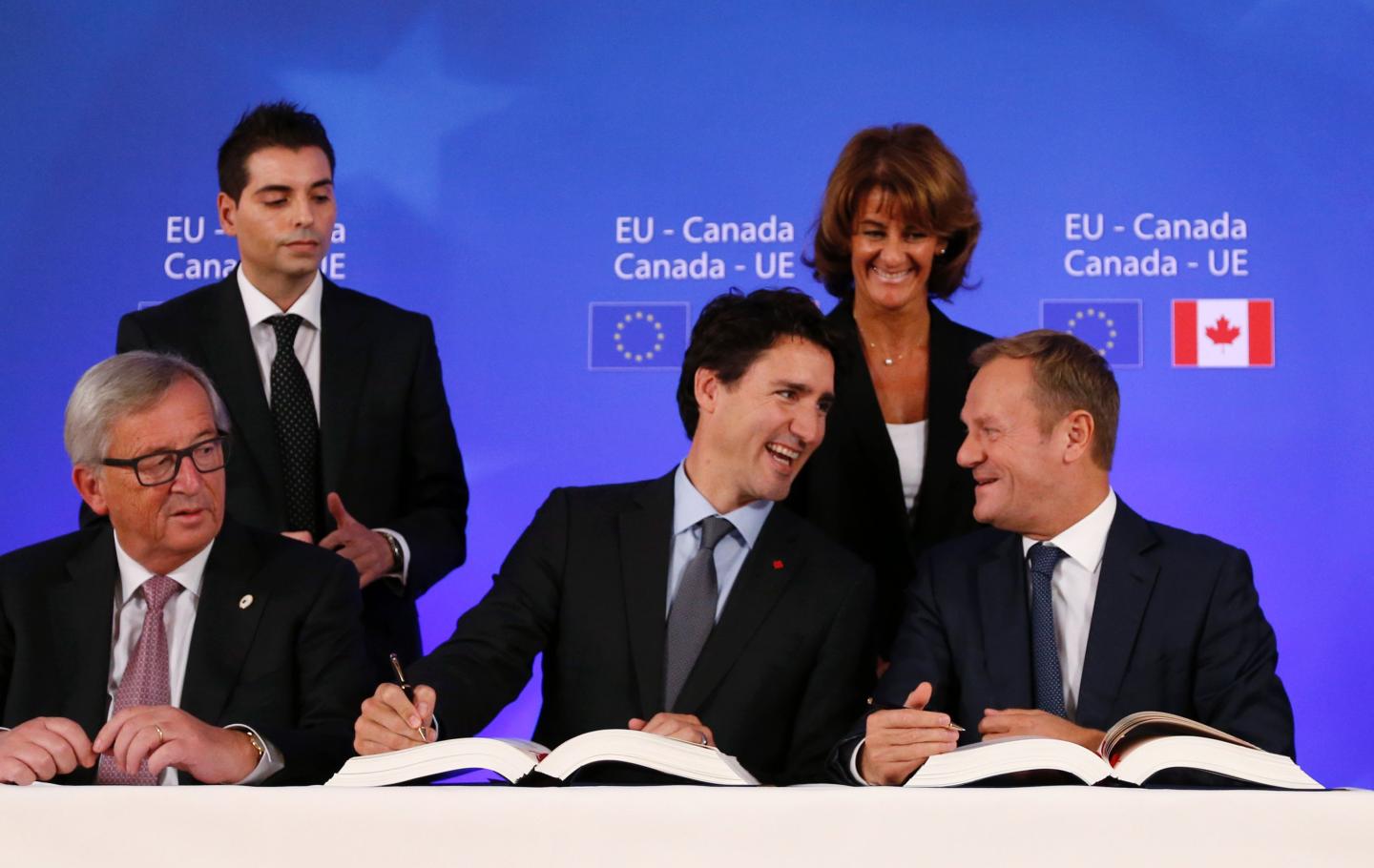
(From L) President of the European Commission Jean-Claude Juncker, Canadian Prime Minister Justin Trudeau and EU Council President Donald Tusk are pictured during the signing ceremony of the Comprehensive Economic and Trade Agreement (CETA), at the European Council in Brussels, on October 30, 2016. The EU and Canada finally signed a landmark free trade deal seven years in the making on October 30, 2016, after overcoming last-minute resistance from a small Belgian region that nearly torpedoed the entire agreement. CETA removes 99 percent of customs duties between the two sides, linking the single EU market of 28 nations with the world's 10th largest economy. / AFP / POOL / FRANCOIS LENOIR (Photo credit should read FRANCOIS LENOIR/AFP/Getty Images)Francois Lenoir — AFP/Getty Images
Add Fortune on Google for similar content.

Last Sunday, after seven years of negotiations, the European Union (EU) and Canada signed a free trade agreement known as the Comprehensive Economic and Trade Agreement (CETA). The agreement provides for duty-free trade between Canada and the EU (for 98% of industrial products) and offers agricultural producers additional market access.

Getting to the point of signing this deal was far from easy. The negotiations had become a cliffhanger after a regional parliament in Belgium, whose approval was necessary as an EU member state, voted down the agreement. It had two primary objections: Belgian farmers did not want more competition from Canadian dairy products, and Belgians in general feared that agreeing to set up a special court for hearing foreign investor disputes would undermine national sovereignty, limiting the ability of local governments to enact environmental, safety, and health regulations.

Since protectionist sentiment and popular anxiety over trade agreements has become a global phenomenon—and a substantial factor in the U.S. presidential election—it is worth looking at what the EU and Canada did to get to the signing table, and what that might mean for global trade going forward.

First, negotiators made every effort to address specific concerns. The Belgian government reportedly promised additional support for its farmers. And the EU addressed the sovereignty concerns by allowing Belgium to challenge the validity of the CETA’s investment tribunal in the European Court of Justice.

Second, the majority of EU member states and the European Commission (the EU’s executive branch) agreed that demonstrating that trade liberalization was possible was important for future economic growth. World trade is slowing and popular opposition to international economic integration is strong, demonstrated most forcefully and recently by the British people voting in June for the United Kingdom to leave the EU.

Third, negotiators knew that the EU wouldn’t be able to negotiate a trade agreement with any other country (Japan or the United States, for example) if it could not find a way to close a deal with a country whose economy is one-tenth the size of Europe’s, and where wage rates and values are so comparable as to not be a concern. Since representing its member states on trade issues is one of the EU’s core competencies, signing a deal was vitally important to the future of European cohesion.

All of the factors that drove Europe to conclude this agreement provide insights for current trade challenges in the U.S. President Obama is trying to get Congress to approve just after the presidential election the Trans-Pacific Partnership (TPP) agreement, which would join the U.S. and 11 Asia-Pacific countries in a pact encompassing 40% of the world economy. Now is the time to resolve as many specific congressional objections to the deal as possible. It is impossible to renegotiate the TPP in the time available, so as with the last-minute negotiations between the EU and Belgium, both the administration and Congress will need to be pragmatic and come to an agreement quickly on outstanding issues.

For the U.S., the TPP is not just about stimulating U.S. and trans-Pacific economic growth. The Obama administration and congressional leaders share the view that the U.S. national interest will be seriously undermined if the U.S. abandons setting trade rules and permits others to fill the vacuum by setting lower standards.

Moreover, if the U.S. cannot get the TPP approved by Congress, negotiating an additional trade agreement with Europe (the Transatlantic Trade and Investment Partnership, or TTIP), as well as signing up South Korea, Indonesia, Thailand, Colombia, and other countries that have expressed interest to the TPP agreement, will not be possible.

While the CETA will cause some problems for U.S. trade—for example, U.S. cars will still face a 10% tariff in Europe, while Canadian cars will enter duty-free; and the CETA creates obstacles to market access for U.S. agriculture producers—it lights a path forward for the U.S. to actively negotiate agreements that enhance access to foreign markets for American products.


As for the EU and Canada, the signing of the CETA allows both sides to breathe a sigh of relief (at least for the present, as the CETA will be put into effect only provisionally, pending ratification by the 28 EU member states and Canada). It is also good news for the world trading system. The CETA was concluded against a backdrop of general gloom on the international trade front. It shows that progress can still be made.

Major EU member state governments announced a few weeks ago that getting the trade deal done with Canada was necessary before doing a much larger deal with the U.S. It will be up to the next U.S. administration to make that possibility a reality.

For these reasons, the EU’s ability to move forward with Canada is more important for global commerce than the specifics of their two-way deal would suggest. It might even be a signal to Congress to take the bold—but still possible—step of approving the TPP during the short lame-duck session after the election.

Alan Wm. Wolff served as a senior trade negotiator in Republican and Democratic administrations, is chairman of the National Foreign Trade Council, and is a senior counsel with the Washington DC office of Dentons.

About the Author
By Alan Wolff
See full bioRight Arrow Button Icon
Add Fortune on Google for similar content.

Latest in Commentary

Finance
Lorem ipsum dolor sit amet, consectetur adipiscing elit, sed do eiusmod tempor incididunt ut labore et dolore magna aliqua. Ut enim ad minim veniam
By Fortune Editors
October 20, 2025
Finance
Lorem ipsum dolor sit amet, consectetur adipiscing elit, sed do eiusmod tempor incididunt ut labore et dolore magna aliqua. Ut enim ad minim veniam
By Fortune Editors
October 20, 2025
Finance
Lorem ipsum dolor sit amet, consectetur adipiscing elit, sed do eiusmod tempor incididunt ut labore et dolore magna aliqua. Ut enim ad minim veniam
By Fortune Editors
October 20, 2025
Finance
Lorem ipsum dolor sit amet, consectetur adipiscing elit, sed do eiusmod tempor incididunt ut labore et dolore magna aliqua. Ut enim ad minim veniam
By Fortune Editors
October 20, 2025
Finance
Lorem ipsum dolor sit amet, consectetur adipiscing elit, sed do eiusmod tempor incididunt ut labore et dolore magna aliqua. Ut enim ad minim veniam
By Fortune Editors
October 20, 2025
Finance
Lorem ipsum dolor sit amet, consectetur adipiscing elit, sed do eiusmod tempor incididunt ut labore et dolore magna aliqua. Ut enim ad minim veniam
By Fortune Editors
October 20, 2025

Most Popular

Finance
Lorem ipsum dolor sit amet, consectetur adipiscing elit, sed do eiusmod tempor incididunt ut labore et dolore magna aliqua. Ut enim ad minim veniam
By Fortune Editors
October 20, 2025
Finance
Lorem ipsum dolor sit amet, consectetur adipiscing elit, sed do eiusmod tempor incididunt ut labore et dolore magna aliqua. Ut enim ad minim veniam
By Fortune Editors
October 20, 2025
Finance
Lorem ipsum dolor sit amet, consectetur adipiscing elit, sed do eiusmod tempor incididunt ut labore et dolore magna aliqua. Ut enim ad minim veniam
By Fortune Editors
October 20, 2025
Finance
Lorem ipsum dolor sit amet, consectetur adipiscing elit, sed do eiusmod tempor incididunt ut labore et dolore magna aliqua. Ut enim ad minim veniam
By Fortune Editors
October 20, 2025
Finance
Lorem ipsum dolor sit amet, consectetur adipiscing elit, sed do eiusmod tempor incididunt ut labore et dolore magna aliqua. Ut enim ad minim veniam
By Fortune Editors
October 20, 2025
Finance
Lorem ipsum dolor sit amet, consectetur adipiscing elit, sed do eiusmod tempor incididunt ut labore et dolore magna aliqua. Ut enim ad minim veniam
By Fortune Editors
October 20, 2025
Fortune Secondary Logo
Rankings
  • 100 Best Companies
  • Fortune 500
  • Global 500
  • Fortune 500 Europe
  • Most Powerful Women
  • World's Most Admired Companies
  • See All Rankings
  • Lists Calendar
Sections
  • Finance
  • Fortune Crypto
  • Features
  • Leadership
  • Health
  • Commentary
  • Success
  • Retail
  • Mpw
  • Tech
  • Lifestyle
  • CEO Initiative
  • Asia
  • Politics
  • Conferences
  • Europe
  • Newsletters
  • Personal Finance
  • Environment
  • Magazine
  • Education
Customer Support
  • Frequently Asked Questions
  • Customer Service Portal
  • Privacy Policy
  • Terms Of Use
  • Single Issues For Purchase
  • International Print
Commercial Services
  • Advertising
  • Fortune Brand Studio
  • Fortune Analytics
  • Fortune Conferences
  • Business Development
  • Group Subscriptions
About Us
  • About Us
  • Press Center
  • Work At Fortune
  • Terms And Conditions
  • Site Map
  • About Us
  • Press Center
  • Work At Fortune
  • Terms And Conditions
  • Site Map
  • Facebook icon
  • Twitter icon
  • LinkedIn icon
  • Instagram icon
  • TikTok icon
  • YouTube icon

Latest in Commentary

craig
CommentaryPharmaceutical Industry
Big pharma’s patent cliff meets a new biotech Cold War: We need to outrun China, not outlaw it
By Craig GarthwaiteJuly 24, 2026
15 hours ago
tim
Commentarysmartphones and mobile devices
NYU Stern pricing expert: There’s a hidden ‘AI tax’ hitting Apple, Dell — and your next phone
By Srikanth JagabathulaJuly 24, 2026
15 hours ago
nyse
CommentaryEconomics
AI doesn’t end scarcity. It relocates it
By François Candelon, Paul-Louis Andres and Augustin ManchonJuly 24, 2026
17 hours ago
Can Bangkok future-proof itself against the heat?
CommentaryThailand
Can Bangkok future-proof itself against the heat?
By Curtis S. Chin and Ella TanJuly 23, 2026
1 day ago
mm
CommentaryLeadership
Michael Muthukrishna: The ‘lone genius’ myth is wrong and it’s holding back your business
By Michael MuthukrishnaJuly 23, 2026
2 days ago
Paul Keary (L) and Mike Sutcliff (R).
CommentaryAI agents
Teneo & Thoughtworks CEOs: the AI race will be won with governance, not speed 
By Paul Keary and Mike SutcliffJuly 23, 2026
2 days ago

Most Popular

Jensen Huang made his $172 billion fortune on AI chips. His family's $75 million gift to Vanderbilt argues art decides what technology is for
Big Tech
Jensen Huang made his $172 billion fortune on AI chips. His family's $75 million gift to Vanderbilt argues art decides what technology is for
By Sydney LakeJuly 23, 2026
2 days ago
'The demographic dividend of the last 40 years is ending': J.P. Morgan says the world is running out of the two things that kept interest rates down
Economy
'The demographic dividend of the last 40 years is ending': J.P. Morgan says the world is running out of the two things that kept interest rates down
By Eleanor PringleJuly 24, 2026
20 hours ago
The $39 trillion U.S. national debt isn’t as high as Japan’s and Singapore’s relative to economy size—and yet it's still worse somehow
Economy
The $39 trillion U.S. national debt isn’t as high as Japan’s and Singapore’s relative to economy size—and yet it's still worse somehow
By Sasha RogelbergJuly 23, 2026
1 day ago
The millennial generation has split, new Fed research shows: Those over 35 are edging toward boomer-style wealth, while everyone else falls behind
Real Estate
The millennial generation has split, new Fed research shows: Those over 35 are edging toward boomer-style wealth, while everyone else falls behind
By Nick LichtenbergJuly 22, 2026
2 days ago
Current price of oil as of July 24, 2026
Personal Finance
Current price of oil as of July 24, 2026
By Joseph HostetlerJuly 24, 2026
17 hours ago
Turns out Dead Internet Theory was right: AI agents are eating the Web, growing by nearly 8,000% and rewiring the Internet's business model
AI
Turns out Dead Internet Theory was right: AI agents are eating the Web, growing by nearly 8,000% and rewiring the Internet's business model
By Mia OsmonbekovJuly 23, 2026
1 day ago

© 2026 Fortune Media IP Limited. All Rights Reserved. Use of this site constitutes acceptance of our Terms of Use and Privacy Policy | CA Notice at Collection and Privacy Notice | Do Not Sell/Share My Personal Information
FORTUNE is a trademark of Fortune Media IP Limited, registered in the U.S. and other countries. FORTUNE may receive compensation for some links to products and services on this website. Offers may be subject to change without notice.