• Home
  • Latest
  • Fortune 500
  • Finance
  • Tech
  • Leadership
  • Lifestyle
  • Rankings
  • Multimedia
Leadershipcrisis management

How Wells Fargo Could Have Saved Its Hard-Earned Reputation

By
Bill George
Bill George
Down Arrow Button Icon
By
Bill George
Bill George
Down Arrow Button Icon
October 13, 2016, 7:30 PM ET
John Stumpf
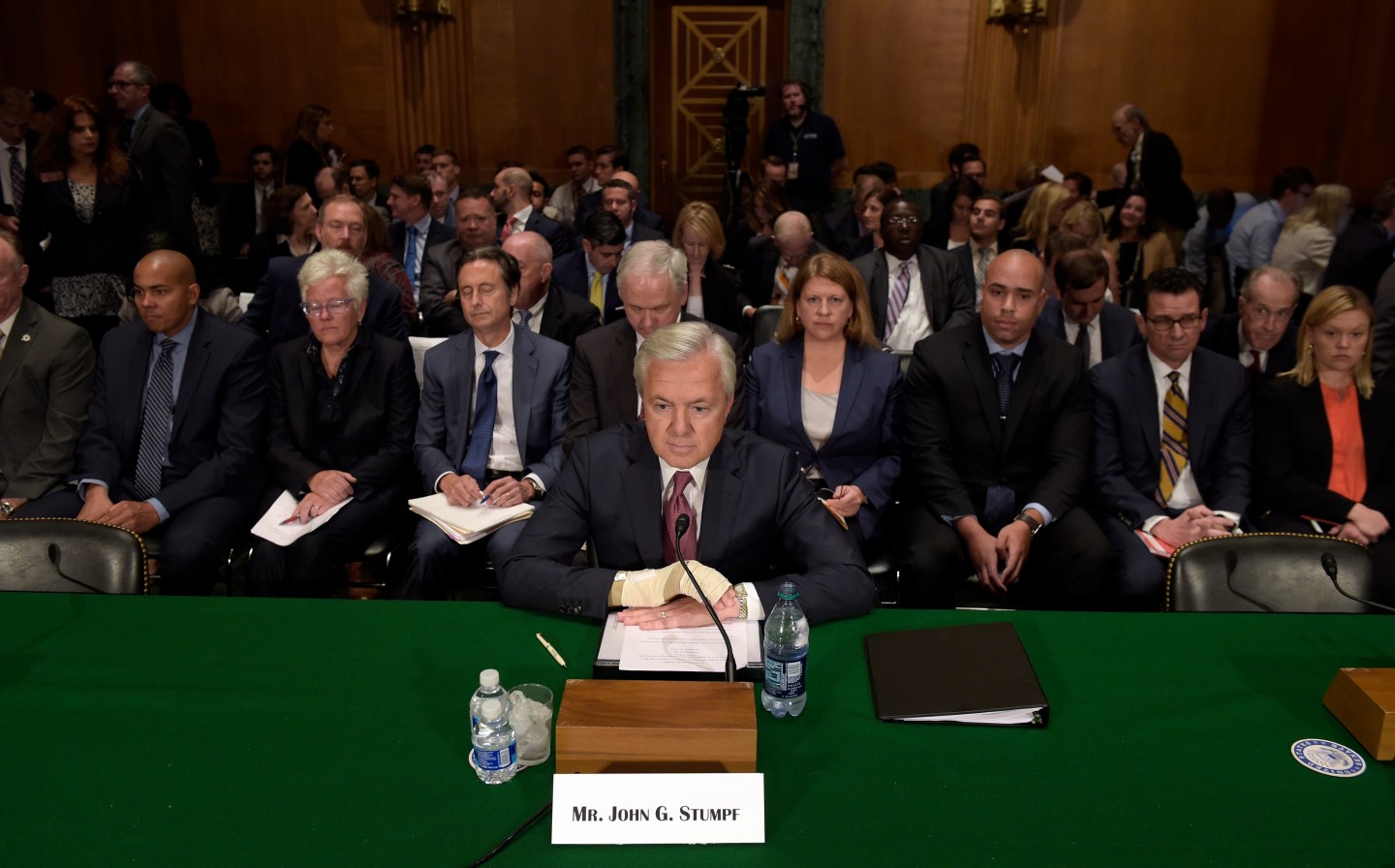
Wells Fargo Chief Executive Officer John Stumpf prepares to testify on Capitol Hill in Washington, Tuesday, Sept. 20, 2016, before Senate Banking Committee. Strumpf was called before the committee for betraying customers' trust in a scandal over allegations that employees opened millions of unauthorized accounts to meet aggressive sales targets. (AP Photo/Susan Walsh)Photograph by Susan Walsh—AP

With Wells Fargo’s flagrant mishandling of its fraudulent account crisis—and the ensuing “retirement” of CEO John Stumpf—we can add one more name to the list of major companies that have severely damaged their reputations by mishandling crisis situations. Wells Fargo joins Samsung, Volkswagen, Mylan, Valeant, and Toyota as once-great companies that failed to step up at the moment of truth.

Wells Fargo (WFC) is a great organization that no doubt will learn from this experience and overcome these problems, as has Toyota, but the damage to its reputation will last for a long time. These companies spent decades building reputations for integrity and customer service and billions on corporate advertising, public relations, and customer and employee surveys. Yet when confronted with crises that tested their integrity and character, their leaders turned to partial truths.

Everyone instinctively recognizes this kind of corporate dissembling. CEOs speak, but they don’t disclose substantive facts. They testify before Congress, but the words are carefully crafted by outside lawyers and public relations specialists. Worst of all, these leaders retreat from openly discussing the challenges with their employees. The self-confident CEOs, who once “seemed everywhere” when they were touting their companies’ success, seemed to disappear just when the public insists they step forward.

In behaving this way, CEOs such as Stumpf, Samsung’s Lee Jae-Yong, Volkswagen’s Martin Winterkorn, Mylan’s Heather Bresch, Valeant’s Mike Pearson, and Toyota’s Akio Toyoda destroyed their credibility with all the constituents who once believed in them.

Indeed, in facing the revelation of Wells Fargo’s creation of 2 million phony customer accounts, Stumpf completely mishandled the situation. Just two months before the bank agreed to pay a $185 million fine, Stumpf praised consumer banking chief Carrie Tolstedt as “a standard-bearer of our culture” and “a champion for our customers.” At the time, Tolstedt was retiring, walking away with a $124 million payout.

When the fine was announced, Stumpf turned him blame not on Tolstedt, but instead on 5,300 terminated employees, saying, “If they’re not going to do the thing that we ask them to do—put customers first, honor our vision and values—I don’t want them here.”

Does anyone really believe that more than 5,000 low level bank employees schemed to destroy Wells’ culture without any direction from the head of the consumer banking unit? Similarly, should the public believe Volkswagen USA CEO Martin Horn’s assertion that Volkswagen’s fraudulent emissions tests were the work of “two rogue engineers?” Or that Mylan wasn’t making an enormous profit on sales of its EpiPens?

Responding to growing pressure from Wall Street to increase their stock prices, these leaders created high-pressure environments focused on short-term performance. The CEOs enjoyed the largest fruits of these rewards with millions in bonuses and stock options. Often employees have no choice but to comply or lose their jobs.


There is a well-proven path to crisis response, one that was demonstrated by Johnson & Johnson CEO James Burke in the wake of the Tylenol drug tampering disaster: Step up to the crisis with full public disclosure, identify the root cause, and implement disciplined plans to fix the problems permanently. In so doing, Burke put his company on the successful road it has navigated the past 30 years.

Had these other CEOs followed Burke’s example, their companies would have fared far better. Burke’s approach is the route that General Motors’ CEO Mary Barra has taken in response to GM’s ignition switch problem. She is using that crisis to effect permanent changes that make GM’s closed culture more transparent, while at the same time improving the design and quality of its vehicles.

Successful leaders demonstrate courage to own the problems created under their leadership, and take personal responsibility to fix the problems. Here is what leaders should do when confronted by crises:

—When the first sign of a crisis appears, CEOs and their top teams should go to the site of the problems, witness the extent of the damage first-hand, and apologize to the victims. In the first 48 hours of a crisis, it is critical to be present and to take action, not wait for reports from lower-level teams.

—An action team of technically competent leaders must work diligently to solve the problems permanently. Only when they are confident that they fully understand the issues can they announce a fix to their customers and take full financial responsibility for its impact.

—While the people closest to the problem are searching for solutions, their CEO needs to be fully visible, holding daily or weekly press conferences to brief the media and all interested parties, and ensuring full transparency about what the company knows (and doesn’t know). In addition, top executives should hold regular town hall forums for employees, recognizing that whatever is said there becomes public information.

—Next, they need to create customer and public response teams, composed of top people, not just lawyers and PR specialists, that can respond to all inquiries and provide specific advice about what to do.

—Finally, they should appoint a senior-level team to reexamine the entire business and its culture, and recommend permanent fixes.

Leading through a crisis is never easy, yet CEOs who take immediate action and follow a clear, transparent process can use the crisis to transform their institutions for the better, and gain public respect through the process.

Bill George is Senior Fellow at Harvard Business School, former Chair & CEO of Medtronic and author of Discover Your True North.

About the Author
By Bill George
See full bioRight Arrow Button Icon

Latest in Leadership

Finance
Lorem ipsum dolor sit amet, consectetur adipiscing elit, sed do eiusmod tempor incididunt ut labore et dolore magna aliqua. Ut enim ad minim veniam
By Fortune Editors
October 20, 2025
Finance
Lorem ipsum dolor sit amet, consectetur adipiscing elit, sed do eiusmod tempor incididunt ut labore et dolore magna aliqua. Ut enim ad minim veniam
By Fortune Editors
October 20, 2025
Finance
Lorem ipsum dolor sit amet, consectetur adipiscing elit, sed do eiusmod tempor incididunt ut labore et dolore magna aliqua. Ut enim ad minim veniam
By Fortune Editors
October 20, 2025
Finance
Lorem ipsum dolor sit amet, consectetur adipiscing elit, sed do eiusmod tempor incididunt ut labore et dolore magna aliqua. Ut enim ad minim veniam
By Fortune Editors
October 20, 2025
Finance
Lorem ipsum dolor sit amet, consectetur adipiscing elit, sed do eiusmod tempor incididunt ut labore et dolore magna aliqua. Ut enim ad minim veniam
By Fortune Editors
October 20, 2025
Finance
Lorem ipsum dolor sit amet, consectetur adipiscing elit, sed do eiusmod tempor incididunt ut labore et dolore magna aliqua. Ut enim ad minim veniam
By Fortune Editors
October 20, 2025

Most Popular

Finance
Lorem ipsum dolor sit amet, consectetur adipiscing elit, sed do eiusmod tempor incididunt ut labore et dolore magna aliqua. Ut enim ad minim veniam
By Fortune Editors
October 20, 2025
Finance
Lorem ipsum dolor sit amet, consectetur adipiscing elit, sed do eiusmod tempor incididunt ut labore et dolore magna aliqua. Ut enim ad minim veniam
By Fortune Editors
October 20, 2025
Finance
Lorem ipsum dolor sit amet, consectetur adipiscing elit, sed do eiusmod tempor incididunt ut labore et dolore magna aliqua. Ut enim ad minim veniam
By Fortune Editors
October 20, 2025
Finance
Lorem ipsum dolor sit amet, consectetur adipiscing elit, sed do eiusmod tempor incididunt ut labore et dolore magna aliqua. Ut enim ad minim veniam
By Fortune Editors
October 20, 2025
Finance
Lorem ipsum dolor sit amet, consectetur adipiscing elit, sed do eiusmod tempor incididunt ut labore et dolore magna aliqua. Ut enim ad minim veniam
By Fortune Editors
October 20, 2025
Finance
Lorem ipsum dolor sit amet, consectetur adipiscing elit, sed do eiusmod tempor incididunt ut labore et dolore magna aliqua. Ut enim ad minim veniam
By Fortune Editors
October 20, 2025
Rankings
  • 100 Best Companies
  • Fortune 500
  • Global 500
  • Fortune 500 Europe
  • Most Powerful Women
  • Future 50
  • World’s Most Admired Companies
  • See All Rankings
Sections
  • Finance
  • Leadership
  • Success
  • Tech
  • Asia
  • Europe
  • Environment
  • Fortune Crypto
  • Health
  • Retail
  • Lifestyle
  • Politics
  • Newsletters
  • Magazine
  • Features
  • Commentary
  • Mpw
  • CEO Initiative
  • Conferences
  • Personal Finance
  • Education
Customer Support
  • Frequently Asked Questions
  • Customer Service Portal
  • Privacy Policy
  • Terms Of Use
  • Single Issues For Purchase
  • International Print
Commercial Services
  • Advertising
  • Fortune Brand Studio
  • Fortune Analytics
  • Fortune Conferences
  • Business Development
About Us
  • About Us
  • Editorial Calendar
  • Press Center
  • Work At Fortune
  • Diversity And Inclusion
  • Terms And Conditions
  • Site Map
  • Facebook icon
  • Twitter icon
  • LinkedIn icon
  • Instagram icon
  • Pinterest icon

Latest in Leadership

SuccessCareers
A decade after his NFL kneeling controversy, Colin Kaepernick has a message for Gen Z: Don’t let the fear of backlash silence you
By Orianna Rosa RoyleFebruary 10, 2026
3 minutes ago
women
Commentarynational debt
America is shorting one of its best assets as the $38 trillion national debt runs out of control 
By Katica RoyFebruary 10, 2026
11 minutes ago
target
C-SuiteRetail
Target’s new CEO just put veteran members of his C-suite on the shelf in first big shakeup
By Anne D'Innocenzio and The Associated PressFebruary 10, 2026
22 minutes ago
trump
CommentaryInequality
The economy isn’t K-shaped. For 87 million, people, it’s desperate and for another 46 million it’s elite
By Josh TanenbaumFebruary 10, 2026
46 minutes ago
hudson
CommentaryPharmaceutical Industry
Sanofi CEO: The enterprise AI shift will reshape pharma in 2026
By Paul HudsonFebruary 10, 2026
1 hour ago
C-SuiteLeadership
This CEO wants to do for hearing aids what she helped do for shapewear at Spanx
By Diane BradyFebruary 10, 2026
3 hours ago

Most Popular

placeholder alt text
C-Suite
Meet Jody Allen, the billionaire owner of the Seattle Seahawks, who plans to sell the team and donate the proceeds to charity
By Jake AngeloFebruary 9, 2026
19 hours ago
placeholder alt text
AI
As billionaires bail, Mark Zuckerberg doubles down on California with $50 million donation
By Sydney LakeFebruary 9, 2026
22 hours ago
placeholder alt text
Economy
China might be beginning to back away from U.S. debt as investors get nervous about overexposure to American assets
By Eleanor PringleFebruary 9, 2026
1 day ago
placeholder alt text
Economy
Elon Musk warns the U.S. is '1,000% going to go bankrupt' unless AI and robotics save the economy from crushing debt
By Jason MaFebruary 7, 2026
3 days ago
placeholder alt text
Commentary
America marks its 250th birthday with a fading dream—the first time that younger generations will make less than their parents
By Mark Robert Rank and The ConversationFebruary 8, 2026
2 days ago
placeholder alt text
Personal Finance
Current price of silver as of Monday, February 9, 2026
By Joseph HostetlerFebruary 9, 2026
1 day ago

© 2026 Fortune Media IP Limited. All Rights Reserved. Use of this site constitutes acceptance of our Terms of Use and Privacy Policy | CA Notice at Collection and Privacy Notice | Do Not Sell/Share My Personal Information
FORTUNE is a trademark of Fortune Media IP Limited, registered in the U.S. and other countries. FORTUNE may receive compensation for some links to products and services on this website. Offers may be subject to change without notice.