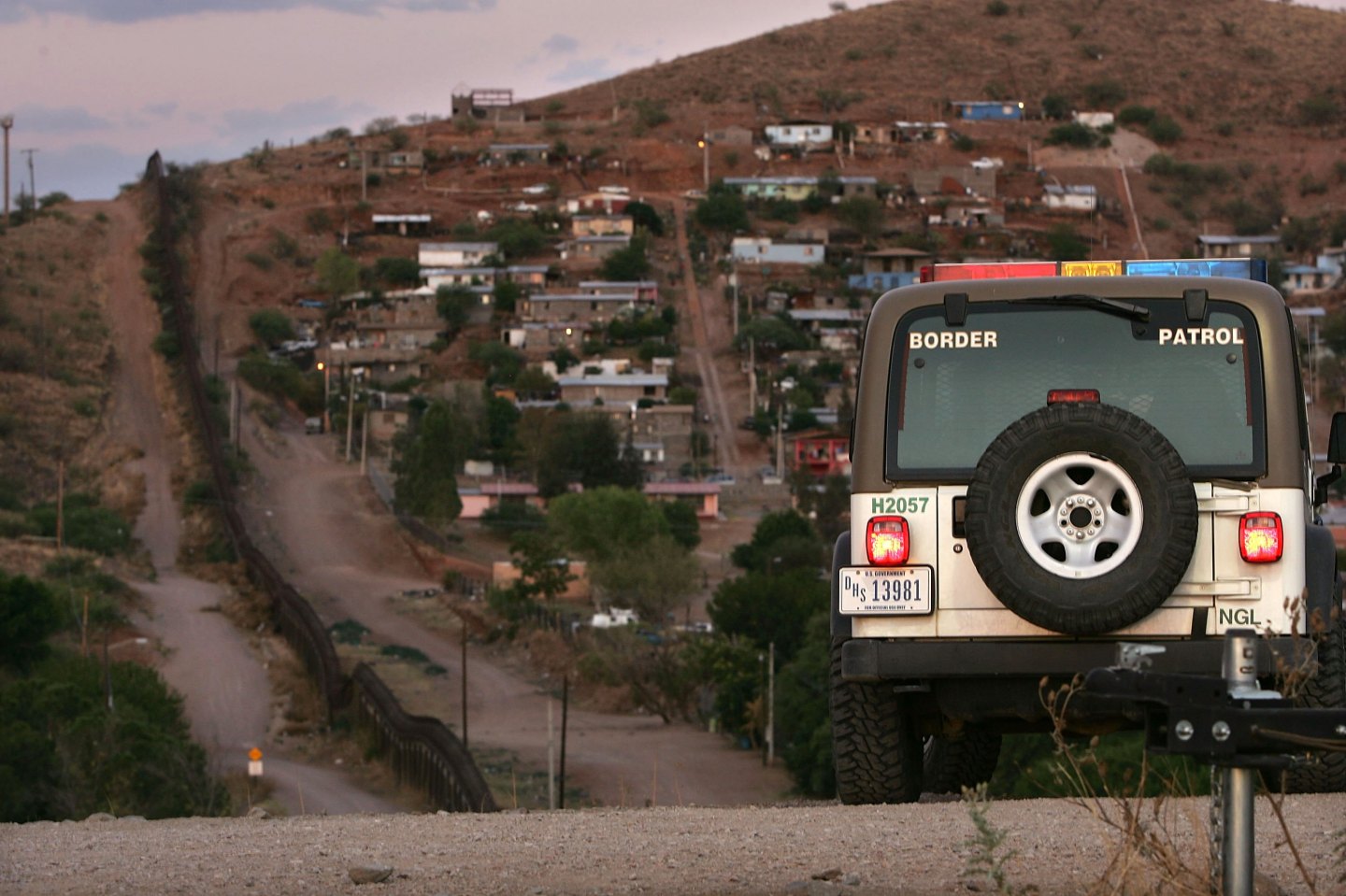
The hills on the Arizona border with Mexico are steep and bumpy as Paul Estrada drives along the fence, patrolling for drug and human smugglers.
Passing traffic signs pocked with bullet holes, the sheriff’s deputy points at parts of the wall that are but a few feet tall and laments how easy it is to get drugs into Arizona. In a mere month, Estrada and his colleagues on the border could confront a new challenge: legal marijuana.
Five states will vote Nov. 8 on whether to allow recreational pot, including Arizona and California, the first two border states to consider the idea.
If Arizona’s ballot measure passes, pot shops would soon arise in a place that has long been a center of drug smuggling. In cities such as Nogales, smugglers are seen almost daily scaling the border fence with backpacks of weed.
“This is a day-in and day-out fight,” said Col. Frank Milstead, head of the Arizona Department of Public Safety. “I can’t tell you that a day goes by that we don’t actually interdict somebody smuggling some sort of drug into the state.”
How drug cartels respond to legalization has been a focus of debate in Arizona.
Law enforcement leaders say the change will strengthen cartels, allowing them to infiltrate the legal pot market and driving them to sell more hard drugs. Advocates of legalization say it will undercut the cartels by eliminating a key segment of their business.
Carlos Alfaro, the deputy campaign manager for Proposition 205, says legalization in other states has already led to a drop in marijuana seizures by the Border Patrol.
From fiscal year 2011 to 2015, the number of seizures made by the agency nationwide fell by 39 percent. In the Tucson sector, at one point the busiest smuggling corridor in the nation, seizures fell by 28 percent, according to Border Patrol statistics.
“Now cartels have competition,” Alfaro said. “They have to compete with legitimate business in the U.S. with product that is more pure, with regulations on the shelf and prices.”
Authorities still confiscate huge volumes of pot in Arizona. The Border Patrol seized nearly 800,000 pounds last fiscal year in the state. Another 120,000 pounds was seized at border crossings within the Tucson sector.
As marijuana becomes legal in more places, the cartels “are seeking to increase market share in other controlled substances, notably heroin and methamphetamine,” Tucson Sector Chief Paul Beeson said in a written statement.
Customs officers confiscated more than 4,100 pounds of meth and 863 pounds of heroin at Tucson sector border crossings last fiscal year. That’s a 46 percent increase in meth and a 77 percent increase in heroin over the last two years. The amount of meth seized so far this fiscal year has already surpassed last year’s.
For now, cannabis remains the primary drug seized on the border, Beeson said.
All around the border, cartels hire lookouts who sit atop hills and mountains, watching for law enforcement activity. They disguise trucks under camouflage deep in the Arizona desert, stripping them of their insides and filling them top to bottom with drugs. Most recently, smugglers have turned to homemade cannons to launch giant loads of marijuana over the border fence.
A few weeks ago, authorities near the border found a 6-foot plastic-wrapped cylinder filled with 110 pounds of pot after hearing a loud boom, Milstead said. Detectives concluded that it had been launched by air cannon and landed about 250 yards from the border fence.
The region’s roads and highways are also peppered with Border Patrol checkpoints, where agents look for drugs and smugglers. Those checkpoints will remain even if pot is made legal.
That’s because marijuana is still illegal under federal law, which trumps state regulations. Border Patrol agents at checkpoints would seize marijuana from anyone who had it regardless of its legal status in the state, a spokesman said. But it’s unlikely they would detain anyone.
Local law enforcement officials say legal pot will present other obstacles, such as impaired drivers. They worry about traffic fatalities, which they say have gone up in Colorado as a result of marijuana, and they say that making drug arrests would be much harder because the smell of cannabis would no longer provide probable cause to search someone.
Retired Drug Enforcement Administration agent Finn Selander, a proponent of legalization, agrees that crime organizations will turn to other drugs, but he said marijuana is their most lucrative moneymaker and legalization would still cripple them.
The possibility that cartels will turn to something else to sell is a given but a “lame excuse” to oppose legal pot, Selander said.
“That’s what organized crime is all about is to find something they can peddle,” he said.





