• Home
  • Latest
  • Fortune 500
  • Finance
  • Tech
  • Leadership
  • Lifestyle
  • Rankings
  • Multimedia
LeadershipCommentary

In Insider Trading Case, Justice Scalia Was the Dog that Didn’t Bark

By
Roger Parloff
Roger Parloff
Down Arrow Button Icon
By
Roger Parloff
Roger Parloff
Down Arrow Button Icon
October 6, 2016, 3:04 PM ET
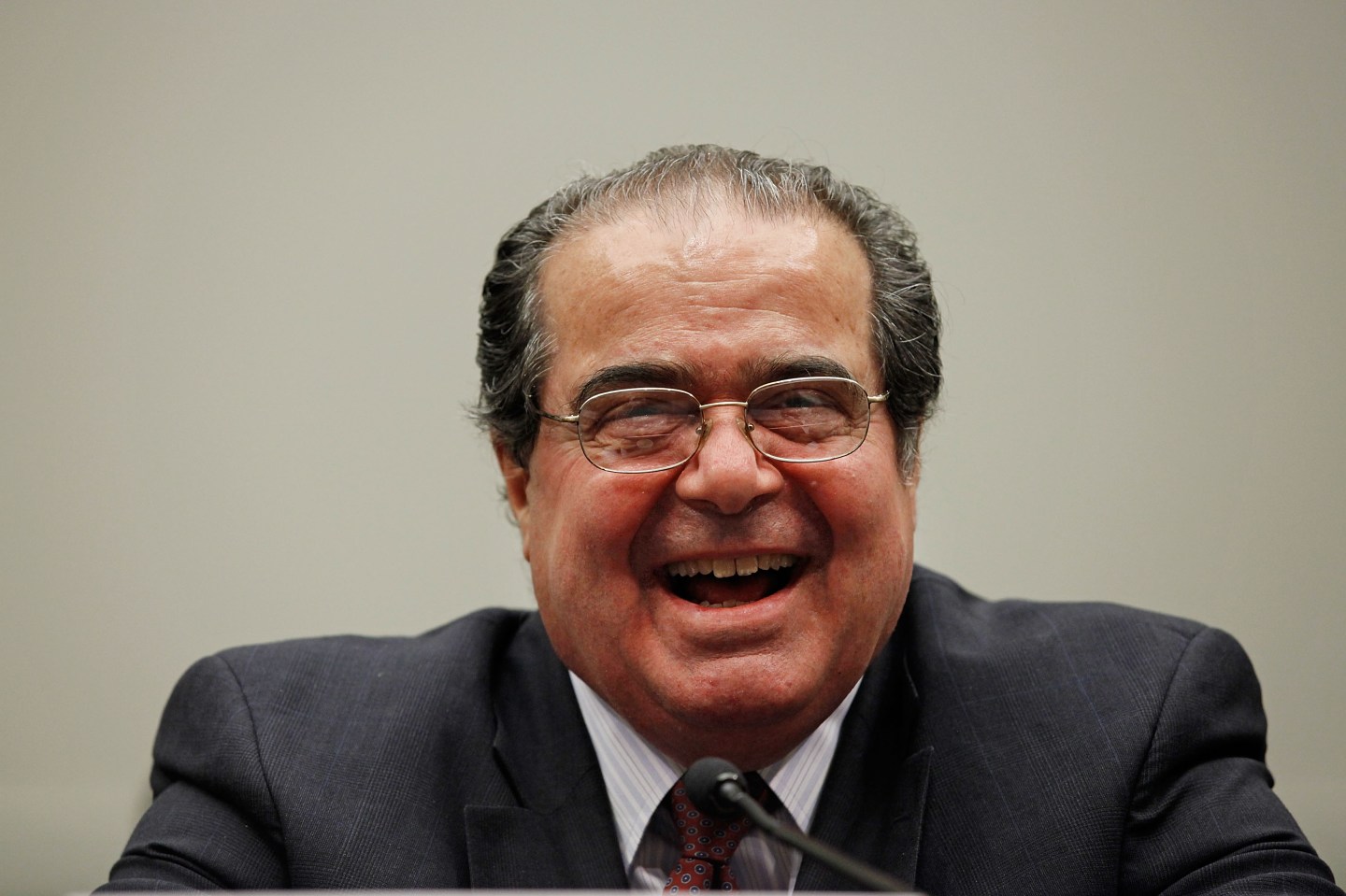
Justices Breyer And Scalia Testify At House Hearing
WASHINGTON - MAY 20: U.S. Supreme Court Associate Justice Antonin Scalia testifies before the House Judiciary Committee's Commercial and Administrative Law Subcommittee on Capitol Hill May 20, 2010 in Washington, DC. Scalia and fellow Associate Justice Stephen Breyer testified to the subcommittee about the Administrative Conference of the United States. (Photo by Chip Somodevilla/Getty Images)Photograph by Chip Somodevilla—Getty Images

At Wednesday’s oral argument in a key insider-trading case the most decisive voice was one that didn’t speak: that of the late Justice Antonin Scalia.

Judging from a transcript of the hearing, a misguided assault on insider-trading prosecutions looks likely to be rebuffed. But beyond that important news, we saw yet another stark example of how Justice Scalia’s sudden death last February has dramatically transformed the Court, and not just by turning five conservative-leaning votes into four.

It is hard not to speculate about how the argument would have gone in the case of Bassam Salman v. United States if the outspoken justice—who died one month after the Court decided to take the matter up—had still been on the bench. He was the dog that didn’t bark at Wednesday’s proceedings, and his silence was deafening.

A mere recitation of the essential facts of the Salman case powerfully conveys the remarkable extent to which the core law against insider trading has come under attack. I challenge the lay reader to even guess what the Court could have thought was questionable about the prosecution’s seemingly slam-dunk, shave-and-a-haircut case against Salman.

Salman was a wholesale grocer. His sister married a man named Maher Kara who was an investment banker with Citigroup working in the healthcare arena. Investment bankers get access to their corporate client’s confidential inside information about deals that are being contemplated and they are forbidden from disclosing that information to anyone.

Maher had a beloved brother, Michael. Michael pestered him to tell him material nonpublic information Maher learned in his position. Though Maher knew he was violating Citigroup’s rules, he gave his brother the information to get him “off his back,” he testified. In their emails, Maher and Michael spoke in code about the leaks, according to the government’s evidence, obviously recognizing that what they were doing was wrong.

After his sister became engaged to marry Maher in 2003, Salman became close to Michael. Michael began tipping Salman off to the information he had wheedled out of his brother Maher. Salman knew the tips came from Maher, and that Maher wasn’t supposed to leak them. Salman traded on that information. Even though Salman had his own trading account, he made these particular trades using someone else’s brokerage account—splitting the profits with that person—in an apparent effort to conceal the connection between himself and Maher.

He and his partner made $1.5 million from these trades, including more than $1 million from a single trade in 2007. On one occasion Salman gave Michael $10,000 as a thank-you, according to the government’s evidence.

A layperson listening to these facts can have only one reaction: WTF? Isn’t this what insider trading is all about? What in God’s name could Bassam Salman’s defense be? And why would the Supreme Court need to review a case like this?

The answer is that the original tipper, Maher Kara, didn’t get paid anything by Michael Kara for supplying him with the material nonpublic information that he traded on.

As for the bigger question—why would that fact possibly matter?—there are a couple lengthy answers, none of which are completely satisfying. I summarized some key ones a few months ago in a story entitled Why Insider Trading May Be Tougher Than Ever to Prosecute. In short, in the landmark 1983 Supreme Court case SEC v. Dirks, the Supreme Court held that—with certain important qualifications—if the tipper receives no “personal benefit” in exchange for a tip, he hasn’t committed fraud and thus can’t be guilty of insider trading.

Suffice it to say that these issues reached a head in December 2014, when the U.S. Court of Appeals for the Second Circuit in New York tossed out the convictions of two hedge fund managers, Todd Newman and Anthony Chiasson, in a broadly worded opinion that has subsequently posed major and, in my humble opinion, unwarranted obstacles for prosecutors in this area. Since the ruling, Manhattan U.S. Attorney Preet Bharara has had to drop at least 10 insider-trading cases—including several involving defendants who had already pled guilty—and still more convicted defendants are now seeking to reopen their cases.

When the Supreme Court took Salman’s case in January—against the wishes and recommendation of the Department of Justice, which apparently feared what the Court, as then constituted, would do with it—it looked quite ominous for the government. Justice Scalia has long had a number of beefs with the insider trading laws, and paring them back seemed in line with his predilections. Insider trading prosecutions triggered all three of Scalia’s big concerns:

  • First of all, he believed that there’d been too much criminalization of business conduct.
  • Second, he believed that there’d been too much federalization of the criminal law (an arena traditionally left to the states).
  • Third, he’d long been wary of any sort of judge-made criminal law, which he feared created too great a risk of due process issues—i.e., defendants not being put on notice before they were charged of precisely what conduct was forbidden. (There is no specific insider-trading statute; judges have interpreted the general securities fraud statute to cover certain forms of insider trading.)

Salman’s attorney, Alexandra Shapiro, repeatedly threw these red-meat, Scalia-directed issues before the Court during Wednesday’s argument. But this time they fell flat on the floor, and no one picked them up.

Instead, Justice Stephen Breyer politely refuted them, without any of his brethren pushing back. “[The securities fraud law has] been around a long time,” he told Shapiro. “Exactly what’s criminal, what’s civil and so forth has been developed by courts over a long time. This statute’s been around since the ‘30s, and we have courts developing law in it. And I believe the marketplace pays a lot of attention to that. And virtually every court, I think, but [the U.S. Court of Appeals for the Second Circuit], has held that this does extend to a tipper giving inside information to a close relative. And it seems to me . . . that to take the minority [view] here [of] the Second Circuit . . . is really more likely to change the law that people have come to rely on then it is to keep it.”

Which is what one would have expected Justice Breyer to say. The striking difference this time was that Justice Scalia didn’t take up the cudgel, coming to Shapiro’s rescue, and supplying forceful new arguments even she hadn’t thought of. And neither did Chief Justice John Roberts, Jr., Justice Anthony Kennedy, Justice Clarence Thomas, or Justice Samuel Alito.

In sum, the oral argument showed that Justice Scalia’s passing has marked not just a new era for insider-trading jurisprudence, but a new era for the Court.

About the Author
By Roger Parloff
See full bioRight Arrow Button Icon

Latest in Leadership

Finance
Lorem ipsum dolor sit amet, consectetur adipiscing elit, sed do eiusmod tempor incididunt ut labore et dolore magna aliqua. Ut enim ad minim veniam
By Fortune Editors
October 20, 2025
Finance
Lorem ipsum dolor sit amet, consectetur adipiscing elit, sed do eiusmod tempor incididunt ut labore et dolore magna aliqua. Ut enim ad minim veniam
By Fortune Editors
October 20, 2025
Finance
Lorem ipsum dolor sit amet, consectetur adipiscing elit, sed do eiusmod tempor incididunt ut labore et dolore magna aliqua. Ut enim ad minim veniam
By Fortune Editors
October 20, 2025
Finance
Lorem ipsum dolor sit amet, consectetur adipiscing elit, sed do eiusmod tempor incididunt ut labore et dolore magna aliqua. Ut enim ad minim veniam
By Fortune Editors
October 20, 2025
Finance
Lorem ipsum dolor sit amet, consectetur adipiscing elit, sed do eiusmod tempor incididunt ut labore et dolore magna aliqua. Ut enim ad minim veniam
By Fortune Editors
October 20, 2025
Finance
Lorem ipsum dolor sit amet, consectetur adipiscing elit, sed do eiusmod tempor incididunt ut labore et dolore magna aliqua. Ut enim ad minim veniam
By Fortune Editors
October 20, 2025

Most Popular

Finance
Lorem ipsum dolor sit amet, consectetur adipiscing elit, sed do eiusmod tempor incididunt ut labore et dolore magna aliqua. Ut enim ad minim veniam
By Fortune Editors
October 20, 2025
Finance
Lorem ipsum dolor sit amet, consectetur adipiscing elit, sed do eiusmod tempor incididunt ut labore et dolore magna aliqua. Ut enim ad minim veniam
By Fortune Editors
October 20, 2025
Finance
Lorem ipsum dolor sit amet, consectetur adipiscing elit, sed do eiusmod tempor incididunt ut labore et dolore magna aliqua. Ut enim ad minim veniam
By Fortune Editors
October 20, 2025
Finance
Lorem ipsum dolor sit amet, consectetur adipiscing elit, sed do eiusmod tempor incididunt ut labore et dolore magna aliqua. Ut enim ad minim veniam
By Fortune Editors
October 20, 2025
Finance
Lorem ipsum dolor sit amet, consectetur adipiscing elit, sed do eiusmod tempor incididunt ut labore et dolore magna aliqua. Ut enim ad minim veniam
By Fortune Editors
October 20, 2025
Finance
Lorem ipsum dolor sit amet, consectetur adipiscing elit, sed do eiusmod tempor incididunt ut labore et dolore magna aliqua. Ut enim ad minim veniam
By Fortune Editors
October 20, 2025
Rankings
  • 100 Best Companies
  • Fortune 500
  • Global 500
  • Fortune 500 Europe
  • Most Powerful Women
  • Future 50
  • World’s Most Admired Companies
  • See All Rankings
Sections
  • Finance
  • Leadership
  • Success
  • Tech
  • Asia
  • Europe
  • Environment
  • Fortune Crypto
  • Health
  • Retail
  • Lifestyle
  • Politics
  • Newsletters
  • Magazine
  • Features
  • Commentary
  • Mpw
  • CEO Initiative
  • Conferences
  • Personal Finance
  • Education
Customer Support
  • Frequently Asked Questions
  • Customer Service Portal
  • Privacy Policy
  • Terms Of Use
  • Single Issues For Purchase
  • International Print
Commercial Services
  • Advertising
  • Fortune Brand Studio
  • Fortune Analytics
  • Fortune Conferences
  • Business Development
About Us
  • About Us
  • Editorial Calendar
  • Press Center
  • Work At Fortune
  • Diversity And Inclusion
  • Terms And Conditions
  • Site Map
  • Facebook icon
  • Twitter icon
  • LinkedIn icon
  • Instagram icon
  • Pinterest icon

Latest in Leadership

AIEducation
AI could spark a new age of learning, but only if governments, tech firms and educators work together
By José Manuel Barroso and Stephen HodgesFebruary 17, 2026
2 hours ago
cafe
Arts & EntertainmentTariffs and trade
Americans’ new tariff coffee math means ditching the Starbucks, McDonald’s and Dunkin’ runs
By Matt Sedensky and The Associated PressFebruary 16, 2026
15 hours ago
wendy's
BankingRestaurants
Wendy’s closes hundreds of restaurants after plunge in same-store sales worse than Wall Street expected
By Dee-Ann Durbin and The Associated PressFebruary 16, 2026
15 hours ago
restaurant
Arts & EntertainmentFood and drink
Ancient stigma around Chinese food is vanishing rapidly in top restaurant scenes: ‘we are trying to break this bias’
By Terry Tang and The Associated PressFebruary 16, 2026
15 hours ago
Brian Moynihan, chief executive officer of Bank of America Corp.
EconomyJobs
Brian Moynihan isn’t so worried about an AI jobs bloodbath, pointing to a 1960s theory that computers would end all management roles
By Eleanor PringleFebruary 16, 2026
16 hours ago
isom
CommentaryAirline industry
The skies for American Airlines are clearer than you think
By Jeffrey Sonnenfeld and Steven TianFebruary 16, 2026
19 hours ago

Most Popular

placeholder alt text
Economy
Social Security's trust fund is nearing insolvency, and the borrowing binge that may follow will rip through debt markets, economist warns
By Jason MaFebruary 15, 2026
1 day ago
placeholder alt text
Future of Work
Malcolm Gladwell tells young people if they want a STEM degree, 'don’t go to Harvard.' You may end up at the bottom of your class and drop out
By Sasha RogelbergFebruary 14, 2026
3 days ago
placeholder alt text
Real Estate
A billionaire and an A-list actor found refuge in a 37-home Florida neighborhood with armed guards—proof that privacy is now the ultimate luxury
By Marco Quiroz-GutierrezFebruary 15, 2026
2 days ago
placeholder alt text
Success
Meet the grandmother living out of a 400-ft ‘granny pod’ to save money and help with child care—it’s become an American ‘economic necessity’
By Emma BurleighFebruary 15, 2026
2 days ago
placeholder alt text
C-Suite
Blackstone mogul warned of 'urgent need' for AI preparedness—Now he’s turning his $48 billion fortune into a top philanthropic foundation
By Sydney LakeFebruary 16, 2026
23 hours ago
placeholder alt text
Commentary
Something big is happening in AI — and most people will be blindsided
By Matt ShumerFebruary 11, 2026
6 days ago

© 2026 Fortune Media IP Limited. All Rights Reserved. Use of this site constitutes acceptance of our Terms of Use and Privacy Policy | CA Notice at Collection and Privacy Notice | Do Not Sell/Share My Personal Information
FORTUNE is a trademark of Fortune Media IP Limited, registered in the U.S. and other countries. FORTUNE may receive compensation for some links to products and services on this website. Offers may be subject to change without notice.