• Home
  • Latest
  • Fortune 500
  • Finance
  • Tech
  • Leadership
  • Lifestyle
  • Rankings
  • Multimedia
Tech

What the World’s First Quantum Satellite Launch Means

Robert Hackett
By
Robert Hackett
Robert Hackett
Down Arrow Button Icon
Robert Hackett
By
Robert Hackett
Robert Hackett
Down Arrow Button Icon
August 16, 2016, 8:28 PM ET
CHINA-JIUQUAN-QUANTUM SATELLITE-LAUNCH (CN)
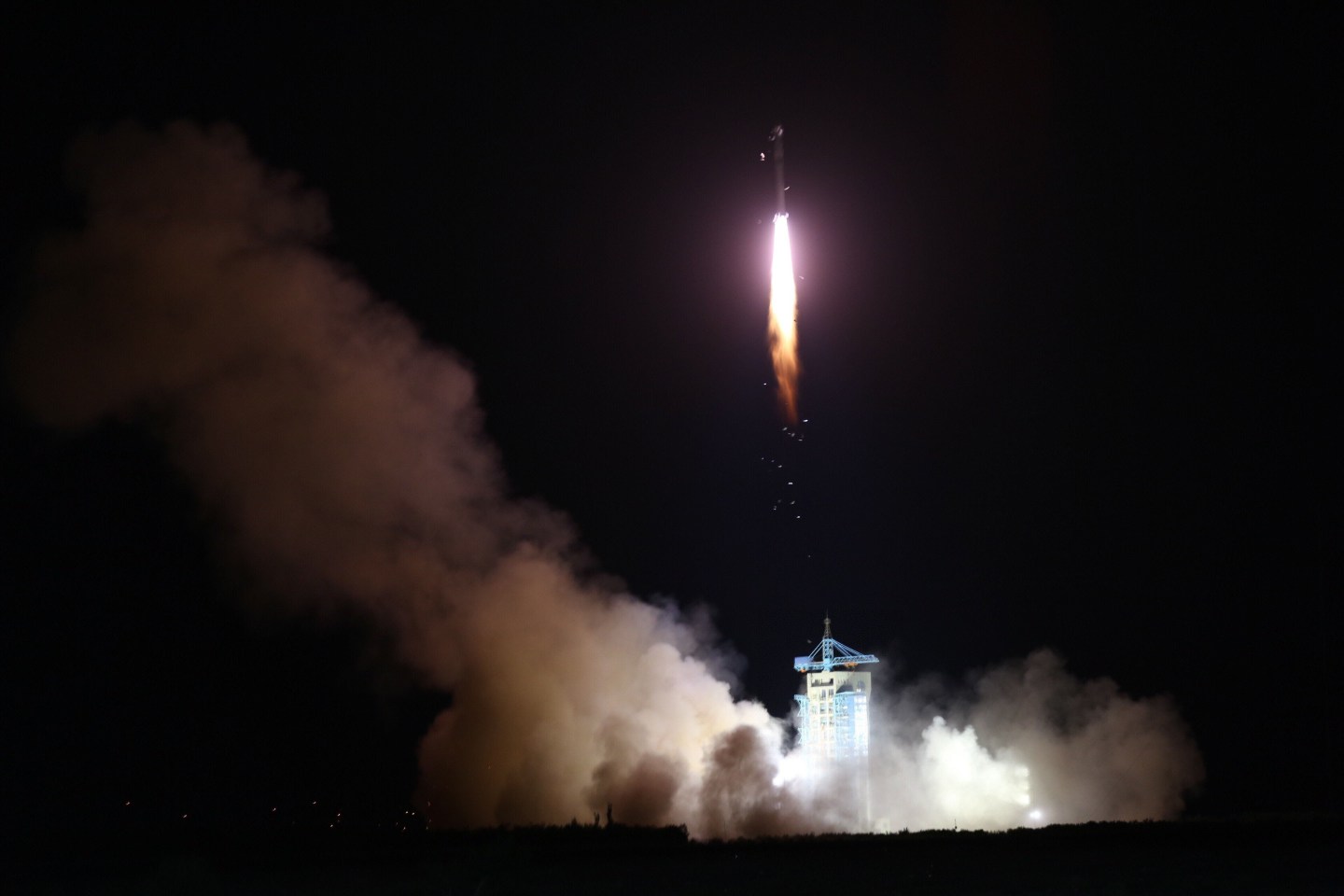
JIUQUAN, Aug. 16, 2016 -- China launches the world's first quantum satellite on top of a Long March-2D rocket from the Jiuquan Satellite Launch Center in Jiuquan, northwest China's Gansu Province, Aug. 16, 2016. The world's first quantum communication satellite, which China is preparing to launch, has been given the moniker "Micius," after a fifth century B.C. Chinese scientist, the Chinese Academy of Sciences announced Monday. (Xinhua/Jin Liwang via Getty Images)Jin Liwang—Xinhua News Agency via Getty Images

China blasted the world’s first quantum communications satellite into orbit from the Gobi Desert early Tuesday.

The project signals the dawn of a potentially game-changing communications technology: quantum key distribution—a dependable system for exchanging secrets (more on this in a bit)—as beamed from space. If the experiment is successful, it could lead to considerably more secure global communications.

While many news outlets have followed Chinese state media’s cue and described the technology as “hack-proof,” a more appropriate descriptor would be “tamper resistant.” (Nothing is “hack-proof.”) Quantum crypto-systems achieve this by exploiting the quirky properties of subatomic particles

Get Data Sheet,Fortune’s technology newsletter.

Here’s how the science works. The fundamental problem of cryptography involves exchanging keys—secret alphanumeric strings—that enable people to encode and decode messages. When two parties swap keys, they normally have no indication whether anyone has intercepted them; an interloper with stolen keys can eavesdrop on correspondence or manipulate it.

When quantum science is applied, the keys can be made to self-destruct or change if a third party interferes with their transmission. The keys are sent using pairs of entangled photons, or light particles that share a special bond, to carry the information.

The Wall Street Journal quoted an executive familiar with the technology as comparing it to “sending a message written on a soap bubble.” Touch, and it pops.

For more on satellites, watch:

The technology is defensive in nature. China, which has increased funding for basic science research in this area over the past few years (likely in response to revelations about other countries’ hacking capabilities) played that aspect up by naming the satellite Micius in honor of an ancient Chinese philosopher who preached a philosophy of “universal love.”

Dubbed Quantum Experiments at Space Scale, the Chinese experiment is not the first time quantum key distribution has been attempted. Ground-based fiber optic networks have successfully transmitted quantum keys in the United States, Europe, and China. Other countries like the U.K. and Singapore have smaller experiments in the works.

Bringing this quantum technology to a satellite network will be a grand feat, however. The team, led by Pan Jianwei, said they would attempt to transmit quantum keys from Beijing to Vienna to test the system’s feasibility.

The experiment of beaming finicky particles over vast distances will be tricky. Yet it could vault China over the international competition in counter-surveillance tech if it does succeed.

For space-based quantum cryptography, the race is on.

About the Author
Robert Hackett
By Robert Hackett
Instagram iconLinkedIn iconTwitter icon
See full bioRight Arrow Button Icon

Latest in Tech

InvestingStock
There have been head fakes before, but this time may be different as the latest stock rotation out of AI is just getting started, analysts say
By Jason MaDecember 13, 2025
49 minutes ago
Politicsdavid sacks
Can there be competency without conflict in Washington?
By Alyson ShontellDecember 13, 2025
1 hour ago
InnovationRobots
Even in Silicon Valley, skepticism looms over robots, while ‘China has certainly a lot more momentum on humanoids’
By Matt O'Brien and The Associated PressDecember 13, 2025
3 hours ago
Sarandos
Arts & EntertainmentM&A
It’s a sequel, it’s a remake, it’s a reboot: Lawyers grow wistful for old corporate rumbles as Paramount, Netflix fight for Warner
By Nick LichtenbergDecember 13, 2025
8 hours ago
Oracle chairman of the board and chief technology officer Larry Ellison delivers a keynote address during the 2019 Oracle OpenWorld on September 16, 2019 in San Francisco, California.
AIOracle
Oracle’s collapsing stock shows the AI boom is running into two hard limits: physics and debt markets
By Eva RoytburgDecember 13, 2025
8 hours ago
robots
InnovationRobots
‘The question is really just how long it will take’: Over 2,000 gather at Humanoids Summit to meet the robots who may take their jobs someday
By Matt O'Brien and The Associated PressDecember 12, 2025
22 hours ago

Most Popular

placeholder alt text
Economy
Tariffs are taxes and they were used to finance the federal government until the 1913 income tax. A top economist breaks it down
By Kent JonesDecember 12, 2025
1 day ago
placeholder alt text
Success
Apple cofounder Ronald Wayne sold his 10% stake for $800 in 1976—today it’d be worth up to $400 billion
By Preston ForeDecember 12, 2025
1 day ago
placeholder alt text
Success
40% of Stanford undergrads receive disability accommodations—but it’s become a college-wide phenomenon as Gen Z try to succeed in the current climate
By Preston ForeDecember 12, 2025
1 day ago
placeholder alt text
Economy
The Fed just ‘Trump-proofed’ itself with a unanimous move to preempt a potential leadership shake-up
By Jason MaDecember 12, 2025
21 hours ago
placeholder alt text
Economy
For the first time since Trump’s tariff rollout, import tax revenue has fallen, threatening his lofty plans to slash the $38 trillion national debt
By Sasha RogelbergDecember 12, 2025
23 hours ago
placeholder alt text
Success
At 18, doctors gave him three hours to live. He played video games from his hospital bed—and now, he’s built a $10 million-a-year video game studio
By Preston ForeDecember 10, 2025
3 days ago
Rankings
  • 100 Best Companies
  • Fortune 500
  • Global 500
  • Fortune 500 Europe
  • Most Powerful Women
  • Future 50
  • World’s Most Admired Companies
  • See All Rankings
Sections
  • Finance
  • Leadership
  • Success
  • Tech
  • Asia
  • Europe
  • Environment
  • Fortune Crypto
  • Health
  • Retail
  • Lifestyle
  • Politics
  • Newsletters
  • Magazine
  • Features
  • Commentary
  • Mpw
  • CEO Initiative
  • Conferences
  • Personal Finance
  • Education
Customer Support
  • Frequently Asked Questions
  • Customer Service Portal
  • Privacy Policy
  • Terms Of Use
  • Single Issues For Purchase
  • International Print
Commercial Services
  • Advertising
  • Fortune Brand Studio
  • Fortune Analytics
  • Fortune Conferences
  • Business Development
About Us
  • About Us
  • Editorial Calendar
  • Press Center
  • Work At Fortune
  • Diversity And Inclusion
  • Terms And Conditions
  • Site Map

© 2025 Fortune Media IP Limited. All Rights Reserved. Use of this site constitutes acceptance of our Terms of Use and Privacy Policy | CA Notice at Collection and Privacy Notice | Do Not Sell/Share My Personal Information
FORTUNE is a trademark of Fortune Media IP Limited, registered in the U.S. and other countries. FORTUNE may receive compensation for some links to products and services on this website. Offers may be subject to change without notice.