• Home
  • Latest
  • Fortune 500
  • Finance
  • Tech
  • Leadership
  • Lifestyle
  • Rankings
  • Multimedia
TechRocket Internet

Germany’s Rocket Internet Falls Back to Earth

By
Reuters
Reuters
Down Arrow Button Icon
By
Reuters
Reuters
Down Arrow Button Icon
June 29, 2016, 9:13 AM ET
NIGERIA-ECONOMY-INTERNET-AFRICA
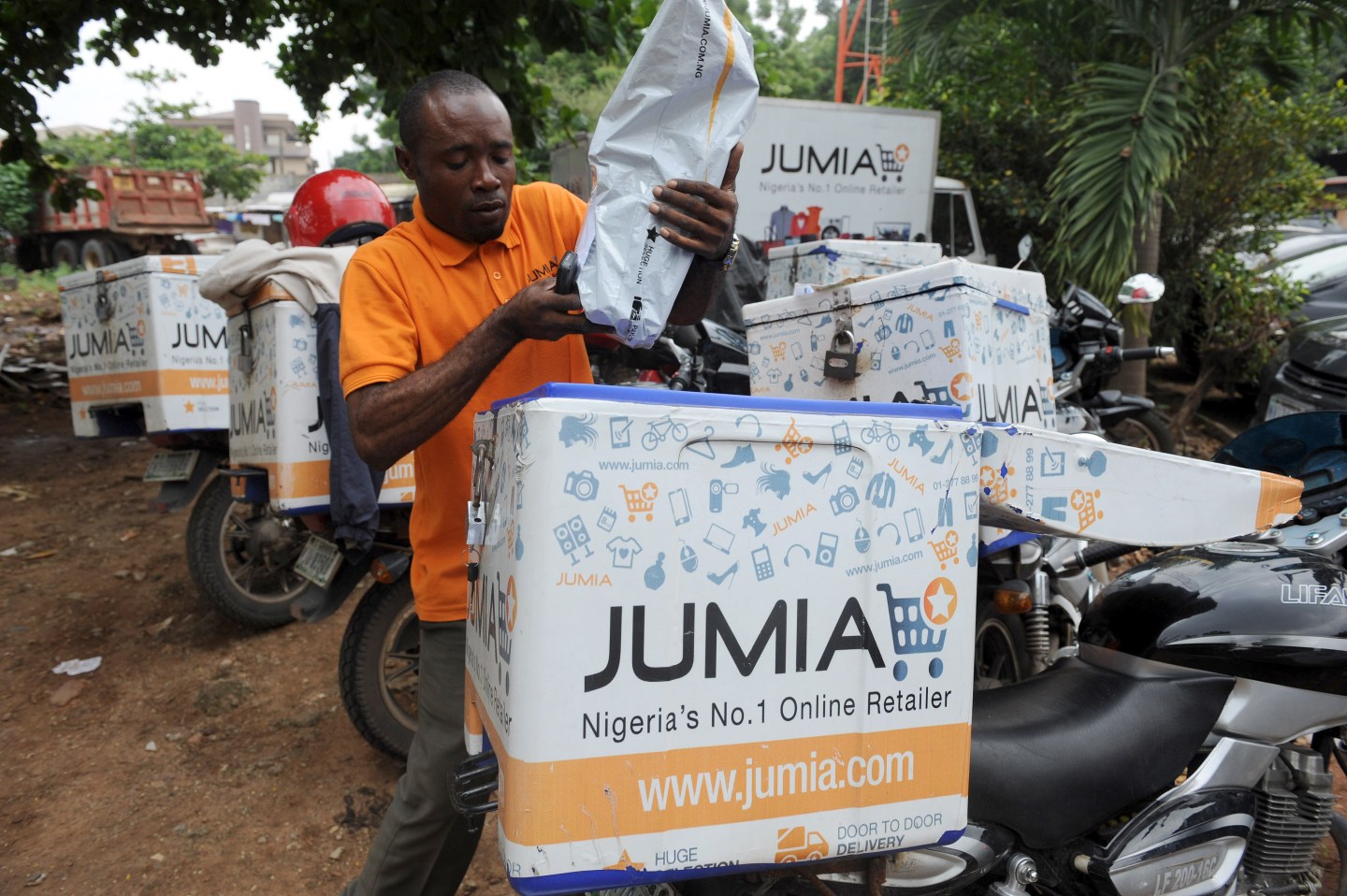
Photograph by Pius Utomi Ekpei — AFP/Getty Images

When German e-commerce investor Rocket Internet launched Jumia in 2012 as a would-be African Amazon, it was optimistic that a rapidly expanding middle class would quickly shift from street markets to shopping online.

Four years on, falling sales for sites like Jumia and slower growth from Nigeria to Russia and Brazil is casting doubt on Rocket Internet’s ambition to become the world’s biggest Internet company outside the United States and China.

Jumia made a loss of $18.8 million in the first three months of 2016 on sales that fell more than a third. The devaluation of Nigeria’s naira last week is a new blow for Jumia, which now operates in more than 20 countries in Africa.

Revenue growth has also slowed at most of Rocket Internet’s other 11 leading startups, ranging from furniture e-commerce and food delivery in Europe to online fashion in markets from India to Latin America and the Middle East.

That is the consequence of Rocket’s shift to rein in spending on marketing and logistics as it seeks to stem losses, which it said peaked at $1.1 billion in 2015.

Get Data Sheet, Fortune’s technology newsletter.

As a result, shareholders have cast doubt on the valuation Rocket has put on its portfolio and questioned the strategy of sending business school graduates to set up 150 startups in more than 110 countries in just a few years.

Exclusive interviews with shareholders reveal growing skepticism about Rocket’s sprawling empire as emerging markets sour and technology stocks cool. Its share price has fallen 39% this year.

“People have started to question whether the company portfolio is really as good as we first thought,” said a top 20 shareholder, who declined to be named as they expect to trade stock. “A lot of trust has been destroyed over the last 12 months.”


Founded in Berlin in 2007 by brothers Oliver, Alexander, and Marc Samwer, Rocket Internet aims to replicate the business models of Amazon, China’s Alibaba, and ride service Uber in new markets.

With few other tech companies listed in Europe, investors jumped at the opportunity to gain exposure to an array of fast-growing businesses when Rocket went public in 2014, pushing the stock up by more than 50% in the first few months.

However, the stock has been on a downward trajectory since peaking in February 2015 after it surprised investors with a new capital hike and shifted strategy to invest in the food-delivery business in developed markets.

The latest share price tumble started in April when Sweden’s Kinnevik, Rocket’s second-biggest shareholder after the Samwer brothers, slashed the valuation for its emerging market fashion websites by two-thirds.

That unsettled investors, especially after Kinnevik said its representatives were stepping down from the board, citing potential conflicts of interest over future investments.

Kinnevik, which has hedged its bets on Rocket in Africa by investing in Jumia’s main rival, Konga, declined to comment for this article. It has said it will work closely with Rocket although it could review its stake in two or three years.

Martin Weber, a partner at venture capital firm Holtzbrinck, which has a 1.9% Rocket stake, says the company has struggled to provide enough information about its holdings.

“The stock market loves transparency. And that is not practically possible at Rocket,” Weber told Reuters. “Rocket needs to prove that it can get profitable companies on their feet.”

Samwer has admitted Rocket had initially done too little to communicate with investors after the firm went public, but he is not worried about the share price.

“We planted a lot of seeds and I believe in the next 24 months a lot of investors will see it the same way,” he told a Berlin tech conference this month.

He says the sale in April of Lazada—Rocket’s loss-making Amazon clone in Southeast Asia—for $1 billion to Alibaba underlines the logic of going into frontier markets before more established rivals.

Some investors are prepared to give him more time.

“We believe that the portfolio is worth a lot more,” said Ralph Dommermuth, chief executive of United Internet, Rocket’s third-biggest shareholder, even after he took a $174 million write-down on his firm’s Rocket stake in May.

“Among European investors in young Internet firms, Rocket Internet is the broadest and has the most experience in the sector.”

CEO’S Promise

Rocket now has a market capitalization of $3.3 billion, well below the $5.89 billion valuation it put on its portfolio at April 30, and only just above the $3.1 billion in cash held by Rocket and its operating companies as of March 31.

Most Internet startups burn cash in early years as they pour money into marketing, logistics, and technology to pursue revenue growth above all else, hoping to move into the black once they reach scale.

That approach has worked for the likes of Amazon (AMZN), Alibaba, and European online fashion site Zalando.

Neil Campling, head of technology research at Northern Trust Securities, who rates the stock a “sell,” doubts the Rocket businesses can replicate Amazon’s success because its markets are so underdeveloped and the cost of logistics so much higher.

“As soon as they reduce marketing, you see revenue growth decline substantially,” he said. “They haven’t got the scale.”

However, Samwer says Rocket has more than enough capital to fund its main startups until they turn profitable.

Samwer promised last September to make three startups profitable by the end of 2017, with Middle East fashion site Namshi, online home furnishings store Westwing and food takeout firm Delivery Hero seen as the most promising.

Jumia, which predicted in late 2013 it could turn a profit within 18 months, is far from that goal. It lost $123 million in 2015 on sales of $150 million.

But Jumia Nigeria CEO Juliet Anammah believes the company can make a profit within three to five years. “Africa is a long-term play,” she said.

Samwer has now changed tack for his Amazon clones, shifting from buying and shipping their own stock—more suited to countries with well-established logistics—to providing a commission-based marketplace for third-party retailers, like Alibaba.

“You are tapping into the supply capacity that exists in the country. So you are not dependant exclusively on your working capital to source and bring in retail products,” Anammah said.

Samwer remains optimistic for Jumia.

“The people are still there even if emerging markets are cold… They still have some money,” he said. “The offline to online shift continues.”


About the Author
By Reuters
See full bioRight Arrow Button Icon

Latest in Tech

Finance
Lorem ipsum dolor sit amet, consectetur adipiscing elit, sed do eiusmod tempor incididunt ut labore et dolore magna aliqua. Ut enim ad minim veniam
By Fortune Editors
October 20, 2025
Finance
Lorem ipsum dolor sit amet, consectetur adipiscing elit, sed do eiusmod tempor incididunt ut labore et dolore magna aliqua. Ut enim ad minim veniam
By Fortune Editors
October 20, 2025
Finance
Lorem ipsum dolor sit amet, consectetur adipiscing elit, sed do eiusmod tempor incididunt ut labore et dolore magna aliqua. Ut enim ad minim veniam
By Fortune Editors
October 20, 2025
Finance
Lorem ipsum dolor sit amet, consectetur adipiscing elit, sed do eiusmod tempor incididunt ut labore et dolore magna aliqua. Ut enim ad minim veniam
By Fortune Editors
October 20, 2025
Finance
Lorem ipsum dolor sit amet, consectetur adipiscing elit, sed do eiusmod tempor incididunt ut labore et dolore magna aliqua. Ut enim ad minim veniam
By Fortune Editors
October 20, 2025
Finance
Lorem ipsum dolor sit amet, consectetur adipiscing elit, sed do eiusmod tempor incididunt ut labore et dolore magna aliqua. Ut enim ad minim veniam
By Fortune Editors
October 20, 2025

Most Popular

Finance
Lorem ipsum dolor sit amet, consectetur adipiscing elit, sed do eiusmod tempor incididunt ut labore et dolore magna aliqua. Ut enim ad minim veniam
By Fortune Editors
October 20, 2025
Finance
Lorem ipsum dolor sit amet, consectetur adipiscing elit, sed do eiusmod tempor incididunt ut labore et dolore magna aliqua. Ut enim ad minim veniam
By Fortune Editors
October 20, 2025
Finance
Lorem ipsum dolor sit amet, consectetur adipiscing elit, sed do eiusmod tempor incididunt ut labore et dolore magna aliqua. Ut enim ad minim veniam
By Fortune Editors
October 20, 2025
Finance
Lorem ipsum dolor sit amet, consectetur adipiscing elit, sed do eiusmod tempor incididunt ut labore et dolore magna aliqua. Ut enim ad minim veniam
By Fortune Editors
October 20, 2025
Finance
Lorem ipsum dolor sit amet, consectetur adipiscing elit, sed do eiusmod tempor incididunt ut labore et dolore magna aliqua. Ut enim ad minim veniam
By Fortune Editors
October 20, 2025
Finance
Lorem ipsum dolor sit amet, consectetur adipiscing elit, sed do eiusmod tempor incididunt ut labore et dolore magna aliqua. Ut enim ad minim veniam
By Fortune Editors
October 20, 2025
Rankings
  • 100 Best Companies
  • Fortune 500
  • Global 500
  • Fortune 500 Europe
  • Most Powerful Women
  • Future 50
  • World’s Most Admired Companies
  • See All Rankings
Sections
  • Finance
  • Leadership
  • Success
  • Tech
  • Asia
  • Europe
  • Environment
  • Fortune Crypto
  • Health
  • Retail
  • Lifestyle
  • Politics
  • Newsletters
  • Magazine
  • Features
  • Commentary
  • Mpw
  • CEO Initiative
  • Conferences
  • Personal Finance
  • Education
Customer Support
  • Frequently Asked Questions
  • Customer Service Portal
  • Privacy Policy
  • Terms Of Use
  • Single Issues For Purchase
  • International Print
Commercial Services
  • Advertising
  • Fortune Brand Studio
  • Fortune Analytics
  • Fortune Conferences
  • Business Development
About Us
  • About Us
  • Editorial Calendar
  • Press Center
  • Work At Fortune
  • Diversity And Inclusion
  • Terms And Conditions
  • Site Map
  • Facebook icon
  • Twitter icon
  • LinkedIn icon
  • Instagram icon
  • Pinterest icon

Latest in Tech

NewslettersTerm Sheet
Exclusive: Cubby raises $63 million in Goldman Sachs-led funding to scale self-storage software
By Allie GarfinkleJanuary 22, 2026
7 hours ago
MagazineDonald Trump
Donald Trump, CEO-in-Chief: How the president’s dealmaking instincts are shaking up business and the government
By Geoff ColvinJanuary 22, 2026
8 hours ago
NewslettersFortune Tech
Apple needs a hit. Is a wearable AI ‘pin’ the answer?
By Alexei OreskovicJanuary 22, 2026
8 hours ago
Big TechElon Musk
Elon Musk predicts ‘agonizingly slow’ Cybercab and Optimus rollout. But he’s not giving up on Tesla’s big bet on robots
By Marco Quiroz-GutierrezJanuary 22, 2026
10 hours ago
MagazineGoogle DeepMind
The pioneer behind Google Gemini is tackling an even bigger challenge—using AI to ‘solve’ disease
By Allie GarfinkleJanuary 22, 2026
10 hours ago
Businessman, screen and presentation in meeting for ai, machine learning or training in workshop office.
C-SuiteNext to Lead
Jamie Dimon says government should have power to intervene in AI-driven mass layoffs
By Ruth UmohJanuary 21, 2026
19 hours ago

© 2026 Fortune Media IP Limited. All Rights Reserved. Use of this site constitutes acceptance of our Terms of Use and Privacy Policy | CA Notice at Collection and Privacy Notice | Do Not Sell/Share My Personal Information
FORTUNE is a trademark of Fortune Media IP Limited, registered in the U.S. and other countries. FORTUNE may receive compensation for some links to products and services on this website. Offers may be subject to change without notice.


Most Popular

placeholder alt text
AI
Elon Musk says that in 10 to 20 years, work will be optional and money will be irrelevant thanks to AI and robotics
By Sasha RogelbergJanuary 19, 2026
3 days ago
placeholder alt text
Economy
Jamie Dimon says he’d have no issue paying higher taxes if it actually went to people who need it. Right now it just goes to the Washington ‘swamp’
By Eleanor PringleJanuary 21, 2026
1 day ago
placeholder alt text
Politics
Jamie Dimon tells Davos: ‘You didn’t do a particularly good job making the world a better place’
By Eleanor PringleJanuary 21, 2026
1 day ago
placeholder alt text
Success
Nvidia CEO Jensen Huang says ‘a lot’ of six-figure jobs in plumbing and construction are about to be unlocked because someone needs to build all these new AI centers
By Preston ForeJanuary 21, 2026
1 day ago
placeholder alt text
Economy
Scott Bessent insists he’s ‘not concerned at all’ about investors selling America—despite the fact it’s unraveled tariffs before
By Eleanor PringleJanuary 21, 2026
1 day ago
placeholder alt text
Success
Billionaire Marc Andreessen spends 3 hours a day listening to podcasts and audiobooks—that’s nearly an entire 24-hour day each week
By Preston ForeJanuary 20, 2026
2 days ago